

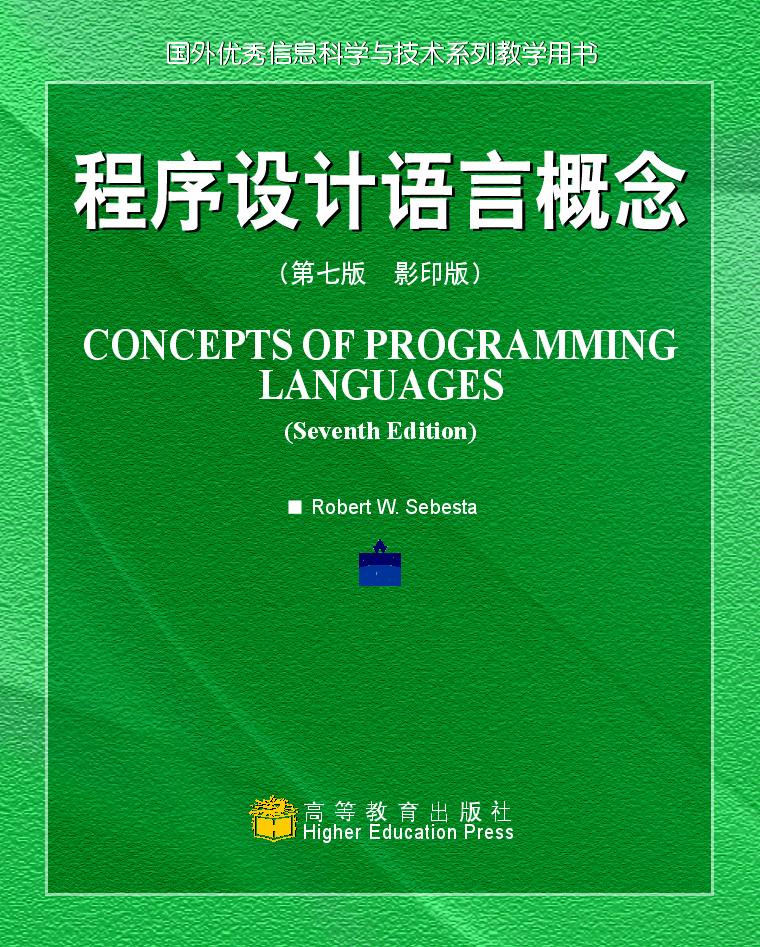
程序设计语言概念(第7版·影印版)
定价:¥49.00
作者: [美]Robert W.Sebesta
出版社:高等教育出版社
- 高等教育出版社
- 9787040194111
- 7版
- 47261071-6
- 异16开
- 940
- 工学
- 计算机类
- 计算机科学与技术
- 本科 研究生及以上
目录
目录
Chapter 1 Preliminaries
1.1 Reasons for Studying Concepts of Programming Languages
1.2 Programming Domains
1.3 Language Evaluation Criteria
1.4 Influences on Language Design
1.5 Language Categories
1.6 Language Design Trade-offs
1.7 Implementation Methods
1.8 Programming Environments
Summary·Review Questions·Problem Set
Chapter 2 Evolution of the Major Programming Languages
2.1 Zuse's Plankalk0l
2.2 Minimal Hardware Programming: Pseudocodes
2.3 The IBM 704 and Fortran
2.4 Functional Programming: LISP
2.5 The First Step Toward Sophistication: ALGOL 60
2.6 Computerizing Business Records: COBOL
2.7 The Beginnings of Timesharing: BASIC
Interview. ALAN COOPER—User Design and Language Design
2.8 Everything for Everybody: Pl/I
2.9 Two Early Dynamic Languages: APL and SNOBOL
2.10 The Beginnings of Data Abstraction: SIMULA 67
2.11 Orthogonal Design: ALGOL 68
2.12 Some Early Descendants of the ALGOLs
2.13 Programming Based on Logic: Prolog
2.14 History's Largest Design Effort: Ada
2.15 Object-Oriented Programming: Smalltalk
2.16 Combining Imperative and Object-Oriented Features: C++
2.17 An Imperative-Based Object-Oriented Language: Java
2.18 Scripting Languages: JavaScript, PHP, and Python
2.19 A C-Based Language for the New Millennium: C#
2.20 Markup/Programming Hybrid Languages
Summary·Bibliographic Notes·Review Questions·Problem Set
Chapter 3 Describing Syntax and Semantics
3.1 Introduction
3.2 The General Problem of Describing Syntax
3.3 Formal Methods of Describing Syntax
3.4 Attribute Grammars
History Note
3.5 Describing the Meanings of Programs: Dynamic Semantics
History Note
Summary·Bibliographic Notes·Review Questions·Problem Set·Programming Exercises
Chapter 4 Lexical and Syntax Analysis
4.1 Introduction
4.2 Lexical Analysis
4.3 The Parsing Problem
4.4 Recursive-Descent Parsing
4.5 Bottom-Up Parsing
Summary·Review Questions·Problem Set·Programming Exercises
Chapter 5 Names, Bindings,Type Checking, and Scopes
5.1 Introduction
5.2 Names
History Note
History Note
5.3 Variables
History Note
5.4 The Concept of Binding
Interview: RASMUS LERDORF—Scripting Languages and Other Examples of Slick Solutions
5.5 Type Checking
5.6 Strong Typing
5.7 Type Compatibility
History Note
5.8 Scope
5.9 Scope and Lifetime
5.10 Referencing Environments
5.11 Named Constants
Summary·Review Questions·Problem Set·Programming Exercises
Chapter 6 Data Types
6.1 Introduction
6.2 Primitive Data Types
6.3 Character String Types
History Note
6.4 User-Defined Ordinal Types
6.5 Array Types
History Note
History Note
6.6 Associative Arrays
Interview: RASMUS LERDORF—The Open Source Movement and Work Life
6.7 Record Types
6.8 Union Types
6.9 Pointer and Reference Types
History Note
Summary·Bibliographic Notes·Review Questions·Problem Set·Programming Exercises
Chapter 7 Expressions and Assignment Statements
7.1 Introduction
7.2 Arithmetic Expressions
History Note
7.3 Overloaded Operators
7.4 Type Conversions
History Note
7.5 Relational and Boolean Expressions
History Note
7.6 Short-Circuit Evaluation
7.7 Assignment Statements
History Note
7.8 Mixed-mode Assignment
Summary·Review Questions·Problem Set·Programming Exercises
Chapter 8 Statement-Level Control Structures
8.1 Introduction
8.2 Selection Statements
History Note
History Note
8.3 Iterative Statements
istoty Note
Interview: LARRY WALL—Part 1:Linguistics and the Birth of Perl
8.4 Unconditional Branching
Histoty Note
8.5 Guarded Commands
8.6 Conclusions
Summary·Review Questions·Problem Set·Programming Exercises
Chapter 9 Subprograms
9.1 Introduction
9.2 Fundamentals of Subprograms
9.3 Design Issues for Subprograms
9.4 Local Referencing Environments
9.5 Parameter-Passing Methods
Interview. LARRY WALL-Part 2: Scripting Languages in General and Perl in Particular
History Note
History Note
History Note
9.6 Parameters That Are Subprogram Names
History Note
9.7 Overloaded Subprograms
9.8 Generic Subprograms
9.9 Design Issues for Functions
9.10 User-Defined Overloaded Operators
9.11 Coroutines
History Note
Summary·Review Questions·Problem Set·Programming Exercises
Chapter 10 Implementing Subprograms
10.1 The General Semantics of Calls and Returns
10.2 Implementing “Simple”Subprograms
10.3 Implementing Subprograms with Stack-Dynamic Local Variables
10.4 Nested Subprograms
Interview. NIKLAUS WIRTH—Keeping It Simple
10.5 Blocks
10.6 Implementing Dynamic Scoping
Summary·Review Questions·Problem Set
Chapter 11 Abstract Data Types and Encapsulation Constructs
11.1 The Concept of Abstraction
11.2 Introduction to Data Abstraction
11.3 Design Issues for Abstract Data Types
11.4 Language Examples
Interview. BJARNE STROUSTRUP-C++: Its Birth, Its Ubiquitousness, and Common Criticisms
11.5 Parameterized Abstract Data Types
11.6 Encapsulation Constructs
11.7 Naming Encapsulations
Summary·Review Questions·Problem Set·Programming Exercises
Chapter 12 Support for Object-Oriented Programming
12.1 Introduction
12.2 Object-Oriented Programming
12.3 Design Issues for Object-Oriented Languages
12.4 Support for Object-Oriented Programming in Smalltalk
12.5 Support for Object-Oriented Programming in C++
Interview. BJARNE STROUSTRUP—On Paradigms and Better Programming
12.6 Support for Object-Oriented Programming in Java
12.7 Support for Object-Oriented Programming in C#
12.8 Support for Object-Oriented Programming in Ada 95
12.9 The Object Model.of JavaScript
12.10 Implementation of Object-Oriented Constructs
Summary·Review Questions·Problem Set·Programming Exercises
Chapter 13 Concurrency
13.1 Introduction
13.2 Introduction to Subprogram-Level Concurrency
13.3 Semaphores
HIstory NOte
13.4 Monitors
13.5 Message Passing
13.6 Ada Support for Concurrency
13.7 Java Threads
13.8 C# Threads
13.9 Statement-Level Concurrency
Summary·Bibliographic Notes·Review Questions·Problem Set·Programming Exercises
Chapter 14 Exception Handling and Event Handling
14.1 Introduction to Exception Handling
History Note
14.2 Exception Handling in Ada
14.3 Exception Handling in C++
14.4 Exception Handling in Java
Interview. JAMES GOSLING—The Birth of Java
14.5 Introduction to Event Handling
14.6 Event Handling with Java
Summary·Bibliographic Notes·Review Questions·Problem Set
Chapter 15 Functional Programming Languages
15.1 Introduction
15.2 Mathematical Functions
15.3 Fundamentals of Functional Programming Languages
15.4 The First Functional Programming Language: LISP
15.5 An Introduction to Scheme
15.6 COMMON LISP
15.7 M L
15.8 Haskell
15.9 Applications of Functional Languages
15.10 A Comparison of Functional and Imperative Languages
Summary·Bibliographic Notes·Review Questions·Problem Set·Programming Exercises
Chapter 16 Logic Programming Languages
16.1 Introduction
16.2 A Brief Introduction to Predicate Calculus
16.3 Predicate Calculus and Proving Theorems
16.4 An Overview of Logic Programming
16.5 The Origins of Prolog
16.6 The Basic Elements of Prolog
16.7 The Deficiencies of Prolog
16.8 Applications of Logic Programming
Summary·Bibliographic Notes·Review Questions.Problem Set·Programming Exercises
Bibliography
Index
Chapter 1 Preliminaries
1.1 Reasons for Studying Concepts of Programming Languages
1.2 Programming Domains
1.3 Language Evaluation Criteria
1.4 Influences on Language Design
1.5 Language Categories
1.6 Language Design Trade-offs
1.7 Implementation Methods
1.8 Programming Environments
Summary·Review Questions·Problem Set
Chapter 2 Evolution of the Major Programming Languages
2.1 Zuse's Plankalk0l
2.2 Minimal Hardware Programming: Pseudocodes
2.3 The IBM 704 and Fortran
2.4 Functional Programming: LISP
2.5 The First Step Toward Sophistication: ALGOL 60
2.6 Computerizing Business Records: COBOL
2.7 The Beginnings of Timesharing: BASIC
Interview. ALAN COOPER—User Design and Language Design
2.8 Everything for Everybody: Pl/I
2.9 Two Early Dynamic Languages: APL and SNOBOL
2.10 The Beginnings of Data Abstraction: SIMULA 67
2.11 Orthogonal Design: ALGOL 68
2.12 Some Early Descendants of the ALGOLs
2.13 Programming Based on Logic: Prolog
2.14 History's Largest Design Effort: Ada
2.15 Object-Oriented Programming: Smalltalk
2.16 Combining Imperative and Object-Oriented Features: C++
2.17 An Imperative-Based Object-Oriented Language: Java
2.18 Scripting Languages: JavaScript, PHP, and Python
2.19 A C-Based Language for the New Millennium: C#
2.20 Markup/Programming Hybrid Languages
Summary·Bibliographic Notes·Review Questions·Problem Set
Chapter 3 Describing Syntax and Semantics
3.1 Introduction
3.2 The General Problem of Describing Syntax
3.3 Formal Methods of Describing Syntax
3.4 Attribute Grammars
History Note
3.5 Describing the Meanings of Programs: Dynamic Semantics
History Note
Summary·Bibliographic Notes·Review Questions·Problem Set·Programming Exercises
Chapter 4 Lexical and Syntax Analysis
4.1 Introduction
4.2 Lexical Analysis
4.3 The Parsing Problem
4.4 Recursive-Descent Parsing
4.5 Bottom-Up Parsing
Summary·Review Questions·Problem Set·Programming Exercises
Chapter 5 Names, Bindings,Type Checking, and Scopes
5.1 Introduction
5.2 Names
History Note
History Note
5.3 Variables
History Note
5.4 The Concept of Binding
Interview: RASMUS LERDORF—Scripting Languages and Other Examples of Slick Solutions
5.5 Type Checking
5.6 Strong Typing
5.7 Type Compatibility
History Note
5.8 Scope
5.9 Scope and Lifetime
5.10 Referencing Environments
5.11 Named Constants
Summary·Review Questions·Problem Set·Programming Exercises
Chapter 6 Data Types
6.1 Introduction
6.2 Primitive Data Types
6.3 Character String Types
History Note
6.4 User-Defined Ordinal Types
6.5 Array Types
History Note
History Note
6.6 Associative Arrays
Interview: RASMUS LERDORF—The Open Source Movement and Work Life
6.7 Record Types
6.8 Union Types
6.9 Pointer and Reference Types
History Note
Summary·Bibliographic Notes·Review Questions·Problem Set·Programming Exercises
Chapter 7 Expressions and Assignment Statements
7.1 Introduction
7.2 Arithmetic Expressions
History Note
7.3 Overloaded Operators
7.4 Type Conversions
History Note
7.5 Relational and Boolean Expressions
History Note
7.6 Short-Circuit Evaluation
7.7 Assignment Statements
History Note
7.8 Mixed-mode Assignment
Summary·Review Questions·Problem Set·Programming Exercises
Chapter 8 Statement-Level Control Structures
8.1 Introduction
8.2 Selection Statements
History Note
History Note
8.3 Iterative Statements
istoty Note
Interview: LARRY WALL—Part 1:Linguistics and the Birth of Perl
8.4 Unconditional Branching
Histoty Note
8.5 Guarded Commands
8.6 Conclusions
Summary·Review Questions·Problem Set·Programming Exercises
Chapter 9 Subprograms
9.1 Introduction
9.2 Fundamentals of Subprograms
9.3 Design Issues for Subprograms
9.4 Local Referencing Environments
9.5 Parameter-Passing Methods
Interview. LARRY WALL-Part 2: Scripting Languages in General and Perl in Particular
History Note
History Note
History Note
9.6 Parameters That Are Subprogram Names
History Note
9.7 Overloaded Subprograms
9.8 Generic Subprograms
9.9 Design Issues for Functions
9.10 User-Defined Overloaded Operators
9.11 Coroutines
History Note
Summary·Review Questions·Problem Set·Programming Exercises
Chapter 10 Implementing Subprograms
10.1 The General Semantics of Calls and Returns
10.2 Implementing “Simple”Subprograms
10.3 Implementing Subprograms with Stack-Dynamic Local Variables
10.4 Nested Subprograms
Interview. NIKLAUS WIRTH—Keeping It Simple
10.5 Blocks
10.6 Implementing Dynamic Scoping
Summary·Review Questions·Problem Set
Chapter 11 Abstract Data Types and Encapsulation Constructs
11.1 The Concept of Abstraction
11.2 Introduction to Data Abstraction
11.3 Design Issues for Abstract Data Types
11.4 Language Examples
Interview. BJARNE STROUSTRUP-C++: Its Birth, Its Ubiquitousness, and Common Criticisms
11.5 Parameterized Abstract Data Types
11.6 Encapsulation Constructs
11.7 Naming Encapsulations
Summary·Review Questions·Problem Set·Programming Exercises
Chapter 12 Support for Object-Oriented Programming
12.1 Introduction
12.2 Object-Oriented Programming
12.3 Design Issues for Object-Oriented Languages
12.4 Support for Object-Oriented Programming in Smalltalk
12.5 Support for Object-Oriented Programming in C++
Interview. BJARNE STROUSTRUP—On Paradigms and Better Programming
12.6 Support for Object-Oriented Programming in Java
12.7 Support for Object-Oriented Programming in C#
12.8 Support for Object-Oriented Programming in Ada 95
12.9 The Object Model.of JavaScript
12.10 Implementation of Object-Oriented Constructs
Summary·Review Questions·Problem Set·Programming Exercises
Chapter 13 Concurrency
13.1 Introduction
13.2 Introduction to Subprogram-Level Concurrency
13.3 Semaphores
HIstory NOte
13.4 Monitors
13.5 Message Passing
13.6 Ada Support for Concurrency
13.7 Java Threads
13.8 C# Threads
13.9 Statement-Level Concurrency
Summary·Bibliographic Notes·Review Questions·Problem Set·Programming Exercises
Chapter 14 Exception Handling and Event Handling
14.1 Introduction to Exception Handling
History Note
14.2 Exception Handling in Ada
14.3 Exception Handling in C++
14.4 Exception Handling in Java
Interview. JAMES GOSLING—The Birth of Java
14.5 Introduction to Event Handling
14.6 Event Handling with Java
Summary·Bibliographic Notes·Review Questions·Problem Set
Chapter 15 Functional Programming Languages
15.1 Introduction
15.2 Mathematical Functions
15.3 Fundamentals of Functional Programming Languages
15.4 The First Functional Programming Language: LISP
15.5 An Introduction to Scheme
15.6 COMMON LISP
15.7 M L
15.8 Haskell
15.9 Applications of Functional Languages
15.10 A Comparison of Functional and Imperative Languages
Summary·Bibliographic Notes·Review Questions·Problem Set·Programming Exercises
Chapter 16 Logic Programming Languages
16.1 Introduction
16.2 A Brief Introduction to Predicate Calculus
16.3 Predicate Calculus and Proving Theorems
16.4 An Overview of Logic Programming
16.5 The Origins of Prolog
16.6 The Basic Elements of Prolog
16.7 The Deficiencies of Prolog
16.8 Applications of Logic Programming
Summary·Bibliographic Notes·Review Questions.Problem Set·Programming Exercises
Bibliography
Index
Chapter 1 Preliminaries
1.1 Reasons for Studying Concepts of Programming Languages
1.2 Programming Domains
1.3 Language Evaluation Criteria
1.4 Influences on Language Design
1.5 Language Categories
1.6 Language Design Trade-offs
1.7 Implementation Methods
1.8 Programming Environments
Summary·Review Questions·Problem Set
Chapter 2 Evolution of the Major Programming Languages
2.1 Zuse's Plankalk0l
2.2 Minimal Hardware Programming: Pseudocodes
2.3 The IBM 704 and Fortran
2.4 Functional Programming: LISP
2.5 The First Step Toward Sophistication: ALGOL 60
2.6 Computerizing Business Records: COBOL
2.7 The Beginnings of Timesharing: BASIC
Interview. ALAN COOPER—User Design and Language Design
2.8 Everything for Everybody: Pl/I
2.9 Two Early Dynamic Languages: APL and SNOBOL
2.10 The Beginnings of Data Abstraction: SIMULA 67
2.11 Orthogonal Design: ALGOL 68
2.12 Some Early Descendants of the ALGOLs
2.13 Programming Based on Logic: Prolog
2.14 History's Largest Design Effort: Ada
2.15 Object-Oriented Programming: Smalltalk
2.16 Combining Imperative and Object-Oriented Features: C++
2.17 An Imperative-Based Object-Oriented Language: Java
2.18 Scripting Languages: JavaScript, PHP, and Python
2.19 A C-Based Language for the New Millennium: C#
2.20 Markup/Programming Hybrid Languages
Summary·Bibliographic Notes·Review Questions·Problem Set
Chapter 3 Describing Syntax and Semantics
3.1 Introduction
3.2 The General Problem of Describing Syntax
3.3 Formal Methods of Describing Syntax
3.4 Attribute Grammars
History Note
3.5 Describing the Meanings of Programs: Dynamic Semantics
History Note
Summary·Bibliographic Notes·Review Questions·Problem Set·Programming Exercises
Chapter 4 Lexical and Syntax Analysis
4.1 Introduction
4.2 Lexical Analysis
4.3 The Parsing Problem
4.4 Recursive-Descent Parsing
4.5 Bottom-Up Parsing
Summary·Review Questions·Problem Set·Programming Exercises
Chapter 5 Names, Bindings,Type Checking, and Scopes
5.1 Introduction
5.2 Names
History Note
History Note
5.3 Variables
History Note
5.4 The Concept of Binding
Interview: RASMUS LERDORF—Scripting Languages and Other Examples of Slick Solutions
5.5 Type Checking
5.6 Strong Typing
5.7 Type Compatibility
History Note
5.8 Scope
5.9 Scope and Lifetime
5.10 Referencing Environments
5.11 Named Constants
Summary·Review Questions·Problem Set·Programming Exercises
Chapter 6 Data Types
6.1 Introduction
6.2 Primitive Data Types
6.3 Character String Types
History Note
6.4 User-Defined Ordinal Types
6.5 Array Types
History Note
History Note
6.6 Associative Arrays
Interview: RASMUS LERDORF—The Open Source Movement and Work Life
6.7 Record Types
6.8 Union Types
6.9 Pointer and Reference Types
History Note
Summary·Bibliographic Notes·Review Questions·Problem Set·Programming Exercises
Chapter 7 Expressions and Assignment Statements
7.1 Introduction
7.2 Arithmetic Expressions
History Note
7.3 Overloaded Operators
7.4 Type Conversions
History Note
7.5 Relational and Boolean Expressions
History Note
7.6 Short-Circuit Evaluation
7.7 Assignment Statements
History Note
7.8 Mixed-mode Assignment
Summary·Review Questions·Problem Set·Programming Exercises
Chapter 8 Statement-Level Control Structures
8.1 Introduction
8.2 Selection Statements
History Note
History Note
8.3 Iterative Statements
istoty Note
Interview: LARRY WALL—Part 1:Linguistics and the Birth of Perl
8.4 Unconditional Branching
Histoty Note
8.5 Guarded Commands
8.6 Conclusions
Summary·Review Questions·Problem Set·Programming Exercises
Chapter 9 Subprograms
9.1 Introduction
9.2 Fundamentals of Subprograms
9.3 Design Issues for Subprograms
9.4 Local Referencing Environments
9.5 Parameter-Passing Methods
Interview. LARRY WALL-Part 2: Scripting Languages in General and Perl in Particular
History Note
History Note
History Note
9.6 Parameters That Are Subprogram Names
History Note
9.7 Overloaded Subprograms
9.8 Generic Subprograms
9.9 Design Issues for Functions
9.10 User-Defined Overloaded Operators
9.11 Coroutines
History Note
Summary·Review Questions·Problem Set·Programming Exercises
Chapter 10 Implementing Subprograms
10.1 The General Semantics of Calls and Returns
10.2 Implementing “Simple”Subprograms
10.3 Implementing Subprograms with Stack-Dynamic Local Variables
10.4 Nested Subprograms
Interview. NIKLAUS WIRTH—Keeping It Simple
10.5 Blocks
10.6 Implementing Dynamic Scoping
Summary·Review Questions·Problem Set
Chapter 11 Abstract Data Types and Encapsulation Constructs
11.1 The Concept of Abstraction
11.2 Introduction to Data Abstraction
11.3 Design Issues for Abstract Data Types
11.4 Language Examples
Interview. BJARNE STROUSTRUP-C++: Its Birth, Its Ubiquitousness, and Common Criticisms
11.5 Parameterized Abstract Data Types
11.6 Encapsulation Constructs
11.7 Naming Encapsulations
Summary·Review Questions·Problem Set·Programming Exercises
Chapter 12 Support for Object-Oriented Programming
12.1 Introduction
12.2 Object-Oriented Programming
12.3 Design Issues for Object-Oriented Languages
12.4 Support for Object-Oriented Programming in Smalltalk
12.5 Support for Object-Oriented Programming in C++
Interview. BJARNE STROUSTRUP—On Paradigms and Better Programming
12.6 Support for Object-Oriented Programming in Java
12.7 Support for Object-Oriented Programming in C#
12.8 Support for Object-Oriented Programming in Ada 95
12.9 The Object Model.of JavaScript
12.10 Implementation of Object-Oriented Constructs
Summary·Review Questions·Problem Set·Programming Exercises
Chapter 13 Concurrency
13.1 Introduction
13.2 Introduction to Subprogram-Level Concurrency
13.3 Semaphores
HIstory NOte
13.4 Monitors
13.5 Message Passing
13.6 Ada Support for Concurrency
13.7 Java Threads
13.8 C# Threads
13.9 Statement-Level Concurrency
Summary·Bibliographic Notes·Review Questions·Problem Set·Programming Exercises
Chapter 14 Exception Handling and Event Handling
14.1 Introduction to Exception Handling
History Note
14.2 Exception Handling in Ada
14.3 Exception Handling in C++
14.4 Exception Handling in Java
Interview. JAMES GOSLING—The Birth of Java
14.5 Introduction to Event Handling
14.6 Event Handling with Java
Summary·Bibliographic Notes·Review Questions·Problem Set
Chapter 15 Functional Programming Languages
15.1 Introduction
15.2 Mathematical Functions
15.3 Fundamentals of Functional Programming Languages
15.4 The First Functional Programming Language: LISP
15.5 An Introduction to Scheme
15.6 COMMON LISP
15.7 M L
15.8 Haskell
15.9 Applications of Functional Languages
15.10 A Comparison of Functional and Imperative Languages
Summary·Bibliographic Notes·Review Questions·Problem Set·Programming Exercises
Chapter 16 Logic Programming Languages
16.1 Introduction
16.2 A Brief Introduction to Predicate Calculus
16.3 Predicate Calculus and Proving Theorems
16.4 An Overview of Logic Programming
16.5 The Origins of Prolog
16.6 The Basic Elements of Prolog
16.7 The Deficiencies of Prolog
16.8 Applications of Logic Programming
Summary·Bibliographic Notes·Review Questions.Problem Set·Programming Exercises
Bibliography
Index
Chapter 1 Preliminaries
1.1 Reasons for Studying Concepts of Programming Languages
1.2 Programming Domains
1.3 Language Evaluation Criteria
1.4 Influences on Language Design
1.5 Language Categories
1.6 Language Design Trade-offs
1.7 Implementation Methods
1.8 Programming Environments
Summary·Review Questions·Problem Set
Chapter 2 Evolution of the Major Programming Languages
2.1 Zuse's Plankalk0l
2.2 Minimal Hardware Programming: Pseudocodes
2.3 The IBM 704 and Fortran
2.4 Functional Programming: LISP
2.5 The First Step Toward Sophistication: ALGOL 60
2.6 Computerizing Business Records: COBOL
2.7 The Beginnings of Timesharing: BASIC
Interview. ALAN COOPER—User Design and Language Design
2.8 Everything for Everybody: Pl/I
2.9 Two Early Dynamic Languages: APL and SNOBOL
2.10 The Beginnings of Data Abstraction: SIMULA 67
2.11 Orthogonal Design: ALGOL 68
2.12 Some Early Descendants of the ALGOLs
2.13 Programming Based on Logic: Prolog
2.14 History's Largest Design Effort: Ada
2.15 Object-Oriented Programming: Smalltalk
2.16 Combining Imperative and Object-Oriented Features: C++
2.17 An Imperative-Based Object-Oriented Language: Java
2.18 Scripting Languages: JavaScript, PHP, and Python
2.19 A C-Based Language for the New Millennium: C#
2.20 Markup/Programming Hybrid Languages
Summary·Bibliographic Notes·Review Questions·Problem Set
Chapter 3 Describing Syntax and Semantics
3.1 Introduction
3.2 The General Problem of Describing Syntax
3.3 Formal Methods of Describing Syntax
3.4 Attribute Grammars
History Note
3.5 Describing the Meanings of Programs: Dynamic Semantics
History Note
Summary·Bibliographic Notes·Review Questions·Problem Set·Programming Exercises
Chapter 4 Lexical and Syntax Analysis
4.1 Introduction
4.2 Lexical Analysis
4.3 The Parsing Problem
4.4 Recursive-Descent Parsing
4.5 Bottom-Up Parsing
Summary·Review Questions·Problem Set·Programming Exercises
Chapter 5 Names, Bindings,Type Checking, and Scopes
5.1 Introduction
5.2 Names
History Note
History Note
5.3 Variables
History Note
5.4 The Concept of Binding
Interview: RASMUS LERDORF—Scripting Languages and Other Examples of Slick Solutions
5.5 Type Checking
5.6 Strong Typing
5.7 Type Compatibility
History Note
5.8 Scope
5.9 Scope and Lifetime
5.10 Referencing Environments
5.11 Named Constants
Summary·Review Questions·Problem Set·Programming Exercises
Chapter 6 Data Types
6.1 Introduction
6.2 Primitive Data Types
6.3 Character String Types
History Note
6.4 User-Defined Ordinal Types
6.5 Array Types
History Note
History Note
6.6 Associative Arrays
Interview: RASMUS LERDORF—The Open Source Movement and Work Life
6.7 Record Types
6.8 Union Types
6.9 Pointer and Reference Types
History Note
Summary·Bibliographic Notes·Review Questions·Problem Set·Programming Exercises
Chapter 7 Expressions and Assignment Statements
7.1 Introduction
7.2 Arithmetic Expressions
History Note
7.3 Overloaded Operators
7.4 Type Conversions
History Note
7.5 Relational and Boolean Expressions
History Note
7.6 Short-Circuit Evaluation
7.7 Assignment Statements
History Note
7.8 Mixed-mode Assignment
Summary·Review Questions·Problem Set·Programming Exercises
Chapter 8 Statement-Level Control Structures
8.1 Introduction
8.2 Selection Statements
History Note
History Note
8.3 Iterative Statements
istoty Note
Interview: LARRY WALL—Part 1:Linguistics and the Birth of Perl
8.4 Unconditional Branching
Histoty Note
8.5 Guarded Commands
8.6 Conclusions
Summary·Review Questions·Problem Set·Programming Exercises
Chapter 9 Subprograms
9.1 Introduction
9.2 Fundamentals of Subprograms
9.3 Design Issues for Subprograms
9.4 Local Referencing Environments
9.5 Parameter-Passing Methods
Interview. LARRY WALL-Part 2: Scripting Languages in General and Perl in Particular
History Note
History Note
History Note
9.6 Parameters That Are Subprogram Names
History Note
9.7 Overloaded Subprograms
9.8 Generic Subprograms
9.9 Design Issues for Functions
9.10 User-Defined Overloaded Operators
9.11 Coroutines
History Note
Summary·Review Questions·Problem Set·Programming Exercises
Chapter 10 Implementing Subprograms
10.1 The General Semantics of Calls and Returns
10.2 Implementing “Simple”Subprograms
10.3 Implementing Subprograms with Stack-Dynamic Local Variables
10.4 Nested Subprograms
Interview. NIKLAUS WIRTH—Keeping It Simple
10.5 Blocks
10.6 Implementing Dynamic Scoping
Summary·Review Questions·Problem Set
Chapter 11 Abstract Data Types and Encapsulation Constructs
11.1 The Concept of Abstraction
11.2 Introduction to Data Abstraction
11.3 Design Issues for Abstract Data Types
11.4 Language Examples
Interview. BJARNE STROUSTRUP-C++: Its Birth, Its Ubiquitousness, and Common Criticisms
11.5 Parameterized Abstract Data Types
11.6 Encapsulation Constructs
11.7 Naming Encapsulations
Summary·Review Questions·Problem Set·Programming Exercises
Chapter 12 Support for Object-Oriented Programming
12.1 Introduction
12.2 Object-Oriented Programming
12.3 Design Issues for Object-Oriented Languages
12.4 Support for Object-Oriented Programming in Smalltalk
12.5 Support for Object-Oriented Programming in C++
Interview. BJARNE STROUSTRUP—On Paradigms and Better Programming
12.6 Support for Object-Oriented Programming in Java
12.7 Support for Object-Oriented Programming in C#
12.8 Support for Object-Oriented Programming in Ada 95
12.9 The Object Model.of JavaScript
12.10 Implementation of Object-Oriented Constructs
Summary·Review Questions·Problem Set·Programming Exercises
Chapter 13 Concurrency
13.1 Introduction
13.2 Introduction to Subprogram-Level Concurrency
13.3 Semaphores
HIstory NOte
13.4 Monitors
13.5 Message Passing
13.6 Ada Support for Concurrency
13.7 Java Threads
13.8 C# Threads
13.9 Statement-Level Concurrency
Summary·Bibliographic Notes·Review Questions·Problem Set·Programming Exercises
Chapter 14 Exception Handling and Event Handling
14.1 Introduction to Exception Handling
History Note
14.2 Exception Handling in Ada
14.3 Exception Handling in C++
14.4 Exception Handling in Java
Interview. JAMES GOSLING—The Birth of Java
14.5 Introduction to Event Handling
14.6 Event Handling with Java
Summary·Bibliographic Notes·Review Questions·Problem Set
Chapter 15 Functional Programming Languages
15.1 Introduction
15.2 Mathematical Functions
15.3 Fundamentals of Functional Programming Languages
15.4 The First Functional Programming Language: LISP
15.5 An Introduction to Scheme
15.6 COMMON LISP
15.7 M L
15.8 Haskell
15.9 Applications of Functional Languages
15.10 A Comparison of Functional and Imperative Languages
Summary·Bibliographic Notes·Review Questions·Problem Set·Programming Exercises
Chapter 16 Logic Programming Languages
16.1 Introduction
16.2 A Brief Introduction to Predicate Calculus
16.3 Predicate Calculus and Proving Theorems
16.4 An Overview of Logic Programming
16.5 The Origins of Prolog
16.6 The Basic Elements of Prolog
16.7 The Deficiencies of Prolog
16.8 Applications of Logic Programming
Summary·Bibliographic Notes·Review Questions.Problem Set·Programming Exercises
Bibliography
Index
