

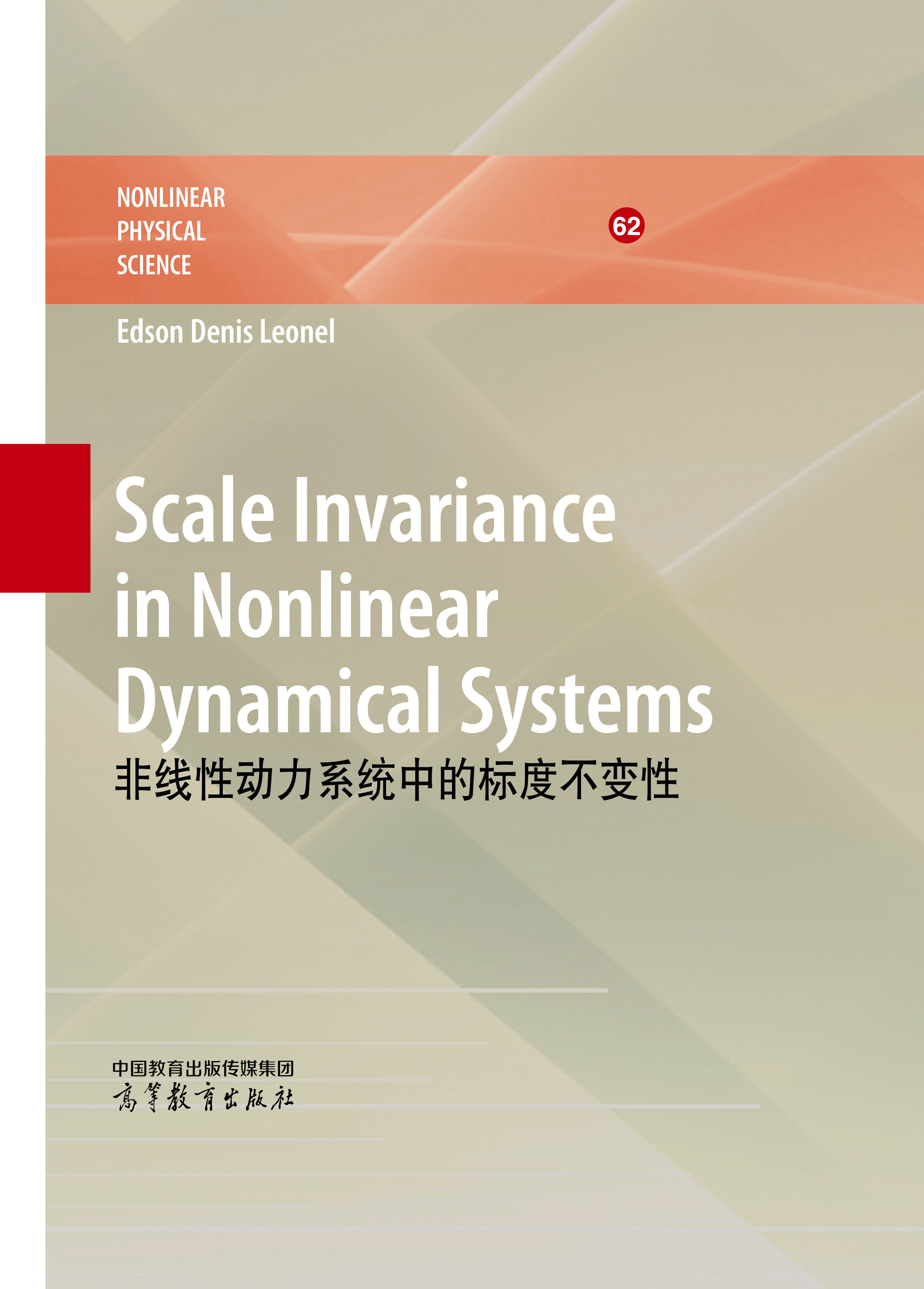






Scale Invariance in Nonlinear Dynamical Systems(非线性动力系统中的标度不变性)(英文版)
定价:¥199.00
作者: Edson Denis Leonel
出版社:高等教育出版社
以下为《Scale Invariance in Nonlinear Dynamical Systems(非线性动力系统中的标度不变性)(英文版)》的配套数字资源,这些资源在您购买图书后将免费附送给您:
- 高等教育出版社
- 9787040676136
- 1版
- 特殊
- 487
目录
目录
前辅文
1 Initial Discussion
1.1 Objectives
1.2 Initial Concepts
1.3 Summary
2 The Concept of Attractor
2.1 Objectives
2.2 Initial Concepts
2.3 The Damped Oscillator
2.3.1 Overdamping
2.3.2 Critical Damping
2.3.3 Underdamped Case
2.4 Van der Pol Oscillator
2.5 Chaotic Attractor
2.5.1 The Lorenz System
2.5.2 Duffing Equation
2.6 Strange Nonchaotic Attractor
2.7 Concept of Attractor
2.8 Summary
2.9 Proposed Exercises
3 Stability of Fixed Points
3.1 Objectives
3.2 First-Order Linear Differential Equation
3.3 Linear Systems
3.4 Nonlinear Systems
3.4.1 Example 1
3.4.2 Example 2
3.4.3 Example 3
3.5 Summary
3.6 Proposed Exercises
4 Some Local Bifurcations
4.1 Objectives
4.2 Local Bifurcations
4.3 Saddle-Node Bifurcation
4.3.1 Example of Saddle-Node Bifurcation
4.4 Transcritical Bifurcation
4.4.1 Example of Transcritical Bifurcation
4.5 Supercritical Pitchfork Bifurcation
4.5.1 Example of Supercritical Pitchfork Bifurcation
4.6 Subcritical Pitchfork Bifurcation
4.7 Normal Forms
4.8 Summary
4.9 Proposed Exercises
5 Scaling Analysis in Local Bifurcations
5.1 Objectives
5.2 Convergence to Fixed Points
5.3 Convergence to the Fixed Point: A Phenomenological Description
5.3.1 Scaling Hypotheses
5.4 Scaling Analysis in the Saddle-Node Bifurcation
5.5 Scaling Analysis in the Transcritical Bifurcation
5.6 Scaling Analysis in the Supercritical Pitchfork Bifurcation
5.7 Summary
5.8 Proposed Exercises
6 One-Dimensional Discrete Maps
6.1 Objectives
6.2 Introduction
6.3 The Concept of Stability
6.3.1 Asymptotically Stable Fixed Point
6.3.2 Neutral Stability
6.3.3 Unstable Fixed Point
6.4 Applications of Fixed-Point Calculation in the Logistic Map
6.5 Bifurcations
6.5.1 Transcritical Bifurcation
6.5.2 Period-Doubling Bifurcation
6.5.3 Tangent Bifurcation
6.6 Summary
6.7 Proposed Exercises
7 Some Dynamical and Statistical Properties of the Logistic Map
7.1 Objectives
7.2 Convergence to the Steady State
7.2.1 Transcritical Bifurcation
7.2.2 Period-Doubling Bifurcation
7.2.3 Route to Chaos via Period Doubling
7.2.4 Tangent Bifurcation
7.3 Lyapunov Exponents
7.4 Summary
7.5 Proposed Exercises
8 The Logistic-Like Map
8.1 Objectives
8.2 The Mapping Equation
8.3 Transcritical Bifurcation
8.3.1 Analytical Determination of the Exponents α, β, z, and δ
8.3.2 Critical Exponents in the Period-Doubling Bifurcation
8.4 Extension of Results to Other Maps
8.4.1 Hassell Map
8.4.2 Maynard Map
8.5 Summary
8.6 Proposed Exercises
9 Introduction to Two-Dimensional Discrete Maps
9.1 Objectives
9.2 Linear Maps
9.3 Nonlinear Maps
9.4 Applications of Two-Dimensional Maps
9.4.1 Hénon Map
9.4.2 Lyapunov Exponents
9.4.3 Ikeda Map
9.5 Summary
9.6 Proposed Exercises
10 The Fermi Accelerator Model: Non-dissipative Version
10.1 Objectives
10.2 The Fermi-Ulam Model
10.2.1 Jacobian Matrix for Indirect Collisions
10.2.2 Jacobian Matrix for Multiple Collisions
10.2.3 Fixed Points
10.2.4 Phase Space
10.2.5 Measure Preservation in Phase Space
10.3 Simplified Version of the Fermi-Ulam Model
10.4 Scaling Properties of the Chaotic Sea
10.5 Location of the First Invariant Spanning Curve
10.6 The Growth Regime
10.7 Summary
10.8 Proposed Exercises
11 Dissipation in the Fermi Accelerator Model
11.1 Objectives
11.2 Dissipation via Inelastic Collisions
11.2.1 Jacobian Matrix for Multiple Collisions
11.2.2 Jacobian Matrix for Indirect Collisions
11.2.3 Phase Space
11.2.4 Fixed Points
11.2.5 Construction of the Manifolds
11.2.6 Determination of the Manifold Crossing and the Transient
11.2.7 Determining the Exponent δ from the Eigenvalues of the Saddle Point
11.3 Dissipation via Viscous Drag
11.3.1 Drag Force F =−˜ηv
11.3.2 Drag Force F =−˜ηv2
11.3.3 Drag Force F =−˜ηvγ
11.4 Summary
11.5 Proposed Exercises
12 Dynamical Properties of the Bouncer Model
12.1 Objectives
12.2 The Model
12.3 Full Version of the Bouncer Model
12.3.1 Successive Collisions
12.3.2 Indirect Collisions
12.3.3 Jacobian Matrix
12.3.4 Phase Space
12.4 Simplified Version of the Bouncer Model
12.5 Numerical Investigation in the Simplified Version
12.6 Continuous-Time Approximation
12.7 Summary
12.8 Proposed Exercises
13 Localization of Invariant Curves
13.1 Objectives
13.2 The Standard Map
13.3 Localization of the Curves
13.4 Rescaling in Phase Space
13.5 Summary
13.6 Proposed Exercises
14 Chaotic Diffusion in Non-dissipative Maps
14.1 Objectives
14.2 A Family of Discrete Maps
14.3 Properties of the Chaotic Sea: A Phenomenological Description
14.4 A Semi-phenomenological Approach
14.5 Obtaining the Probability via the Diffusion Equation
14.6 Summary
14.7 Proposed Exercises
15 Introduction to Billiard Dynamics
15.1 Objectives
15.2 The Billiard
15.2.1 Circular Billiard
15.2.2 Elliptical Billiard
15.2.3 Ovoid Billiard
15.3 Summary
15.4 Proposed Exercises
16 Time-Dependent Billiards
16.1 Objectives
16.2 The Billiard
16.2.1 LRA Conjecture
16.3 Time-Dependent Elliptical Billiard
16.4 Oval Billiard
16.5 Summary
16.6 Proposed Exercises
17 Suppression of Fermi Acceleration in the Oval Billiard
17.1 Objectives
17.2 The Model and the Mapping
17.3 Results for the Case Fα−V
17.4 Results for the Case Fα−V2
17.5 Results for the Case Fα−Vδ
17.6 Summary
17.7 Proposed Exercises
18 A Thermodynamic Model for Time-Dependent Billiards
18.1 Objectives
18.2 Motivation
18.3 Heat Transfer
18.4 Billiard Formalism
18.4.1 Steady State
18.4.2 Dynamical Regime
18.4.3 Numerical Simulations
18.4.4 Velocity Average Over n
18.4.5 Critical Exponents
18.4.6 Velocity Distribution
18.5 Connection Between the Two Formalisms
18.6 Summary
18.7 Proposed Exercises
Appendix A: Euler Relations
Appendix B: Numerical Integration Methods
Appendix C: Expressions for the Coefficients j in the Dynamical Approach
Appendix D: Change of Reference Frame
Appendix E: Solution of the Diffusion Equation
Appendix F: Heat Flux Equation
Appendix G: Connection Between t and n in the Time-Dependent Ovoid Billiard
Appendix H: Solution of the Integral for the Relation Between n and t in the Time-Dependent Ovoid Billiard
References
Index
前辅文
1 Initial Discussion
1.1 Objectives
1.2 Initial Concepts
1.3 Summary
2 The Concept of Attractor
2.1 Objectives
2.2 Initial Concepts
2.3 The Damped Oscillator
2.3.1 Overdamping
2.3.2 Critical Damping
2.3.3 Underdamped Case
2.4 Van der Pol Oscillator
2.5 Chaotic Attractor
2.5.1 The Lorenz System
2.5.2 Duffing Equation
2.6 Strange Nonchaotic Attractor
2.7 Concept of Attractor
2.8 Summary
2.9 Proposed Exercises
3 Stability of Fixed Points
3.1 Objectives
3.2 First-Order Linear Differential Equation
3.3 Linear Systems
3.4 Nonlinear Systems
3.4.1 Example 1
3.4.2 Example 2
3.4.3 Example 3
3.5 Summary
3.6 Proposed Exercises
4 Some Local Bifurcations
4.1 Objectives
4.2 Local Bifurcations
4.3 Saddle-Node Bifurcation
4.3.1 Example of Saddle-Node Bifurcation
4.4 Transcritical Bifurcation
4.4.1 Example of Transcritical Bifurcation
4.5 Supercritical Pitchfork Bifurcation
4.5.1 Example of Supercritical Pitchfork Bifurcation
4.6 Subcritical Pitchfork Bifurcation
4.7 Normal Forms
4.8 Summary
4.9 Proposed Exercises
5 Scaling Analysis in Local Bifurcations
5.1 Objectives
5.2 Convergence to Fixed Points
5.3 Convergence to the Fixed Point: A Phenomenological Description
5.3.1 Scaling Hypotheses
5.4 Scaling Analysis in the Saddle-Node Bifurcation
5.5 Scaling Analysis in the Transcritical Bifurcation
5.6 Scaling Analysis in the Supercritical Pitchfork Bifurcation
5.7 Summary
5.8 Proposed Exercises
6 One-Dimensional Discrete Maps
6.1 Objectives
6.2 Introduction
6.3 The Concept of Stability
6.3.1 Asymptotically Stable Fixed Point
6.3.2 Neutral Stability
6.3.3 Unstable Fixed Point
6.4 Applications of Fixed-Point Calculation in the Logistic Map
6.5 Bifurcations
6.5.1 Transcritical Bifurcation
6.5.2 Period-Doubling Bifurcation
6.5.3 Tangent Bifurcation
6.6 Summary
6.7 Proposed Exercises
7 Some Dynamical and Statistical Properties of the Logistic Map
7.1 Objectives
7.2 Convergence to the Steady State
7.2.1 Transcritical Bifurcation
7.2.2 Period-Doubling Bifurcation
7.2.3 Route to Chaos via Period Doubling
7.2.4 Tangent Bifurcation
7.3 Lyapunov Exponents
7.4 Summary
7.5 Proposed Exercises
8 The Logistic-Like Map
8.1 Objectives
8.2 The Mapping Equation
8.3 Transcritical Bifurcation
8.3.1 Analytical Determination of the Exponents α, β, z, and δ
8.3.2 Critical Exponents in the Period-Doubling Bifurcation
8.4 Extension of Results to Other Maps
8.4.1 Hassell Map
8.4.2 Maynard Map
8.5 Summary
8.6 Proposed Exercises
9 Introduction to Two-Dimensional Discrete Maps
9.1 Objectives
9.2 Linear Maps
9.3 Nonlinear Maps
9.4 Applications of Two-Dimensional Maps
9.4.1 Hénon Map
9.4.2 Lyapunov Exponents
9.4.3 Ikeda Map
9.5 Summary
9.6 Proposed Exercises
10 The Fermi Accelerator Model: Non-dissipative Version
10.1 Objectives
10.2 The Fermi-Ulam Model
10.2.1 Jacobian Matrix for Indirect Collisions
10.2.2 Jacobian Matrix for Multiple Collisions
10.2.3 Fixed Points
10.2.4 Phase Space
10.2.5 Measure Preservation in Phase Space
10.3 Simplified Version of the Fermi-Ulam Model
10.4 Scaling Properties of the Chaotic Sea
10.5 Location of the First Invariant Spanning Curve
10.6 The Growth Regime
10.7 Summary
10.8 Proposed Exercises
11 Dissipation in the Fermi Accelerator Model
11.1 Objectives
11.2 Dissipation via Inelastic Collisions
11.2.1 Jacobian Matrix for Multiple Collisions
11.2.2 Jacobian Matrix for Indirect Collisions
11.2.3 Phase Space
11.2.4 Fixed Points
11.2.5 Construction of the Manifolds
11.2.6 Determination of the Manifold Crossing and the Transient
11.2.7 Determining the Exponent δ from the Eigenvalues of the Saddle Point
11.3 Dissipation via Viscous Drag
11.3.1 Drag Force F =−˜ηv
11.3.2 Drag Force F =−˜ηv2
11.3.3 Drag Force F =−˜ηvγ
11.4 Summary
11.5 Proposed Exercises
12 Dynamical Properties of the Bouncer Model
12.1 Objectives
12.2 The Model
12.3 Full Version of the Bouncer Model
12.3.1 Successive Collisions
12.3.2 Indirect Collisions
12.3.3 Jacobian Matrix
12.3.4 Phase Space
12.4 Simplified Version of the Bouncer Model
12.5 Numerical Investigation in the Simplified Version
12.6 Continuous-Time Approximation
12.7 Summary
12.8 Proposed Exercises
13 Localization of Invariant Curves
13.1 Objectives
13.2 The Standard Map
13.3 Localization of the Curves
13.4 Rescaling in Phase Space
13.5 Summary
13.6 Proposed Exercises
14 Chaotic Diffusion in Non-dissipative Maps
14.1 Objectives
14.2 A Family of Discrete Maps
14.3 Properties of the Chaotic Sea: A Phenomenological Description
14.4 A Semi-phenomenological Approach
14.5 Obtaining the Probability via the Diffusion Equation
14.6 Summary
14.7 Proposed Exercises
15 Introduction to Billiard Dynamics
15.1 Objectives
15.2 The Billiard
15.2.1 Circular Billiard
15.2.2 Elliptical Billiard
15.2.3 Ovoid Billiard
15.3 Summary
15.4 Proposed Exercises
16 Time-Dependent Billiards
16.1 Objectives
16.2 The Billiard
16.2.1 LRA Conjecture
16.3 Time-Dependent Elliptical Billiard
16.4 Oval Billiard
16.5 Summary
16.6 Proposed Exercises
17 Suppression of Fermi Acceleration in the Oval Billiard
17.1 Objectives
17.2 The Model and the Mapping
17.3 Results for the Case Fα−V
17.4 Results for the Case Fα−V2
17.5 Results for the Case Fα−Vδ
17.6 Summary
17.7 Proposed Exercises
18 A Thermodynamic Model for Time-Dependent Billiards
18.1 Objectives
18.2 Motivation
18.3 Heat Transfer
18.4 Billiard Formalism
18.4.1 Steady State
18.4.2 Dynamical Regime
18.4.3 Numerical Simulations
18.4.4 Velocity Average Over n
18.4.5 Critical Exponents
18.4.6 Velocity Distribution
18.5 Connection Between the Two Formalisms
18.6 Summary
18.7 Proposed Exercises
Appendix A: Euler Relations
Appendix B: Numerical Integration Methods
Appendix C: Expressions for the Coefficients j in the Dynamical Approach
Appendix D: Change of Reference Frame
Appendix E: Solution of the Diffusion Equation
Appendix F: Heat Flux Equation
Appendix G: Connection Between t and n in the Time-Dependent Ovoid Billiard
Appendix H: Solution of the Integral for the Relation Between n and t in the Time-Dependent Ovoid Billiard
References
Index
前辅文
1 Initial Discussion
1.1 Objectives
1.2 Initial Concepts
1.3 Summary
2 The Concept of Attractor
2.1 Objectives
2.2 Initial Concepts
2.3 The Damped Oscillator
2.3.1 Overdamping
2.3.2 Critical Damping
2.3.3 Underdamped Case
2.4 Van der Pol Oscillator
2.5 Chaotic Attractor
2.5.1 The Lorenz System
2.5.2 Duffing Equation
2.6 Strange Nonchaotic Attractor
2.7 Concept of Attractor
2.8 Summary
2.9 Proposed Exercises
3 Stability of Fixed Points
3.1 Objectives
3.2 First-Order Linear Differential Equation
3.3 Linear Systems
3.4 Nonlinear Systems
3.4.1 Example 1
3.4.2 Example 2
3.4.3 Example 3
3.5 Summary
3.6 Proposed Exercises
4 Some Local Bifurcations
4.1 Objectives
4.2 Local Bifurcations
4.3 Saddle-Node Bifurcation
4.3.1 Example of Saddle-Node Bifurcation
4.4 Transcritical Bifurcation
4.4.1 Example of Transcritical Bifurcation
4.5 Supercritical Pitchfork Bifurcation
4.5.1 Example of Supercritical Pitchfork Bifurcation
4.6 Subcritical Pitchfork Bifurcation
4.7 Normal Forms
4.8 Summary
4.9 Proposed Exercises
5 Scaling Analysis in Local Bifurcations
5.1 Objectives
5.2 Convergence to Fixed Points
5.3 Convergence to the Fixed Point: A Phenomenological Description
5.3.1 Scaling Hypotheses
5.4 Scaling Analysis in the Saddle-Node Bifurcation
5.5 Scaling Analysis in the Transcritical Bifurcation
5.6 Scaling Analysis in the Supercritical Pitchfork Bifurcation
5.7 Summary
5.8 Proposed Exercises
6 One-Dimensional Discrete Maps
6.1 Objectives
6.2 Introduction
6.3 The Concept of Stability
6.3.1 Asymptotically Stable Fixed Point
6.3.2 Neutral Stability
6.3.3 Unstable Fixed Point
6.4 Applications of Fixed-Point Calculation in the Logistic Map
6.5 Bifurcations
6.5.1 Transcritical Bifurcation
6.5.2 Period-Doubling Bifurcation
6.5.3 Tangent Bifurcation
6.6 Summary
6.7 Proposed Exercises
7 Some Dynamical and Statistical Properties of the Logistic Map
7.1 Objectives
7.2 Convergence to the Steady State
7.2.1 Transcritical Bifurcation
7.2.2 Period-Doubling Bifurcation
7.2.3 Route to Chaos via Period Doubling
7.2.4 Tangent Bifurcation
7.3 Lyapunov Exponents
7.4 Summary
7.5 Proposed Exercises
8 The Logistic-Like Map
8.1 Objectives
8.2 The Mapping Equation
8.3 Transcritical Bifurcation
8.3.1 Analytical Determination of the Exponents α, β, z, and δ
8.3.2 Critical Exponents in the Period-Doubling Bifurcation
8.4 Extension of Results to Other Maps
8.4.1 Hassell Map
8.4.2 Maynard Map
8.5 Summary
8.6 Proposed Exercises
9 Introduction to Two-Dimensional Discrete Maps
9.1 Objectives
9.2 Linear Maps
9.3 Nonlinear Maps
9.4 Applications of Two-Dimensional Maps
9.4.1 Hénon Map
9.4.2 Lyapunov Exponents
9.4.3 Ikeda Map
9.5 Summary
9.6 Proposed Exercises
10 The Fermi Accelerator Model: Non-dissipative Version
10.1 Objectives
10.2 The Fermi-Ulam Model
10.2.1 Jacobian Matrix for Indirect Collisions
10.2.2 Jacobian Matrix for Multiple Collisions
10.2.3 Fixed Points
10.2.4 Phase Space
10.2.5 Measure Preservation in Phase Space
10.3 Simplified Version of the Fermi-Ulam Model
10.4 Scaling Properties of the Chaotic Sea
10.5 Location of the First Invariant Spanning Curve
10.6 The Growth Regime
10.7 Summary
10.8 Proposed Exercises
11 Dissipation in the Fermi Accelerator Model
11.1 Objectives
11.2 Dissipation via Inelastic Collisions
11.2.1 Jacobian Matrix for Multiple Collisions
11.2.2 Jacobian Matrix for Indirect Collisions
11.2.3 Phase Space
11.2.4 Fixed Points
11.2.5 Construction of the Manifolds
11.2.6 Determination of the Manifold Crossing and the Transient
11.2.7 Determining the Exponent δ from the Eigenvalues of the Saddle Point
11.3 Dissipation via Viscous Drag
11.3.1 Drag Force F =−˜ηv
11.3.2 Drag Force F =−˜ηv2
11.3.3 Drag Force F =−˜ηvγ
11.4 Summary
11.5 Proposed Exercises
12 Dynamical Properties of the Bouncer Model
12.1 Objectives
12.2 The Model
12.3 Full Version of the Bouncer Model
12.3.1 Successive Collisions
12.3.2 Indirect Collisions
12.3.3 Jacobian Matrix
12.3.4 Phase Space
12.4 Simplified Version of the Bouncer Model
12.5 Numerical Investigation in the Simplified Version
12.6 Continuous-Time Approximation
12.7 Summary
12.8 Proposed Exercises
13 Localization of Invariant Curves
13.1 Objectives
13.2 The Standard Map
13.3 Localization of the Curves
13.4 Rescaling in Phase Space
13.5 Summary
13.6 Proposed Exercises
14 Chaotic Diffusion in Non-dissipative Maps
14.1 Objectives
14.2 A Family of Discrete Maps
14.3 Properties of the Chaotic Sea: A Phenomenological Description
14.4 A Semi-phenomenological Approach
14.5 Obtaining the Probability via the Diffusion Equation
14.6 Summary
14.7 Proposed Exercises
15 Introduction to Billiard Dynamics
15.1 Objectives
15.2 The Billiard
15.2.1 Circular Billiard
15.2.2 Elliptical Billiard
15.2.3 Ovoid Billiard
15.3 Summary
15.4 Proposed Exercises
16 Time-Dependent Billiards
16.1 Objectives
16.2 The Billiard
16.2.1 LRA Conjecture
16.3 Time-Dependent Elliptical Billiard
16.4 Oval Billiard
16.5 Summary
16.6 Proposed Exercises
17 Suppression of Fermi Acceleration in the Oval Billiard
17.1 Objectives
17.2 The Model and the Mapping
17.3 Results for the Case Fα−V
17.4 Results for the Case Fα−V2
17.5 Results for the Case Fα−Vδ
17.6 Summary
17.7 Proposed Exercises
18 A Thermodynamic Model for Time-Dependent Billiards
18.1 Objectives
18.2 Motivation
18.3 Heat Transfer
18.4 Billiard Formalism
18.4.1 Steady State
18.4.2 Dynamical Regime
18.4.3 Numerical Simulations
18.4.4 Velocity Average Over n
18.4.5 Critical Exponents
18.4.6 Velocity Distribution
18.5 Connection Between the Two Formalisms
18.6 Summary
18.7 Proposed Exercises
Appendix A: Euler Relations
Appendix B: Numerical Integration Methods
Appendix C: Expressions for the Coefficients j in the Dynamical Approach
Appendix D: Change of Reference Frame
Appendix E: Solution of the Diffusion Equation
Appendix F: Heat Flux Equation
Appendix G: Connection Between t and n in the Time-Dependent Ovoid Billiard
Appendix H: Solution of the Integral for the Relation Between n and t in the Time-Dependent Ovoid Billiard
References
Index
前辅文
1 Initial Discussion
1.1 Objectives
1.2 Initial Concepts
1.3 Summary
2 The Concept of Attractor
2.1 Objectives
2.2 Initial Concepts
2.3 The Damped Oscillator
2.3.1 Overdamping
2.3.2 Critical Damping
2.3.3 Underdamped Case
2.4 Van der Pol Oscillator
2.5 Chaotic Attractor
2.5.1 The Lorenz System
2.5.2 Duffing Equation
2.6 Strange Nonchaotic Attractor
2.7 Concept of Attractor
2.8 Summary
2.9 Proposed Exercises
3 Stability of Fixed Points
3.1 Objectives
3.2 First-Order Linear Differential Equation
3.3 Linear Systems
3.4 Nonlinear Systems
3.4.1 Example 1
3.4.2 Example 2
3.4.3 Example 3
3.5 Summary
3.6 Proposed Exercises
4 Some Local Bifurcations
4.1 Objectives
4.2 Local Bifurcations
4.3 Saddle-Node Bifurcation
4.3.1 Example of Saddle-Node Bifurcation
4.4 Transcritical Bifurcation
4.4.1 Example of Transcritical Bifurcation
4.5 Supercritical Pitchfork Bifurcation
4.5.1 Example of Supercritical Pitchfork Bifurcation
4.6 Subcritical Pitchfork Bifurcation
4.7 Normal Forms
4.8 Summary
4.9 Proposed Exercises
5 Scaling Analysis in Local Bifurcations
5.1 Objectives
5.2 Convergence to Fixed Points
5.3 Convergence to the Fixed Point: A Phenomenological Description
5.3.1 Scaling Hypotheses
5.4 Scaling Analysis in the Saddle-Node Bifurcation
5.5 Scaling Analysis in the Transcritical Bifurcation
5.6 Scaling Analysis in the Supercritical Pitchfork Bifurcation
5.7 Summary
5.8 Proposed Exercises
6 One-Dimensional Discrete Maps
6.1 Objectives
6.2 Introduction
6.3 The Concept of Stability
6.3.1 Asymptotically Stable Fixed Point
6.3.2 Neutral Stability
6.3.3 Unstable Fixed Point
6.4 Applications of Fixed-Point Calculation in the Logistic Map
6.5 Bifurcations
6.5.1 Transcritical Bifurcation
6.5.2 Period-Doubling Bifurcation
6.5.3 Tangent Bifurcation
6.6 Summary
6.7 Proposed Exercises
7 Some Dynamical and Statistical Properties of the Logistic Map
7.1 Objectives
7.2 Convergence to the Steady State
7.2.1 Transcritical Bifurcation
7.2.2 Period-Doubling Bifurcation
7.2.3 Route to Chaos via Period Doubling
7.2.4 Tangent Bifurcation
7.3 Lyapunov Exponents
7.4 Summary
7.5 Proposed Exercises
8 The Logistic-Like Map
8.1 Objectives
8.2 The Mapping Equation
8.3 Transcritical Bifurcation
8.3.1 Analytical Determination of the Exponents α, β, z, and δ
8.3.2 Critical Exponents in the Period-Doubling Bifurcation
8.4 Extension of Results to Other Maps
8.4.1 Hassell Map
8.4.2 Maynard Map
8.5 Summary
8.6 Proposed Exercises
9 Introduction to Two-Dimensional Discrete Maps
9.1 Objectives
9.2 Linear Maps
9.3 Nonlinear Maps
9.4 Applications of Two-Dimensional Maps
9.4.1 Hénon Map
9.4.2 Lyapunov Exponents
9.4.3 Ikeda Map
9.5 Summary
9.6 Proposed Exercises
10 The Fermi Accelerator Model: Non-dissipative Version
10.1 Objectives
10.2 The Fermi-Ulam Model
10.2.1 Jacobian Matrix for Indirect Collisions
10.2.2 Jacobian Matrix for Multiple Collisions
10.2.3 Fixed Points
10.2.4 Phase Space
10.2.5 Measure Preservation in Phase Space
10.3 Simplified Version of the Fermi-Ulam Model
10.4 Scaling Properties of the Chaotic Sea
10.5 Location of the First Invariant Spanning Curve
10.6 The Growth Regime
10.7 Summary
10.8 Proposed Exercises
11 Dissipation in the Fermi Accelerator Model
11.1 Objectives
11.2 Dissipation via Inelastic Collisions
11.2.1 Jacobian Matrix for Multiple Collisions
11.2.2 Jacobian Matrix for Indirect Collisions
11.2.3 Phase Space
11.2.4 Fixed Points
11.2.5 Construction of the Manifolds
11.2.6 Determination of the Manifold Crossing and the Transient
11.2.7 Determining the Exponent δ from the Eigenvalues of the Saddle Point
11.3 Dissipation via Viscous Drag
11.3.1 Drag Force F =−˜ηv
11.3.2 Drag Force F =−˜ηv2
11.3.3 Drag Force F =−˜ηvγ
11.4 Summary
11.5 Proposed Exercises
12 Dynamical Properties of the Bouncer Model
12.1 Objectives
12.2 The Model
12.3 Full Version of the Bouncer Model
12.3.1 Successive Collisions
12.3.2 Indirect Collisions
12.3.3 Jacobian Matrix
12.3.4 Phase Space
12.4 Simplified Version of the Bouncer Model
12.5 Numerical Investigation in the Simplified Version
12.6 Continuous-Time Approximation
12.7 Summary
12.8 Proposed Exercises
13 Localization of Invariant Curves
13.1 Objectives
13.2 The Standard Map
13.3 Localization of the Curves
13.4 Rescaling in Phase Space
13.5 Summary
13.6 Proposed Exercises
14 Chaotic Diffusion in Non-dissipative Maps
14.1 Objectives
14.2 A Family of Discrete Maps
14.3 Properties of the Chaotic Sea: A Phenomenological Description
14.4 A Semi-phenomenological Approach
14.5 Obtaining the Probability via the Diffusion Equation
14.6 Summary
14.7 Proposed Exercises
15 Introduction to Billiard Dynamics
15.1 Objectives
15.2 The Billiard
15.2.1 Circular Billiard
15.2.2 Elliptical Billiard
15.2.3 Ovoid Billiard
15.3 Summary
15.4 Proposed Exercises
16 Time-Dependent Billiards
16.1 Objectives
16.2 The Billiard
16.2.1 LRA Conjecture
16.3 Time-Dependent Elliptical Billiard
16.4 Oval Billiard
16.5 Summary
16.6 Proposed Exercises
17 Suppression of Fermi Acceleration in the Oval Billiard
17.1 Objectives
17.2 The Model and the Mapping
17.3 Results for the Case Fα−V
17.4 Results for the Case Fα−V2
17.5 Results for the Case Fα−Vδ
17.6 Summary
17.7 Proposed Exercises
18 A Thermodynamic Model for Time-Dependent Billiards
18.1 Objectives
18.2 Motivation
18.3 Heat Transfer
18.4 Billiard Formalism
18.4.1 Steady State
18.4.2 Dynamical Regime
18.4.3 Numerical Simulations
18.4.4 Velocity Average Over n
18.4.5 Critical Exponents
18.4.6 Velocity Distribution
18.5 Connection Between the Two Formalisms
18.6 Summary
18.7 Proposed Exercises
Appendix A: Euler Relations
Appendix B: Numerical Integration Methods
Appendix C: Expressions for the Coefficients j in the Dynamical Approach
Appendix D: Change of Reference Frame
Appendix E: Solution of the Diffusion Equation
Appendix F: Heat Flux Equation
Appendix G: Connection Between t and n in the Time-Dependent Ovoid Billiard
Appendix H: Solution of the Integral for the Relation Between n and t in the Time-Dependent Ovoid Billiard
References
Index
