

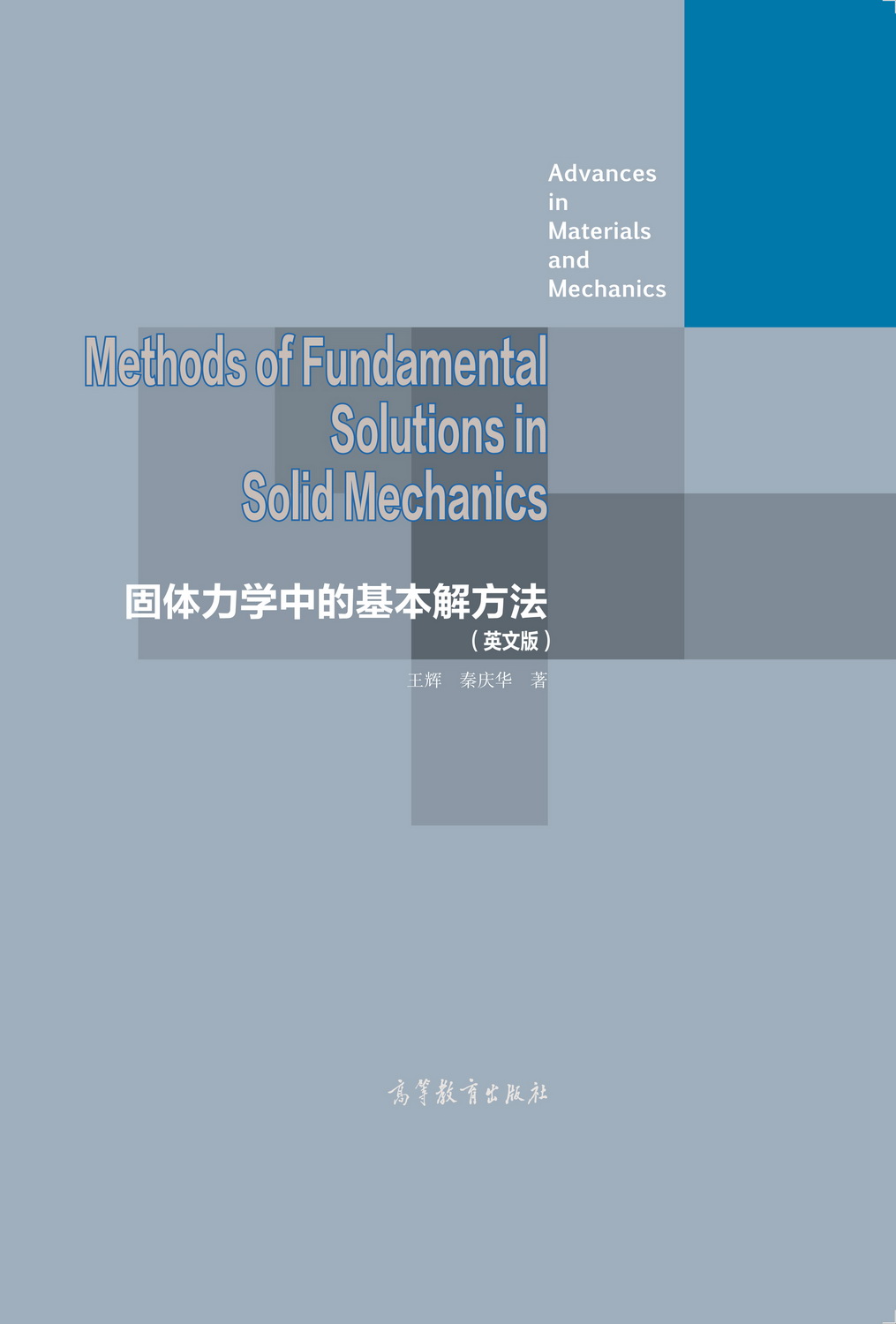
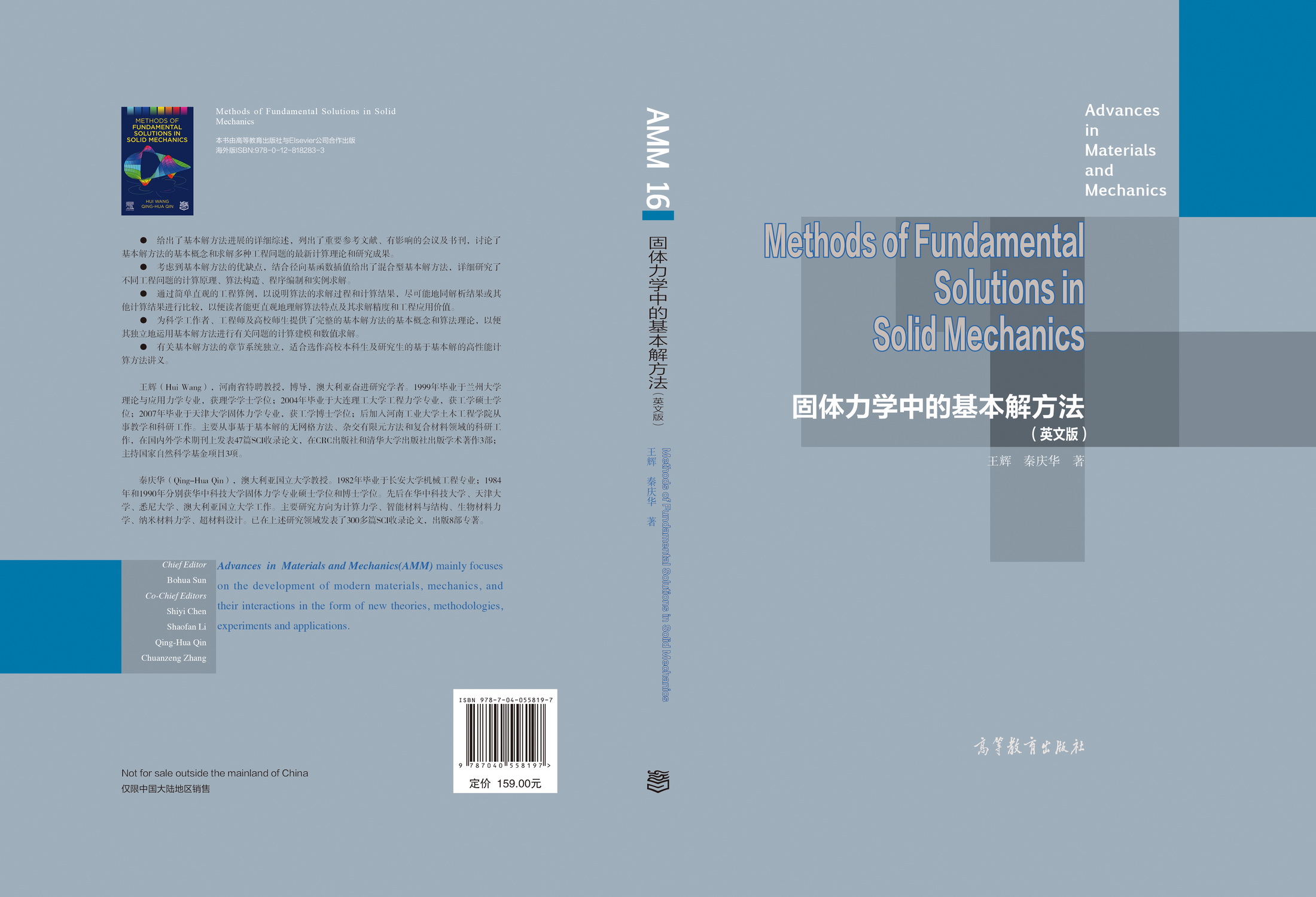







固体力学中的基本解方法(英文版)
定价:¥159.00
作者: 王辉,秦庆华
出版社:高等教育出版社
- 高等教育出版社
- 9787040558197
- 1版
- 47267262-5
- 16开
- 400
- 工学
- 力学类
- 力学类
- 研究生及以上
内容简介
本书是一部详尽讨论关于基本解方法的原理和应用研究的学术专著,提供了齐次和非齐次、标量场和矢量场等工程问题的基本解方法求解过程。本书从连续介质力学的基本原理和无网格方法的基本概念出发,结合作者多年从事该研究领域的实践经验,系统地讨论了基本解方法的理论基础、算法构造、程序编制、实例求解,然后结合算法的优缺点给出了融合径向基函数插值的改进的混合型基本解方法,进而分别求解了梁弯曲问题、薄板弯曲问题、平面弹性问题、平面压电问题和热传导问题。作者在叙述每一种问题的控制方程和边界条件后,通过计算区域内部和边界配点,阐述基本解方法的计算原理和算法构造,然后通过一些简单直观的工程算例清楚地说明求解过程和计算结果,尽可能地同解析结果或其他计算结果进行比较,以便读者能更直观地理解算法特点及其求解精度和工程应用价值。期望读者在学习和理解了本书介绍的计算方法后,会独立地运用基本解方法进行有关问题的计算建模和数值求解。
目录
目录
前辅文
Part I Fundamentals of meshless methods
Chapter 1 Overview of meshless methods
1.1. Why we need meshless methods
1.2. Review of meshless methods
1.3. Basic ideas of the method offundamental solutions
1.3.1 Weighted residual method
1.3.2 Method of fundamental solutions
1.4. Application to the two-dimensiorLaplace problem
1.4.1 Problem description
1.4.2 MFS formulation
1.4.3 Program structure and source code
1.5. Some limitations for implementin the method of fundamental solutions
1.5.1 Dependence of fundamental solutions
1.5.2 Location of source points
1.5.3 lll-conditioning treatments
1.5.4 Inhomogeneous problems
1.5.5 Multiple domain problems
1.6. Extended method of fundamen solutions
1.7. Outline of the book
References
Chapter 2 Mechanics of solids and structures
2.1. Introduction
2.2. Basic physical quantities
2.2.1 Displacement components
2.2.2 Stress components
2.2.3 Strain components
2.3. Equations for three-dimensional solids
2.3.1 Strain-displacement relation
2.3.2 Equilibrium equations
2.3.3 Constitutive equations
2.3.4 Boundary conditions
2.4. Equations for plane solids
2.4.1 Plane stress and plane strain
2.4.2 Governing equations
2.4.3 Boundary conditions
2.5. Equations for Euler-Bernoulli beams
2.5.1 Deformation mode
2.5.2 Governing equations
2.5.3 Boundary conditions
2.5.4 Continuity requirements
2.6. Equations for thin plates
2.6.1 Deformation mode
2.6.2 Governing equations
2.6.3 Boundary conditions
2.7. Equations for piezoelectricity
2.7.1 Governing equations
2.7.2 Boundary conditions
2.8. Remarks
References
Chapter 3 Basics of fundamental solutions and radial basis functions
3.1. Introduction
3.2. Basic concept of fundamental solutions
3.2.1 Partial differential operators
3.2.2 Fundamental solutions
3.3. Radial basis function interpolation
3.3.1 Radial basis functions
3.3.2 Radial basis function interpolation
3.4. Remarks
References
Part II Applications of the meshless method
Chapter 4 Meshless analysis for thin beam bending problems
4.1. Introduction
4.2. Solution procedures
4.2.1 Homogeneous solution
4.2.2 Particular solution
4.2.3 Approximated fullsolution
4.2.4 Construction of solving equations
4.2.5 Treatment ofdiscontinuous loading
4.3. Results and discussion
4.3.1 Statically indeterminate beam under uniformly distributed loading
4.3.2 Statically indeterminate beam under middle-concentrated load
4.3.3 Cantilever beam with end-cond load
4.4. Remarks
References
Chapter 5 Meshless analysis for thin plate bending problems
5.1. Introduction
5.2. Fundamental solutions for thin plate bending
5.3. Solutions procedure for thin plate bending
5.3.1 Particular solution
5.3.2 Homogeneous solution
5.3.3 Approximated full solution
5.3.4 Construction of solving equations
5.4. Results and discussion
5.4.1 Square plate with simple-supported edges
5.4.2 Square plate on a winkler elastic foundation
5.5. Remarks
References
Chapter 6 Meshless analysis for two-dimens elastic problems
6.1. Introduction
6.2. Fundamental solutions for two-dimensional elasticity
6.3. Solution procedure for homogeneous elasticity
6.3.1 Solution procedure
6.3.2 Program structure and source code
6.3.3 Results and discussion
6.4. Solution procedure for inhomogeneous elasticity
6.4.1 Particular solution
6.4.2 Homogeneous solution
6.4.3 Approximated full solution
6.4.4 Results and discussion
6.5. Further analysis for functionally graded solids
6.5.1 Concept of functionally graded material
6.5.2 Thermomechanical systems in FGMs
6.5.3 Solution procedure for FGMs
6.5.4 Numerical experiments
6.6. Remarks
References
Chapter 7 Meshless analysis for plane piezoelectric problems
7.1. Introduction
7.2. Fundamental solutions for plane piezoelectricity
7.3. Solution procedure for plane piezoelectricity
7.4. Results and discussion
7.4.1 Simple tension of a piezoelectric prism
7.4.2 An infinite piezoelectric plane with a circular hole under remote tension
7.4.3 An infinite piezoelectric plane with a circular hole subject to internal pressure
7.5. Remarks
References
Chapter 8 Meshless analysis of heat transfer in heterogeneous media
8.1. Introduction
8.2. Basics of heat transfer
8.2.1 Energy balance equation
8.2.2 Fourier's law
8.2.3 Governing equation
8.2.4 Boundary conditions
8.2.5 Thermal conductivity matrix
8.3. Solution procedure of general steady-state heat transfer
8.3.1 Solution procedure
8.3.2 Results and discussion
8.4. Solution procedure of transient heat transfer
8.4.1 Solution procedure
8.4.2 Results and discussion
8.5. Remarks
References
Appendix A Derivatives of functions in terms of radial variable r
Appendix B Transformations
B.1 Coordinate transformation
B.2 Vector transformation
B.3 Stress transformation
Appendix C Derivatives of approximated particular solutions in inhomogeneous plane elasticity
C.1 Power spline (PS) function
C.2 Thin plate spline (TPS) function
Index
前辅文
Part I Fundamentals of meshless methods
Chapter 1 Overview of meshless methods
1.1. Why we need meshless methods
1.2. Review of meshless methods
1.3. Basic ideas of the method offundamental solutions
1.3.1 Weighted residual method
1.3.2 Method of fundamental solutions
1.4. Application to the two-dimensiorLaplace problem
1.4.1 Problem description
1.4.2 MFS formulation
1.4.3 Program structure and source code
1.5. Some limitations for implementin the method of fundamental solutions
1.5.1 Dependence of fundamental solutions
1.5.2 Location of source points
1.5.3 lll-conditioning treatments
1.5.4 Inhomogeneous problems
1.5.5 Multiple domain problems
1.6. Extended method of fundamen solutions
1.7. Outline of the book
References
Chapter 2 Mechanics of solids and structures
2.1. Introduction
2.2. Basic physical quantities
2.2.1 Displacement components
2.2.2 Stress components
2.2.3 Strain components
2.3. Equations for three-dimensional solids
2.3.1 Strain-displacement relation
2.3.2 Equilibrium equations
2.3.3 Constitutive equations
2.3.4 Boundary conditions
2.4. Equations for plane solids
2.4.1 Plane stress and plane strain
2.4.2 Governing equations
2.4.3 Boundary conditions
2.5. Equations for Euler-Bernoulli beams
2.5.1 Deformation mode
2.5.2 Governing equations
2.5.3 Boundary conditions
2.5.4 Continuity requirements
2.6. Equations for thin plates
2.6.1 Deformation mode
2.6.2 Governing equations
2.6.3 Boundary conditions
2.7. Equations for piezoelectricity
2.7.1 Governing equations
2.7.2 Boundary conditions
2.8. Remarks
References
Chapter 3 Basics of fundamental solutions and radial basis functions
3.1. Introduction
3.2. Basic concept of fundamental solutions
3.2.1 Partial differential operators
3.2.2 Fundamental solutions
3.3. Radial basis function interpolation
3.3.1 Radial basis functions
3.3.2 Radial basis function interpolation
3.4. Remarks
References
Part II Applications of the meshless method
Chapter 4 Meshless analysis for thin beam bending problems
4.1. Introduction
4.2. Solution procedures
4.2.1 Homogeneous solution
4.2.2 Particular solution
4.2.3 Approximated fullsolution
4.2.4 Construction of solving equations
4.2.5 Treatment ofdiscontinuous loading
4.3. Results and discussion
4.3.1 Statically indeterminate beam under uniformly distributed loading
4.3.2 Statically indeterminate beam under middle-concentrated load
4.3.3 Cantilever beam with end-cond load
4.4. Remarks
References
Chapter 5 Meshless analysis for thin plate bending problems
5.1. Introduction
5.2. Fundamental solutions for thin plate bending
5.3. Solutions procedure for thin plate bending
5.3.1 Particular solution
5.3.2 Homogeneous solution
5.3.3 Approximated full solution
5.3.4 Construction of solving equations
5.4. Results and discussion
5.4.1 Square plate with simple-supported edges
5.4.2 Square plate on a winkler elastic foundation
5.5. Remarks
References
Chapter 6 Meshless analysis for two-dimens elastic problems
6.1. Introduction
6.2. Fundamental solutions for two-dimensional elasticity
6.3. Solution procedure for homogeneous elasticity
6.3.1 Solution procedure
6.3.2 Program structure and source code
6.3.3 Results and discussion
6.4. Solution procedure for inhomogeneous elasticity
6.4.1 Particular solution
6.4.2 Homogeneous solution
6.4.3 Approximated full solution
6.4.4 Results and discussion
6.5. Further analysis for functionally graded solids
6.5.1 Concept of functionally graded material
6.5.2 Thermomechanical systems in FGMs
6.5.3 Solution procedure for FGMs
6.5.4 Numerical experiments
6.6. Remarks
References
Chapter 7 Meshless analysis for plane piezoelectric problems
7.1. Introduction
7.2. Fundamental solutions for plane piezoelectricity
7.3. Solution procedure for plane piezoelectricity
7.4. Results and discussion
7.4.1 Simple tension of a piezoelectric prism
7.4.2 An infinite piezoelectric plane with a circular hole under remote tension
7.4.3 An infinite piezoelectric plane with a circular hole subject to internal pressure
7.5. Remarks
References
Chapter 8 Meshless analysis of heat transfer in heterogeneous media
8.1. Introduction
8.2. Basics of heat transfer
8.2.1 Energy balance equation
8.2.2 Fourier's law
8.2.3 Governing equation
8.2.4 Boundary conditions
8.2.5 Thermal conductivity matrix
8.3. Solution procedure of general steady-state heat transfer
8.3.1 Solution procedure
8.3.2 Results and discussion
8.4. Solution procedure of transient heat transfer
8.4.1 Solution procedure
8.4.2 Results and discussion
8.5. Remarks
References
Appendix A Derivatives of functions in terms of radial variable r
Appendix B Transformations
B.1 Coordinate transformation
B.2 Vector transformation
B.3 Stress transformation
Appendix C Derivatives of approximated particular solutions in inhomogeneous plane elasticity
C.1 Power spline (PS) function
C.2 Thin plate spline (TPS) function
Index
前辅文
Part I Fundamentals of meshless methods
Chapter 1 Overview of meshless methods
1.1. Why we need meshless methods
1.2. Review of meshless methods
1.3. Basic ideas of the method offundamental solutions
1.3.1 Weighted residual method
1.3.2 Method of fundamental solutions
1.4. Application to the two-dimensiorLaplace problem
1.4.1 Problem description
1.4.2 MFS formulation
1.4.3 Program structure and source code
1.5. Some limitations for implementin the method of fundamental solutions
1.5.1 Dependence of fundamental solutions
1.5.2 Location of source points
1.5.3 lll-conditioning treatments
1.5.4 Inhomogeneous problems
1.5.5 Multiple domain problems
1.6. Extended method of fundamen solutions
1.7. Outline of the book
References
Chapter 2 Mechanics of solids and structures
2.1. Introduction
2.2. Basic physical quantities
2.2.1 Displacement components
2.2.2 Stress components
2.2.3 Strain components
2.3. Equations for three-dimensional solids
2.3.1 Strain-displacement relation
2.3.2 Equilibrium equations
2.3.3 Constitutive equations
2.3.4 Boundary conditions
2.4. Equations for plane solids
2.4.1 Plane stress and plane strain
2.4.2 Governing equations
2.4.3 Boundary conditions
2.5. Equations for Euler-Bernoulli beams
2.5.1 Deformation mode
2.5.2 Governing equations
2.5.3 Boundary conditions
2.5.4 Continuity requirements
2.6. Equations for thin plates
2.6.1 Deformation mode
2.6.2 Governing equations
2.6.3 Boundary conditions
2.7. Equations for piezoelectricity
2.7.1 Governing equations
2.7.2 Boundary conditions
2.8. Remarks
References
Chapter 3 Basics of fundamental solutions and radial basis functions
3.1. Introduction
3.2. Basic concept of fundamental solutions
3.2.1 Partial differential operators
3.2.2 Fundamental solutions
3.3. Radial basis function interpolation
3.3.1 Radial basis functions
3.3.2 Radial basis function interpolation
3.4. Remarks
References
Part II Applications of the meshless method
Chapter 4 Meshless analysis for thin beam bending problems
4.1. Introduction
4.2. Solution procedures
4.2.1 Homogeneous solution
4.2.2 Particular solution
4.2.3 Approximated fullsolution
4.2.4 Construction of solving equations
4.2.5 Treatment ofdiscontinuous loading
4.3. Results and discussion
4.3.1 Statically indeterminate beam under uniformly distributed loading
4.3.2 Statically indeterminate beam under middle-concentrated load
4.3.3 Cantilever beam with end-cond load
4.4. Remarks
References
Chapter 5 Meshless analysis for thin plate bending problems
5.1. Introduction
5.2. Fundamental solutions for thin plate bending
5.3. Solutions procedure for thin plate bending
5.3.1 Particular solution
5.3.2 Homogeneous solution
5.3.3 Approximated full solution
5.3.4 Construction of solving equations
5.4. Results and discussion
5.4.1 Square plate with simple-supported edges
5.4.2 Square plate on a winkler elastic foundation
5.5. Remarks
References
Chapter 6 Meshless analysis for two-dimens elastic problems
6.1. Introduction
6.2. Fundamental solutions for two-dimensional elasticity
6.3. Solution procedure for homogeneous elasticity
6.3.1 Solution procedure
6.3.2 Program structure and source code
6.3.3 Results and discussion
6.4. Solution procedure for inhomogeneous elasticity
6.4.1 Particular solution
6.4.2 Homogeneous solution
6.4.3 Approximated full solution
6.4.4 Results and discussion
6.5. Further analysis for functionally graded solids
6.5.1 Concept of functionally graded material
6.5.2 Thermomechanical systems in FGMs
6.5.3 Solution procedure for FGMs
6.5.4 Numerical experiments
6.6. Remarks
References
Chapter 7 Meshless analysis for plane piezoelectric problems
7.1. Introduction
7.2. Fundamental solutions for plane piezoelectricity
7.3. Solution procedure for plane piezoelectricity
7.4. Results and discussion
7.4.1 Simple tension of a piezoelectric prism
7.4.2 An infinite piezoelectric plane with a circular hole under remote tension
7.4.3 An infinite piezoelectric plane with a circular hole subject to internal pressure
7.5. Remarks
References
Chapter 8 Meshless analysis of heat transfer in heterogeneous media
8.1. Introduction
8.2. Basics of heat transfer
8.2.1 Energy balance equation
8.2.2 Fourier's law
8.2.3 Governing equation
8.2.4 Boundary conditions
8.2.5 Thermal conductivity matrix
8.3. Solution procedure of general steady-state heat transfer
8.3.1 Solution procedure
8.3.2 Results and discussion
8.4. Solution procedure of transient heat transfer
8.4.1 Solution procedure
8.4.2 Results and discussion
8.5. Remarks
References
Appendix A Derivatives of functions in terms of radial variable r
Appendix B Transformations
B.1 Coordinate transformation
B.2 Vector transformation
B.3 Stress transformation
Appendix C Derivatives of approximated particular solutions in inhomogeneous plane elasticity
C.1 Power spline (PS) function
C.2 Thin plate spline (TPS) function
Index
前辅文
Part I Fundamentals of meshless methods
Chapter 1 Overview of meshless methods
1.1. Why we need meshless methods
1.2. Review of meshless methods
1.3. Basic ideas of the method offundamental solutions
1.3.1 Weighted residual method
1.3.2 Method of fundamental solutions
1.4. Application to the two-dimensiorLaplace problem
1.4.1 Problem description
1.4.2 MFS formulation
1.4.3 Program structure and source code
1.5. Some limitations for implementin the method of fundamental solutions
1.5.1 Dependence of fundamental solutions
1.5.2 Location of source points
1.5.3 lll-conditioning treatments
1.5.4 Inhomogeneous problems
1.5.5 Multiple domain problems
1.6. Extended method of fundamen solutions
1.7. Outline of the book
References
Chapter 2 Mechanics of solids and structures
2.1. Introduction
2.2. Basic physical quantities
2.2.1 Displacement components
2.2.2 Stress components
2.2.3 Strain components
2.3. Equations for three-dimensional solids
2.3.1 Strain-displacement relation
2.3.2 Equilibrium equations
2.3.3 Constitutive equations
2.3.4 Boundary conditions
2.4. Equations for plane solids
2.4.1 Plane stress and plane strain
2.4.2 Governing equations
2.4.3 Boundary conditions
2.5. Equations for Euler-Bernoulli beams
2.5.1 Deformation mode
2.5.2 Governing equations
2.5.3 Boundary conditions
2.5.4 Continuity requirements
2.6. Equations for thin plates
2.6.1 Deformation mode
2.6.2 Governing equations
2.6.3 Boundary conditions
2.7. Equations for piezoelectricity
2.7.1 Governing equations
2.7.2 Boundary conditions
2.8. Remarks
References
Chapter 3 Basics of fundamental solutions and radial basis functions
3.1. Introduction
3.2. Basic concept of fundamental solutions
3.2.1 Partial differential operators
3.2.2 Fundamental solutions
3.3. Radial basis function interpolation
3.3.1 Radial basis functions
3.3.2 Radial basis function interpolation
3.4. Remarks
References
Part II Applications of the meshless method
Chapter 4 Meshless analysis for thin beam bending problems
4.1. Introduction
4.2. Solution procedures
4.2.1 Homogeneous solution
4.2.2 Particular solution
4.2.3 Approximated fullsolution
4.2.4 Construction of solving equations
4.2.5 Treatment ofdiscontinuous loading
4.3. Results and discussion
4.3.1 Statically indeterminate beam under uniformly distributed loading
4.3.2 Statically indeterminate beam under middle-concentrated load
4.3.3 Cantilever beam with end-cond load
4.4. Remarks
References
Chapter 5 Meshless analysis for thin plate bending problems
5.1. Introduction
5.2. Fundamental solutions for thin plate bending
5.3. Solutions procedure for thin plate bending
5.3.1 Particular solution
5.3.2 Homogeneous solution
5.3.3 Approximated full solution
5.3.4 Construction of solving equations
5.4. Results and discussion
5.4.1 Square plate with simple-supported edges
5.4.2 Square plate on a winkler elastic foundation
5.5. Remarks
References
Chapter 6 Meshless analysis for two-dimens elastic problems
6.1. Introduction
6.2. Fundamental solutions for two-dimensional elasticity
6.3. Solution procedure for homogeneous elasticity
6.3.1 Solution procedure
6.3.2 Program structure and source code
6.3.3 Results and discussion
6.4. Solution procedure for inhomogeneous elasticity
6.4.1 Particular solution
6.4.2 Homogeneous solution
6.4.3 Approximated full solution
6.4.4 Results and discussion
6.5. Further analysis for functionally graded solids
6.5.1 Concept of functionally graded material
6.5.2 Thermomechanical systems in FGMs
6.5.3 Solution procedure for FGMs
6.5.4 Numerical experiments
6.6. Remarks
References
Chapter 7 Meshless analysis for plane piezoelectric problems
7.1. Introduction
7.2. Fundamental solutions for plane piezoelectricity
7.3. Solution procedure for plane piezoelectricity
7.4. Results and discussion
7.4.1 Simple tension of a piezoelectric prism
7.4.2 An infinite piezoelectric plane with a circular hole under remote tension
7.4.3 An infinite piezoelectric plane with a circular hole subject to internal pressure
7.5. Remarks
References
Chapter 8 Meshless analysis of heat transfer in heterogeneous media
8.1. Introduction
8.2. Basics of heat transfer
8.2.1 Energy balance equation
8.2.2 Fourier's law
8.2.3 Governing equation
8.2.4 Boundary conditions
8.2.5 Thermal conductivity matrix
8.3. Solution procedure of general steady-state heat transfer
8.3.1 Solution procedure
8.3.2 Results and discussion
8.4. Solution procedure of transient heat transfer
8.4.1 Solution procedure
8.4.2 Results and discussion
8.5. Remarks
References
Appendix A Derivatives of functions in terms of radial variable r
Appendix B Transformations
B.1 Coordinate transformation
B.2 Vector transformation
B.3 Stress transformation
Appendix C Derivatives of approximated particular solutions in inhomogeneous plane elasticity
C.1 Power spline (PS) function
C.2 Thin plate spline (TPS) function
Index
