

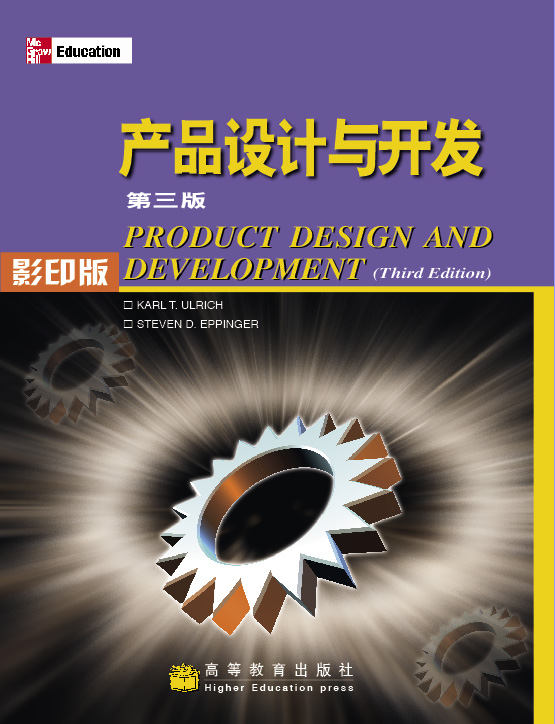





产品设计与开发(第3版)(影印版)
作者: Karl T. Ulrich and Steven D. E
出版时间:2004-06-15
出版社:高等教育出版社
- 高等教育出版社
- 9787040145106
- 1
- 16开
- 2004-06-15
- 500
《产品设计与开发》(影印版第3版)在2000年修订版的基础上,增加了第13章强化设计和第14章专利和知识产权,使之更为完善。本书内容包括:开发程序与组织、产品规划、甄别消费者需求、产品规格说明、概念生成、概念选择、概念测试、产品构造、工业设计、制造工艺设计、原型化、强化设计、专利和知识产权、产品开发经济分析、项目管理等。本书可作为工业设计专业产品开发设计课程的教材,也可作为MBA和设计管理方向研究生的教材。
1 Introduction
2 Development Processes and Organizations
3 Product Planning
4 Identifying Customer Needs
5 Product Specifications Appendix: Target Costing
6 Concept Generation
7 Concept Selection
Appendix: Concept-Screening Matrix
Example
Appendix: Concept-Scoring Matrix
Example
8 Concept Testing
Appendix: Estimating Market
Sizes
9 Product Architecture
10 Industrial Design
11 Design for Manufacturing
Appendix A: Materials Costs
Appendix B: Component
Manufacturing Costs
Appendix C: Assembly Costs
Appendix D: Cost Structures
12 Prototyping
13 Robust Design
Appendix: Orthogonal Arrays
14 Patents and Intellectual Property
Appendix A: Trademarks
Appendix B: Advice to Individual
Inventors
15 Product Development Economics
Appendix A: Time Value of Money and the Net Present Value
Technique
Appendix B: Modeling Uncertain Cash Flows Using Net Present Value Analysis
16 Managing Projects
Appendix: Design Structure Matrix
Example
Index
Chapter 1
Introduction
Characteristics of Successful Product
Development
Who Designs and Develops Products?
Duration and Cost of Product
Development
The Challenges of Product Development
Approach of This Book
Structured Methods
Industrial Examples
Organizational Realities
Road Map of the Book
References and Bibliography
Exercises
Thought Question
Organizational Links May Be Aligned with
Functions, Projects, or Both
Choosing an Organizational Structure
The AMF Organization
Summary
References and Bibliography
Exercises
Thought Questions
Chapter 2
Development Processes
and Organizations
A Generic Development Process
Concept Development: The Front-End
Process
Adapting the Generic Product Development
Process
Technology-Push Products
Platform Products
Process-Intensive Products
Customized Products
High-Risk Products
Quick-Build Products
Complex Systems
Product Development Process Flows
The AMF Development Process
Product Development Organizations
Organizations Are Formed by Establishing Links
among Individuals
Chapter 3
Product Planning
The Product Planning Process
Four Types of Product Development Projects
The process
Step 1:Identify Opportunities
Step 2: Evaluate and Pnoritize Projects
Competitive Strategy
Market Segmentation
Technological Trajectories
Product Platform Planning
Evaluating Fundamentally New Product
Opportunities
Balancing the Portfolio
Step 3:Allocate Resources and Plan Timing
Resource Allocation
Project Timing
The Product Plan
Step 4: Complete Pre-Project Planning
Mission Statements
Assumptions and Constraints
Staffing and Other Pre-Project Planning
Activities
Step S: Reflect on the Results and the Process
Summary
References and Bibliography
Exercises
Thought Questions
Chapter 4
Identifying Customer Needs
Step 1:Gather Raw Data from Customers
Choosing Customers
The Art of Eliciting Customer Needs Data
Documenting Interactions with Customers
Step 2: Interpret Raw Data in Terms of Customer
Needs
Step 3: Organize the Needs into a Hierarchy
Step 4: Establish the Relative Importance of the Needs
Step 5: Reflect on the Results and the Process Summary
References and Bibliography
Exercises
Thought Questions
Chapter 5
Product Specifications
What Are Specifications?
When Are Specifications Established?
Establishing Target Specifications
Step l: Prepare the List of Metrics
Step 2: Collect Competitive Benchmarking Information
Step 3: Set Ideal and Marginally Acceptable
Target Values
Step 4: Refl ect on the Results and the Process
Setting the Final Specifications
Step 1: Develop Technical Models
of the Product
Step 2: Develop a Cost Model of the Product
Step 3: Refine the Specifications, Making Trade-Offs
Where Necessary
Step 4: Flow Down the Specifications
as Appropriate
Step5:Reflect on the Results and the Process
Summary
References and Bibliography
Exercises
Thought Questions
Appendix
Target Costing
Chapter 6
Concept Generation
The Activity of Concept Generation
Structured Approaches Reduce the Likelihood
of costly Problems
A Five-Step Method
Step 1:Clarify the Problem
Decompose a Complex Problem into Simpler
Subproblems
Focus Initial Efforts on the Critical
Subproblems
Step 2: Search Externally
Interview Lead Users
Consult Experts
Search Patents
Search Published Literature
Benchmark Related Products
Step 3: Search Internally
Both Individual and Group Sessions Can
Be Useful
Hints for Generating Solution Concepts
Step 4: Explore Systematically
Concept Classification Tree
Concept Combination Table
Managing the Exploration Process
Step 5: Reflect on the Results and the Process
Summary
References and Bibliography
Exercises
Thought Questions
Chapter 7
Concept Selection
Concept Selection Is an Integral Part of the Product Development Process
All Teams Use Some Method for Choosing a Concept
A Structured Method Offers Several Benefits Overview of Methodology Concept Screening
Step 1: Prepare the Selection Matrix
Step 2: Rate the Concepts
Step 3: Rank the Concepts
Step 4: Combine and Improve the Concepts
Step 5: Select One or More Concepts
Step 6: Reflect on the Results and the Process Concept Scoring
Step l: Prepare the Selection Matrix
Step 2: Rate the Concepts
Step 3: Rank the Concepts
Step 4: Combine and Improve the Concepts
Step 5: Select One or More Concepts
Step 6: Reflect on the Results and the Process
Caveats
Summary
References and Bibliography
Exercises
Thought Questions
Appendix A Concept-Screening Matrix
Example
Appendix B
Concept-Scoring Matrix Example
Chapter 8
Concept Testing
Step 1:Define the Purpose
of the Concept Test
Step 2: Choose a Survey Population
Step 3: Choose a Survey Format
Step 4: Communicate the Concept
Matching the Survey Format with the Means of Communicating the Concept
Issues in Communicating the Concept
Step 5: Measure Customer Response
Step 6: Interpret the Results
Step 7: Reflect on the Results and the Process
Summary
References and Bibliography
Exercises
Thought Questions
Appendix
Estimating Market Sizes
Chapter 9
Product Architecture
What Is Product Architecture?
Types of Modularity
When Is the Product Architecture Defined?
Implications of the Architecture
Product Change
Product Variety
Component Standardization
Product Performance
Manufacturability
Product Development Management
Establishing the Architecture
Step 1: Create a Schematic of the Product
Step 2: Cluster the Elements
of the Schematic
Step 3: Create a Rough Geometric Layout
Step 4: Identify the Fundamental and Incidental
Interactions
Delayed Differentiation
Platform Planning
Differentiation Plan
Commonality Plan
Managing the Trade-Off between Differentiation and Commonality
Related System-Level Design Issues
Defining Secondary Systems
Establishing the Architecture of the Chunks
Creating Detached Interface Specifications
Summary
References and Bibliography
Exercises
Thought Questions
Chapter 10
Industrial Design
What Is Industrial Design?
Assessing the Need for Industrial Design
Expenditures for Industrial Design
How Important Is Industrial Design to a Product?
Ergonomic Needs
Aesthetic Needs
The Impact of Industrial Design Is Industrial Design Worth the Investment?
How Does Industrial Design Establish a Corporate Identity?
The Industnal Design Process
Investigation of Customer Needs
Conceptualization
Preliminary Refinement
Further Refinement and Final Concept Selection
Control Drawings
Coordination with Engineering, Manufacturing, and External Vendors
The Impact of Computer-Based Tools on the ID Process Management of the Industrial Design
Process
Timing of Industrial Design Involvement
Assessing the Quality of Industrial Design
ality of the User Interfaces
otional Appeal
ility to Maintain and Repair the Product
propriate Use of Resources
duct Differentiation
Summary
References and Bibliography
Exercises
Thought Questions
Chapter 11
Design for Manufacturing
Design for Manufacturing Defined
DFM Requires a Cross-Functional Team
DFM Is Performed throughout the Development Precess Overview of the DFM Process
Step 1:Estimate the Manufacturing Costs
Fixed Costs versus Variable Costs
The Bill of Materials
Estimating the Costs of Standard Components
Estimating the Costs of Custom Components
Estimating the Cost of Assembly
Estimating the Overhead Costs
Step 2: Reduce the Costs of Components
Understand the Process Constraints and Cost Drivers
Redesign Components to Eliminate Processing
Steps
Choose the Appropriate Economic Scale
for the Part Process
Standardize Components and Processes
Adhere to “Black Box”Component Procurement
Step 3: Reduce the Costs of Assembly
Keeping Score
Integrate Parts
Maximize Ease of Assembly
Consider Customer Assembly
Step 4: Reduce the Costs of Supporting
Production
Minimize Systemic Complexity
Error Proofing
Step 5: Consider the Impact of DFM Decisions
on Other Factors
The Impact of DFM on Development Time
The Impact of DFM on Development Cost
The Impact of DFM on Product Quality
The Impact of DFM on External Factors
Results
Summary
References and Bibliography
Exercises
Thought Questions
Appendix A
Materials Costs
AppendixB
Component Manufacturing Costs
Appendix C
Assembly Costs
Appendix D
Cost Structures
Chapter 12
Prototyping
Prototype Basics
What Is a Prototype?
Types of Prototypes
What Are Prototypes Used For?
Principles of Prototyping
Analytical Prototypes Are Generally More Flexible
than Physical Prototypes
Physical Prototypes Are Required to Detect
Unanticipated Phenomena
A Prototype May Reduce the Risk
of Costly Iterations
A Prototype May Expedite Other Development
Steps
A Prototype May Restructure Task Dependencies
Prototyping Technologies
3D Computer Modeling
Free-Form Fabrication
Planning for Prototypes
Step 1: Define the Purpose of the Prototype
Step 2: Establish the Level of Approximation
of the Prototype
Step 3: Outline an Experimental Plan
Step 4: Create a Schedule for Procurement,
Construction, and Testing
Planning Milestone Prototypes
Summary
References and Bibliography
Exercises
Thought Questions
Chapter 13
Robust Design
What Is Robust Design?
Design of Experiments
The Robust Design Process
Step 1:Identify Control Factors, Noise Factors
and Performance Metrics
Step 2: Formulate an Objective Function
Step 3: Develop the Experimental Plan
Experimental Designs
Testing Noise Factors
Step 4: Run the Experiment
Step 5: Conduct the Analysis
Computing the Objective Function
Computing Factor Effects by Analysis
of Means
Step 6: Select and Confirm Factor
Setpoints
Step 7: Reflect and Repeat
Caveats
Summary
References and Bibliography
Exercises
Thought Questions
Appendix
Orthogonal Arrays
Chapter 14
Patents and Intellectual Property
What Is Intellectual Property?
Overview of Patents
Utility Patents
Preparing a Disclosure
Step 1:Formulate a Strategy and Plan
Timing of Patent Applications
Type of Application
Scope of Application
Step 2: Study Prior Inventions
Step 3: Outline Claims
Step 4: Write the Description of the Invention
Figures
Writing the Detailed Description
Defensive Disclosure
Step 5: Refine Claims
Writing the Claims
Guidelines for Crafting Claims
Step 6: Pursue Application
Step 7: Reflect on the Results and the Process
Summary
References and Bibliography
Exercises
Thought Questions
Appendix A
Trademarks
Appendix B
Advice to Individual Inventors
Chapter 15
Product Development Economics
Elements of Economic Analysis
Quantitative Analysis
Qualitative Analysis
When Should Economic Analys is Be
Performed?
Economic Analysis Process
Step 1:Build a Base-Case Financial Model
Estimate the Timing and Magnitude of Future Cash
Inflows and Outflows
Compute the Net Present Value of the Cash Flows
The Base-Case Financial Model Can Support
Go/No-Go Decisions and Major Investment ecisions
Step 2: Perform Sensitivity Analysis
Development Cost Example
Development Time Example
Step 3: Use Sensitivity Analysis to Understand
Project Trade-Offs
Six Potential Interactions
Trade-Off Rules
Limitations of Quantitative Analys is
Step 4: Consider the Influence of the Qualitative
Factors on Project Success
Projects Interact with the Firm, the Market, and the
Macro Environment
Carrying Out Qualitative Analysis
Summary
References and Bibliography
Exercises
Thought Questions
Appendix A
Time Value of Money and the Net Present
Value Technique
Appendix B
Modeling Uncertain Cash Flows Using Net
Present Value Analysis
Chapter 16
Managing Projects
Understanding and Representing Tasks
Sequential, Parallel, and Coupled Tasks
The Design Structure Matrix
Gantt Charts
PERT Charts
The Critical Path
Baseline Project Planning
The Contract Book
Project Task List
Team Staffing and Organization
Project Schedule
Project Budget
Project Risk Plan
Modifying the Baseline Plan
Accelerating Projects
Project Execution
Coordination Mechanisms
Assessing Project Status
Corrective Actions
Postmortem Project Evaluation
Summary
References and Bibliography
Exercises
Thought Questions
Appendix
Design Structure Matrix Example
Index
