

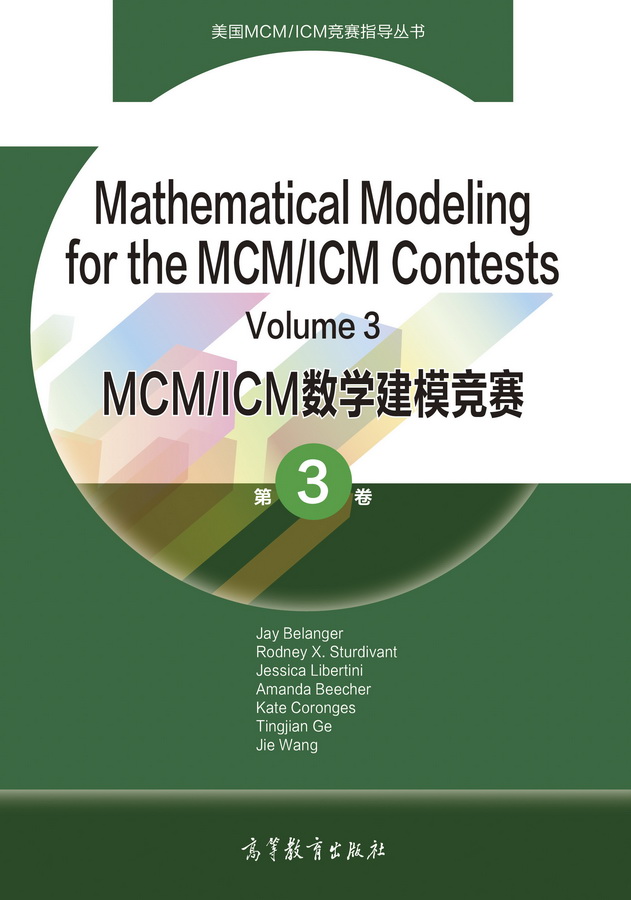









MCM/ICM数学建模竞赛 第3卷
定价:¥59.00
作者: Jay Belanger等
出版社:高等教育出版社
- 高等教育出版社
- 9787040491210
- 1版
- 47266466-3
- 16开
- 310
- 理学
- 数学类
- 数学类
- 本科
目录
目录
前辅文
1 Writing for Winning
Jie Wang
1.1 Paper Evaluations
1.2 Tell A Good Story
1.3 Tell the Story Well
1.4 Sensitivity Analysis Is a Must
1.5 Write Well
Exercises
References
2 A Hot Bath
Jay Belanger
2.1 Problem Description
2.2 Outstanding Winners
2.3 Previous Work
2.3.1 Classic formulas
2.3.2 Bathtub measurements
2.3.3 Previous work on water cooling
2.4 Approaching the Problem
2.5 Models
2.5.1 Assumptions and justifications
2.5.2 Functions and parameters
2.5.3 Determining the heat loss
2.5.4 Preserving heat
2.5.5 Heat dispersal
2.5.6 Answering the main question
2.5.7 Other questions
2.5.8 Results
2.6 Sensitivity Analysis
2.7 Strengths and Weaknesses
2.7.1 Strengths
2.7.2 Weaknesses
2.8 Comments
Exercises
References
3 Space Junk
Jay Belanger
3.1 Problem Description
3.2 Outstanding Winners
3.3 Previous Work
3.3.1 Kessler's work
3.3.2 Debris removal methods
3.3.3 Political obstacles
3.3.4 Business opportunities
3.4 Approaching the Problem
3.5 A Continuous Approach
3.5.1 How to approach the problem
3.5.2 Assumptions and justifications
3.5.3 Modeling details
3.5.4 Results
3.6 A Probabilistic Approach
3.6.1 How to approach the problem
3.6.2 Assumptions and justifications
3.6.3 Modeling details
3.6.4 Results
3.7 Sensitivity Analysis
3.8 Strengths and Weaknesses
3.8.1 Strengths
3.8.2 Weaknesses
3.9 Comments
Exercises
References
4 The Goodgrant Challenge
Robert E. Burks, Rodney X. Sturdivant
4.1 Problem Description
4.2 Outstanding Winners
4.3 Previous Work
4.3.1 Bill and Melinda Gates Foundation
4.3.2 Lumina Foundation
4.3.3 Principal component analysis
4.3.4 Analytic hierarchy process
4.4 Modeling Approach
4.4.1 Thinking about the problem
4.4.2 Assumptions
4.4.3 Data analytics
4.4.4 Selecting metrics of success
4.4.5 Return on investment
4.5 Modeling Approach
4.6 Sensitivity Analysis
4.7 Strengths and Weaknesses
4.7.1 Strengths
4.7.2 Weaknesses
4.8 Comments
Exercises
References
5 Measuring the Evolution and Influence in Society's Information Networks
Jessica Libertini, Ralucca Gera
5.1 Problem Description
5.2 Outstanding Winners
5.3 Approaching the Problem
5.4 Diffusion Networks
5.4.1 Basic assumptions and justification
5.4.2 Defining ``news''
5.4.3 Previous work
5.4.4 Results
5.4.5 Exploring the future of communication
5.4.6 Sensitivity analysis
5.4.7 Conclusions, strengths, weaknesses, and future work
5.5 Modeling Communication Using Disease Models
5.5.1 The information circulation network
5.5.2 The news filter model
5.5.3 Testing and using the NF model
5.5.4 The information circulation network prediction model
5.5.5 The public interest and information network interaction model
5.5.6 Sensitivity analysis
5.5.7 Strengths and weaknesses
5.6 Comments
Exercises
References
6 Are We Heading Towards A Thirsty Planet?
Amanda Beecher, Amy Richmond
6.1 Problem Description
6.2 Outstanding Winners
6.3 Previous Work
6.4 A Three-pronged Interdisciplinary Modeling Approach
6.4.1 Approach to the problem
6.4.2 Case study: the water problem in Haiti
6.4.3 Assumptions and justifications
6.4.4 System-network model
6.4.5 Algorithmic model
6.4.6 Agent-based network model
6.4.7 Intervention plan
6.4.8 Sensitivity analysis
6.4.9 Strengths and weaknesses
6.5 A Flow Model based on Time-Constrained Water Use
6.5.1 Model development
6.5.2 Case study: water scarcity in Egypt
6.5.3 Model adaption
6.5.4 Results
6.5.5 Intervention
6.6 Comments
Exercises
References
7 Modeling Refugee Immigration Policies
Evelyn Panangkou, Yulia Tyshchuck, Christian Nattiel, Don Stanley Dalisay, Kate Coronges
7.1 Current Refugee Problems
7.2 Problem Description
7.3 Outstanding Winners
7.4 How to Approach the Problem
7.5 Empirical Policy Research
7.6 Identify Parameters and Develop Metrics
7.7 Modeling Approaches to Policy Problem
7.7.1 Assumptions
7.7.2 Static modeling approach
7.7.3 Dynamical modeling approaches
7.8 Sensitivity Analysis
7.8.1 Scalability
7.8.2 Robustness
7.8.3 Uncertainty
7.9 Policy Recommendations
7.10 Strengths and Weaknesses
7.11 Judges' Comments by Task
Exercises
References
8 Complex Event and Pattern Models in Sequence Data Processing
Tingjian Ge, Yan Li, Cindy Chen
8.1 Introduction and Problem Description
8.1.1 Windowed subsequence matching
8.1.2 Extended regular expressions
8.1.3 Event patterns with graph structure
8.2 Formal Definition of Pattern Models
8.2.1 Windowed subsequence
8.2.2 Extended regular expressions
8.2.3 Event pattern with graph structure
8.3 Error Models
8.4 Matching Algorithms
8.4.1 Algorithms for windowed subsequence matching
8.4.2 Algorithms for extended regular expression matching
8.4.3 Algorithms for event pattern with graph structure
Exercises
References
Index
前辅文
1 Writing for Winning
Jie Wang
1.1 Paper Evaluations
1.2 Tell A Good Story
1.3 Tell the Story Well
1.4 Sensitivity Analysis Is a Must
1.5 Write Well
Exercises
References
2 A Hot Bath
Jay Belanger
2.1 Problem Description
2.2 Outstanding Winners
2.3 Previous Work
2.3.1 Classic formulas
2.3.2 Bathtub measurements
2.3.3 Previous work on water cooling
2.4 Approaching the Problem
2.5 Models
2.5.1 Assumptions and justifications
2.5.2 Functions and parameters
2.5.3 Determining the heat loss
2.5.4 Preserving heat
2.5.5 Heat dispersal
2.5.6 Answering the main question
2.5.7 Other questions
2.5.8 Results
2.6 Sensitivity Analysis
2.7 Strengths and Weaknesses
2.7.1 Strengths
2.7.2 Weaknesses
2.8 Comments
Exercises
References
3 Space Junk
Jay Belanger
3.1 Problem Description
3.2 Outstanding Winners
3.3 Previous Work
3.3.1 Kessler's work
3.3.2 Debris removal methods
3.3.3 Political obstacles
3.3.4 Business opportunities
3.4 Approaching the Problem
3.5 A Continuous Approach
3.5.1 How to approach the problem
3.5.2 Assumptions and justifications
3.5.3 Modeling details
3.5.4 Results
3.6 A Probabilistic Approach
3.6.1 How to approach the problem
3.6.2 Assumptions and justifications
3.6.3 Modeling details
3.6.4 Results
3.7 Sensitivity Analysis
3.8 Strengths and Weaknesses
3.8.1 Strengths
3.8.2 Weaknesses
3.9 Comments
Exercises
References
4 The Goodgrant Challenge
Robert E. Burks, Rodney X. Sturdivant
4.1 Problem Description
4.2 Outstanding Winners
4.3 Previous Work
4.3.1 Bill and Melinda Gates Foundation
4.3.2 Lumina Foundation
4.3.3 Principal component analysis
4.3.4 Analytic hierarchy process
4.4 Modeling Approach
4.4.1 Thinking about the problem
4.4.2 Assumptions
4.4.3 Data analytics
4.4.4 Selecting metrics of success
4.4.5 Return on investment
4.5 Modeling Approach
4.6 Sensitivity Analysis
4.7 Strengths and Weaknesses
4.7.1 Strengths
4.7.2 Weaknesses
4.8 Comments
Exercises
References
5 Measuring the Evolution and Influence in Society's Information Networks
Jessica Libertini, Ralucca Gera
5.1 Problem Description
5.2 Outstanding Winners
5.3 Approaching the Problem
5.4 Diffusion Networks
5.4.1 Basic assumptions and justification
5.4.2 Defining ``news''
5.4.3 Previous work
5.4.4 Results
5.4.5 Exploring the future of communication
5.4.6 Sensitivity analysis
5.4.7 Conclusions, strengths, weaknesses, and future work
5.5 Modeling Communication Using Disease Models
5.5.1 The information circulation network
5.5.2 The news filter model
5.5.3 Testing and using the NF model
5.5.4 The information circulation network prediction model
5.5.5 The public interest and information network interaction model
5.5.6 Sensitivity analysis
5.5.7 Strengths and weaknesses
5.6 Comments
Exercises
References
6 Are We Heading Towards A Thirsty Planet?
Amanda Beecher, Amy Richmond
6.1 Problem Description
6.2 Outstanding Winners
6.3 Previous Work
6.4 A Three-pronged Interdisciplinary Modeling Approach
6.4.1 Approach to the problem
6.4.2 Case study: the water problem in Haiti
6.4.3 Assumptions and justifications
6.4.4 System-network model
6.4.5 Algorithmic model
6.4.6 Agent-based network model
6.4.7 Intervention plan
6.4.8 Sensitivity analysis
6.4.9 Strengths and weaknesses
6.5 A Flow Model based on Time-Constrained Water Use
6.5.1 Model development
6.5.2 Case study: water scarcity in Egypt
6.5.3 Model adaption
6.5.4 Results
6.5.5 Intervention
6.6 Comments
Exercises
References
7 Modeling Refugee Immigration Policies
Evelyn Panangkou, Yulia Tyshchuck, Christian Nattiel, Don Stanley Dalisay, Kate Coronges
7.1 Current Refugee Problems
7.2 Problem Description
7.3 Outstanding Winners
7.4 How to Approach the Problem
7.5 Empirical Policy Research
7.6 Identify Parameters and Develop Metrics
7.7 Modeling Approaches to Policy Problem
7.7.1 Assumptions
7.7.2 Static modeling approach
7.7.3 Dynamical modeling approaches
7.8 Sensitivity Analysis
7.8.1 Scalability
7.8.2 Robustness
7.8.3 Uncertainty
7.9 Policy Recommendations
7.10 Strengths and Weaknesses
7.11 Judges' Comments by Task
Exercises
References
8 Complex Event and Pattern Models in Sequence Data Processing
Tingjian Ge, Yan Li, Cindy Chen
8.1 Introduction and Problem Description
8.1.1 Windowed subsequence matching
8.1.2 Extended regular expressions
8.1.3 Event patterns with graph structure
8.2 Formal Definition of Pattern Models
8.2.1 Windowed subsequence
8.2.2 Extended regular expressions
8.2.3 Event pattern with graph structure
8.3 Error Models
8.4 Matching Algorithms
8.4.1 Algorithms for windowed subsequence matching
8.4.2 Algorithms for extended regular expression matching
8.4.3 Algorithms for event pattern with graph structure
Exercises
References
Index
前辅文
1 Writing for Winning
Jie Wang
1.1 Paper Evaluations
1.2 Tell A Good Story
1.3 Tell the Story Well
1.4 Sensitivity Analysis Is a Must
1.5 Write Well
Exercises
References
2 A Hot Bath
Jay Belanger
2.1 Problem Description
2.2 Outstanding Winners
2.3 Previous Work
2.3.1 Classic formulas
2.3.2 Bathtub measurements
2.3.3 Previous work on water cooling
2.4 Approaching the Problem
2.5 Models
2.5.1 Assumptions and justifications
2.5.2 Functions and parameters
2.5.3 Determining the heat loss
2.5.4 Preserving heat
2.5.5 Heat dispersal
2.5.6 Answering the main question
2.5.7 Other questions
2.5.8 Results
2.6 Sensitivity Analysis
2.7 Strengths and Weaknesses
2.7.1 Strengths
2.7.2 Weaknesses
2.8 Comments
Exercises
References
3 Space Junk
Jay Belanger
3.1 Problem Description
3.2 Outstanding Winners
3.3 Previous Work
3.3.1 Kessler's work
3.3.2 Debris removal methods
3.3.3 Political obstacles
3.3.4 Business opportunities
3.4 Approaching the Problem
3.5 A Continuous Approach
3.5.1 How to approach the problem
3.5.2 Assumptions and justifications
3.5.3 Modeling details
3.5.4 Results
3.6 A Probabilistic Approach
3.6.1 How to approach the problem
3.6.2 Assumptions and justifications
3.6.3 Modeling details
3.6.4 Results
3.7 Sensitivity Analysis
3.8 Strengths and Weaknesses
3.8.1 Strengths
3.8.2 Weaknesses
3.9 Comments
Exercises
References
4 The Goodgrant Challenge
Robert E. Burks, Rodney X. Sturdivant
4.1 Problem Description
4.2 Outstanding Winners
4.3 Previous Work
4.3.1 Bill and Melinda Gates Foundation
4.3.2 Lumina Foundation
4.3.3 Principal component analysis
4.3.4 Analytic hierarchy process
4.4 Modeling Approach
4.4.1 Thinking about the problem
4.4.2 Assumptions
4.4.3 Data analytics
4.4.4 Selecting metrics of success
4.4.5 Return on investment
4.5 Modeling Approach
4.6 Sensitivity Analysis
4.7 Strengths and Weaknesses
4.7.1 Strengths
4.7.2 Weaknesses
4.8 Comments
Exercises
References
5 Measuring the Evolution and Influence in Society's Information Networks
Jessica Libertini, Ralucca Gera
5.1 Problem Description
5.2 Outstanding Winners
5.3 Approaching the Problem
5.4 Diffusion Networks
5.4.1 Basic assumptions and justification
5.4.2 Defining ``news''
5.4.3 Previous work
5.4.4 Results
5.4.5 Exploring the future of communication
5.4.6 Sensitivity analysis
5.4.7 Conclusions, strengths, weaknesses, and future work
5.5 Modeling Communication Using Disease Models
5.5.1 The information circulation network
5.5.2 The news filter model
5.5.3 Testing and using the NF model
5.5.4 The information circulation network prediction model
5.5.5 The public interest and information network interaction model
5.5.6 Sensitivity analysis
5.5.7 Strengths and weaknesses
5.6 Comments
Exercises
References
6 Are We Heading Towards A Thirsty Planet?
Amanda Beecher, Amy Richmond
6.1 Problem Description
6.2 Outstanding Winners
6.3 Previous Work
6.4 A Three-pronged Interdisciplinary Modeling Approach
6.4.1 Approach to the problem
6.4.2 Case study: the water problem in Haiti
6.4.3 Assumptions and justifications
6.4.4 System-network model
6.4.5 Algorithmic model
6.4.6 Agent-based network model
6.4.7 Intervention plan
6.4.8 Sensitivity analysis
6.4.9 Strengths and weaknesses
6.5 A Flow Model based on Time-Constrained Water Use
6.5.1 Model development
6.5.2 Case study: water scarcity in Egypt
6.5.3 Model adaption
6.5.4 Results
6.5.5 Intervention
6.6 Comments
Exercises
References
7 Modeling Refugee Immigration Policies
Evelyn Panangkou, Yulia Tyshchuck, Christian Nattiel, Don Stanley Dalisay, Kate Coronges
7.1 Current Refugee Problems
7.2 Problem Description
7.3 Outstanding Winners
7.4 How to Approach the Problem
7.5 Empirical Policy Research
7.6 Identify Parameters and Develop Metrics
7.7 Modeling Approaches to Policy Problem
7.7.1 Assumptions
7.7.2 Static modeling approach
7.7.3 Dynamical modeling approaches
7.8 Sensitivity Analysis
7.8.1 Scalability
7.8.2 Robustness
7.8.3 Uncertainty
7.9 Policy Recommendations
7.10 Strengths and Weaknesses
7.11 Judges' Comments by Task
Exercises
References
8 Complex Event and Pattern Models in Sequence Data Processing
Tingjian Ge, Yan Li, Cindy Chen
8.1 Introduction and Problem Description
8.1.1 Windowed subsequence matching
8.1.2 Extended regular expressions
8.1.3 Event patterns with graph structure
8.2 Formal Definition of Pattern Models
8.2.1 Windowed subsequence
8.2.2 Extended regular expressions
8.2.3 Event pattern with graph structure
8.3 Error Models
8.4 Matching Algorithms
8.4.1 Algorithms for windowed subsequence matching
8.4.2 Algorithms for extended regular expression matching
8.4.3 Algorithms for event pattern with graph structure
Exercises
References
Index
前辅文
1 Writing for Winning
Jie Wang
1.1 Paper Evaluations
1.2 Tell A Good Story
1.3 Tell the Story Well
1.4 Sensitivity Analysis Is a Must
1.5 Write Well
Exercises
References
2 A Hot Bath
Jay Belanger
2.1 Problem Description
2.2 Outstanding Winners
2.3 Previous Work
2.3.1 Classic formulas
2.3.2 Bathtub measurements
2.3.3 Previous work on water cooling
2.4 Approaching the Problem
2.5 Models
2.5.1 Assumptions and justifications
2.5.2 Functions and parameters
2.5.3 Determining the heat loss
2.5.4 Preserving heat
2.5.5 Heat dispersal
2.5.6 Answering the main question
2.5.7 Other questions
2.5.8 Results
2.6 Sensitivity Analysis
2.7 Strengths and Weaknesses
2.7.1 Strengths
2.7.2 Weaknesses
2.8 Comments
Exercises
References
3 Space Junk
Jay Belanger
3.1 Problem Description
3.2 Outstanding Winners
3.3 Previous Work
3.3.1 Kessler's work
3.3.2 Debris removal methods
3.3.3 Political obstacles
3.3.4 Business opportunities
3.4 Approaching the Problem
3.5 A Continuous Approach
3.5.1 How to approach the problem
3.5.2 Assumptions and justifications
3.5.3 Modeling details
3.5.4 Results
3.6 A Probabilistic Approach
3.6.1 How to approach the problem
3.6.2 Assumptions and justifications
3.6.3 Modeling details
3.6.4 Results
3.7 Sensitivity Analysis
3.8 Strengths and Weaknesses
3.8.1 Strengths
3.8.2 Weaknesses
3.9 Comments
Exercises
References
4 The Goodgrant Challenge
Robert E. Burks, Rodney X. Sturdivant
4.1 Problem Description
4.2 Outstanding Winners
4.3 Previous Work
4.3.1 Bill and Melinda Gates Foundation
4.3.2 Lumina Foundation
4.3.3 Principal component analysis
4.3.4 Analytic hierarchy process
4.4 Modeling Approach
4.4.1 Thinking about the problem
4.4.2 Assumptions
4.4.3 Data analytics
4.4.4 Selecting metrics of success
4.4.5 Return on investment
4.5 Modeling Approach
4.6 Sensitivity Analysis
4.7 Strengths and Weaknesses
4.7.1 Strengths
4.7.2 Weaknesses
4.8 Comments
Exercises
References
5 Measuring the Evolution and Influence in Society's Information Networks
Jessica Libertini, Ralucca Gera
5.1 Problem Description
5.2 Outstanding Winners
5.3 Approaching the Problem
5.4 Diffusion Networks
5.4.1 Basic assumptions and justification
5.4.2 Defining ``news''
5.4.3 Previous work
5.4.4 Results
5.4.5 Exploring the future of communication
5.4.6 Sensitivity analysis
5.4.7 Conclusions, strengths, weaknesses, and future work
5.5 Modeling Communication Using Disease Models
5.5.1 The information circulation network
5.5.2 The news filter model
5.5.3 Testing and using the NF model
5.5.4 The information circulation network prediction model
5.5.5 The public interest and information network interaction model
5.5.6 Sensitivity analysis
5.5.7 Strengths and weaknesses
5.6 Comments
Exercises
References
6 Are We Heading Towards A Thirsty Planet?
Amanda Beecher, Amy Richmond
6.1 Problem Description
6.2 Outstanding Winners
6.3 Previous Work
6.4 A Three-pronged Interdisciplinary Modeling Approach
6.4.1 Approach to the problem
6.4.2 Case study: the water problem in Haiti
6.4.3 Assumptions and justifications
6.4.4 System-network model
6.4.5 Algorithmic model
6.4.6 Agent-based network model
6.4.7 Intervention plan
6.4.8 Sensitivity analysis
6.4.9 Strengths and weaknesses
6.5 A Flow Model based on Time-Constrained Water Use
6.5.1 Model development
6.5.2 Case study: water scarcity in Egypt
6.5.3 Model adaption
6.5.4 Results
6.5.5 Intervention
6.6 Comments
Exercises
References
7 Modeling Refugee Immigration Policies
Evelyn Panangkou, Yulia Tyshchuck, Christian Nattiel, Don Stanley Dalisay, Kate Coronges
7.1 Current Refugee Problems
7.2 Problem Description
7.3 Outstanding Winners
7.4 How to Approach the Problem
7.5 Empirical Policy Research
7.6 Identify Parameters and Develop Metrics
7.7 Modeling Approaches to Policy Problem
7.7.1 Assumptions
7.7.2 Static modeling approach
7.7.3 Dynamical modeling approaches
7.8 Sensitivity Analysis
7.8.1 Scalability
7.8.2 Robustness
7.8.3 Uncertainty
7.9 Policy Recommendations
7.10 Strengths and Weaknesses
7.11 Judges' Comments by Task
Exercises
References
8 Complex Event and Pattern Models in Sequence Data Processing
Tingjian Ge, Yan Li, Cindy Chen
8.1 Introduction and Problem Description
8.1.1 Windowed subsequence matching
8.1.2 Extended regular expressions
8.1.3 Event patterns with graph structure
8.2 Formal Definition of Pattern Models
8.2.1 Windowed subsequence
8.2.2 Extended regular expressions
8.2.3 Event pattern with graph structure
8.3 Error Models
8.4 Matching Algorithms
8.4.1 Algorithms for windowed subsequence matching
8.4.2 Algorithms for extended regular expression matching
8.4.3 Algorithms for event pattern with graph structure
Exercises
References
Index
