

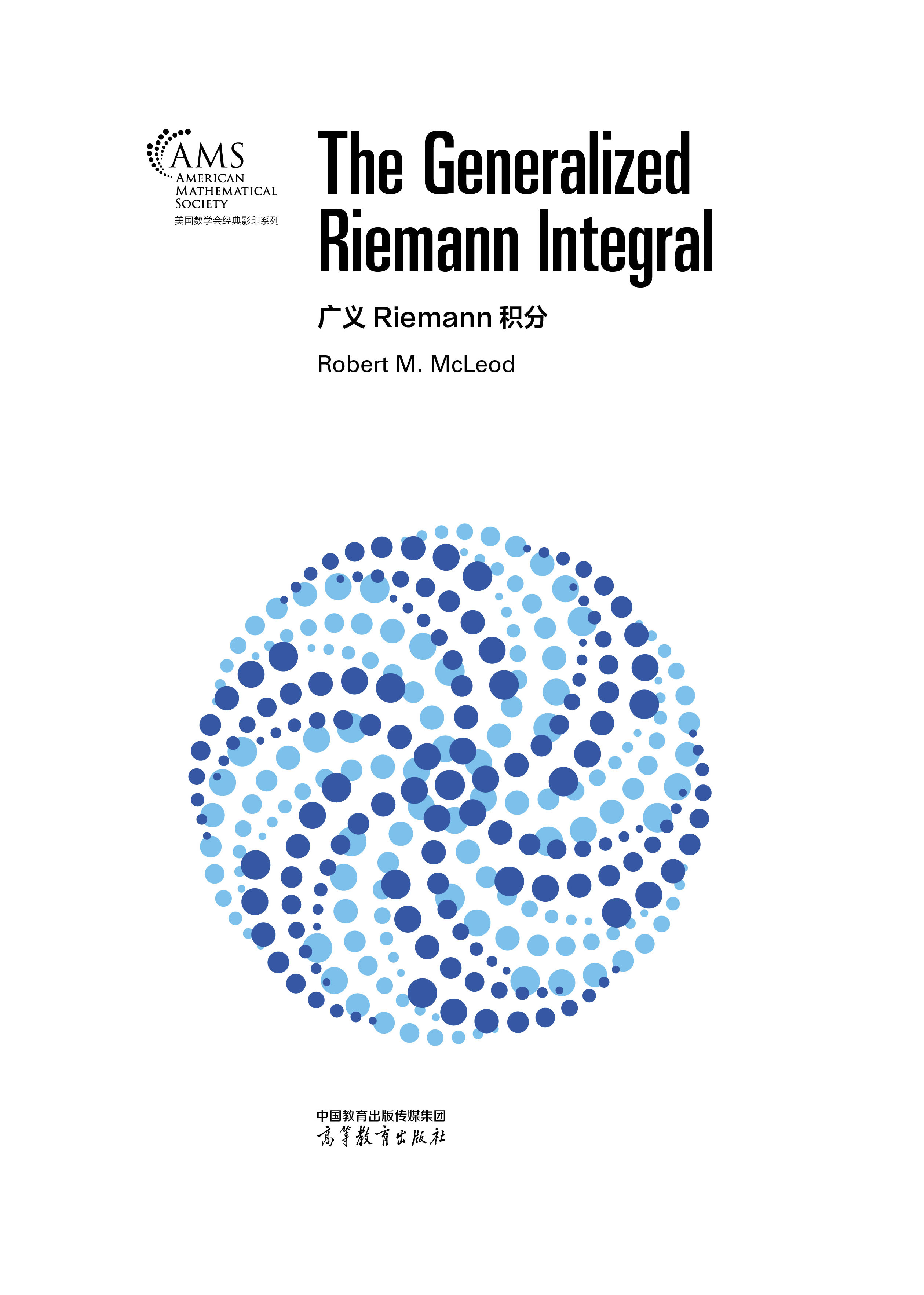






广义Riemann积分(影印版)
定价:¥135.00
作者: Robert M.McLeod
出版社:高等教育出版社
- 高等教育出版社
- 9787040659726
- 1版
- 64270698-0
- 特殊
- 理学
- 数学类
- 数学类
- 本科 研究生及以上
目录
目录
前辅文
INTRODUCTION
CHAPTER 1—DEFINITION OF THE GENERALIZED RIEMANN INTEGRAL
1.1 Selecting Riemann sums
1.2 Definition of the generalized Riemann integral
1.3 Integration over unbounded intervals
1.4 The fundamental theorem of calculus
1.5 The status of improper integrals
1.6 Multiple integrals
1.7 Sum of a series viewed as an integral
S1.8 The limit based on gauges
S1.9 Proof of the fundamental theorem
1.10 Exercises
CHAPTER 2—BASIC PROPERTTIES OF THE INTEGRAL
2.1 The integral as a function of the integrand
2.2 The Cauchy criterion
2.3 Integrability on subintervals
2.4 The additivity of integrals
2.5 Finite additivity of functions of intervals
2.6 Continuity of integrals. Existence of primitives
2.7 Change of variables in integrals on intervals in -R
S2.8 Limits of integrals over expanding intervals
2.9 Exercises
CHAPTER 3—ABSOLUTE INTEGRABILITY AND CONVERGENCE THEOREMS
3.1 Henstock's lemma
3.2 Integrability of the absolute value of an integrable function
3.3 Lattice operations on integrable functions
3.4 Uniformly convergent sequences of functions
3.5 The monotone convergence theorem
3.6 The dominated convergence theorem
S3.7 Proof of Henstock's lemma
S3.8 Proof of the criterion for integrability of |f|
S3.9 Iterated limits
S3.10 Proof of the monotone and dominated convergence theorems
3.11 Exercises
CHAPTER 4—INTEGRATION ON SUBSETS OF INTERVALS
4.1 Null functions and null sets
4.2 Convergence almost everywhere
4.3 Integration over sets which are not intervals
4.4 Integration of continuous functions on closed, bounded sets
4.5 Integrals on sequences of sets
4.6 Length, area, volume, and measure
4.7 Exercises
CHAPTER 5—MEASURABLE FUNCTIONS
5.1 Measurable functions
5.2 Measurability and absolute integrability
5.3 Operations on measurable functions
5.4 Integrability of products
S5.5 Approximation by step functions
5.6 Exercises.
CHAPTER 6—MULTIPLE AND ITERATED INTEGRALS
6.1 Fubini's theorem
6.2 Determining integrability from iterated integrals
S6.3 Compound divisions. Compatibility theorem
S6.4 Proof of Fubini's theorem
S6.5 Double series
6.6 Exercises
CHAPTER 7—INTEGRALS OF STIELTJES TYPE
7.1 Three versions of the Riemann-Stieltjes integral
7.2 Basic properties of Riemann-Stieltjes integrals
7.3 Limits, continuity, and differentiability of integrals
7.4 Values of certain integrals
7.5 Existence theorems for Riemann-Stieltjes integrals
7.6 Integration by parts
7.7 Integration of absolute values. Lattice operations
7.8 Monotone and dominated convergence
7.9 Change of variables
7.10 Mean value theorems for integrals
S7.11 Sequences of integrators
S7.12 Line integrals
S7.13 Functions of bounded variation and regulated functions
S7.14 Proof of the absolute integrability theorem
7.15 Exercises
CHAPTER 8—COMPARISON OF INTEGRALS
S8.1 Characterization of measurable sets
S8.2 Lebesgue measure and integral
S8.3 Characterization of absolute integrability using Riemann sums
8.4 Suggestions for further study
REFERENCES
APPENDIX Solutions of In-text Exercises
INDEX
