

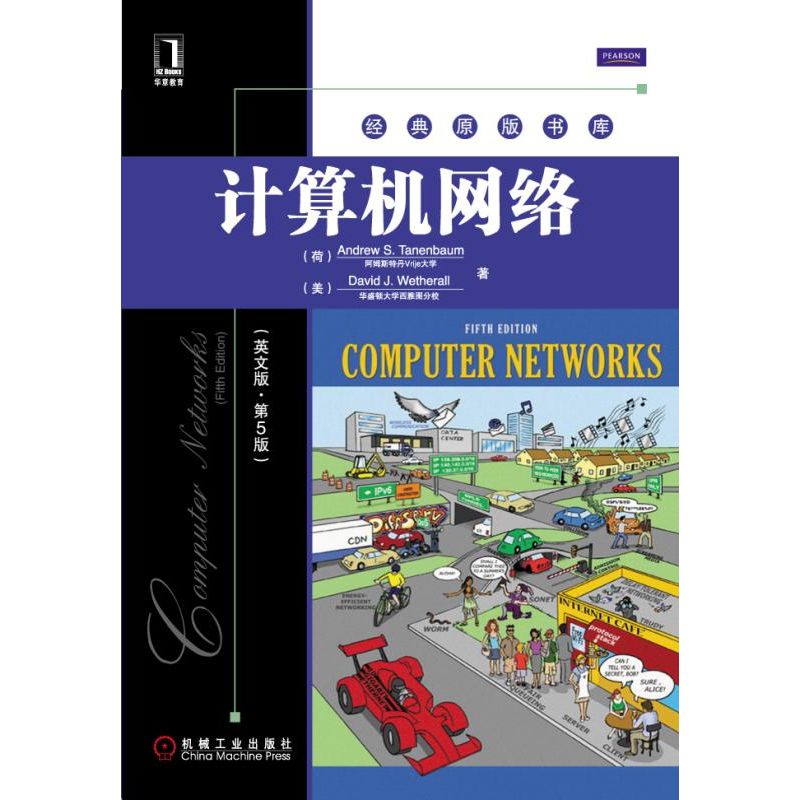









计算机网络(英文版)(第5版) / 经典原版书库
定价:¥99.00
作者: Andrew S.Tanenbaum,David J.Wetherall
出版时间:2011-10-20
出版社:机械工业出版社
- 机械工业出版社
- 9787111359258
- 1-18
- 44219943-6
- 16开
- 2011-10-20
- 1425
- 计算机通信类
- 本科
作者简介
内容简介
Original edition, entitled COMPUTER NETWORKS, 5E, 9780132553179 by TANENBAUM, ANDREW S.; WETHERALL, DAVID J., published by Pearson Education, Inc., publishing as Prentice Hall, Copyright 2011, 2003, 1996, 1989, 1981.
All rights reserved. No part of this book may be reproduced or transmitted in any form or by any means, electronic or mechanical, including photocopying, recording or by any information storage retrieval system, without permission from Pearson Education, Inc.
China edition published by PEARSON EDUCATION ASIA LTD., and CHINA MACHINE PRESS, Copyright 2011.
This edition is manufactured in the People抯 Republic of China, and is authorized for sale and distribution in the People抯 Republic of China exclusively (except Taiwan, Hong Kong SAR and Macau SAR).
All rights reserved. No part of this book may be reproduced or transmitted in any form or by any means, electronic or mechanical, including photocopying, recording or by any information storage retrieval system, without permission from Pearson Education, Inc.
China edition published by PEARSON EDUCATION ASIA LTD., and CHINA MACHINE PRESS, Copyright 2011.
This edition is manufactured in the People抯 Republic of China, and is authorized for sale and distribution in the People抯 Republic of China exclusively (except Taiwan, Hong Kong SAR and Macau SAR).
目录
PREFACE
ABOUT THE AUTHORS
1 INTRODUCTION
1.1 USES OF COMPUTER NETWORKS
1.1.1 Business Applications
1.1.2 Home Applications
1.1.3 Mobile Users
1.1.4 Social Issues
1.2 NETWORK HARDWARE
1.2.1 Personal Area Networks
1.2.2 Local Area Networks
1.2.3 Metropolitan Area Networks
1.2.4 Wide Area Networks
1.2.5 Internetworks
1.3 NETWORK SOFI'WARE
1.3.1 Protocol Hierarchies
1.3.2 Design Issues for the Layers
1.3.3 Connection-Oriented Versus Connectionless Service
1.3.4 Service Primitives
1.3.5 The Relationship of Services to Protocols
1.4 REFERENCE MODELS
1.4.1 The OSI Reference Model,
1.4.2 The TCP/IP Reference Model
1.4.3 The Model Used in This Book
1.4.4 A Comparison of the OSI and TCP/IP Reference Models
1.4.5 A Critique of the OSI Model and Protocols
1.4.6 A Critique of the TCP/IP Reference Model
1.5 EXAMPLE NETWORKS
1.5,1 The Internet
1.5.2 Third-Generation Mobile Phone Networks
1.5.3 Wireless LANs: 802.11
1.5.4 RFID and Sensor Networks
1.6 NETWORK STANDARDIZATION
1.6,1 Who's Who in the Telecommunications World
1.6.2 Who's Who in the International Standards World
1.6.3 Who's Who in the Internet Standards World
1.7 METRIC UNITS
1.8 OUTLINE OF THE REST OF THE BOOK
1.9 SUMMARY
2 THE PHYSICAL LAYER
2.1 THE THEORETICAL BASIS FOR DATA COMMUNICATION
2.1.1 Fourier Analysis
2.1.2 Bandwidth-Limited Signals
2.1.3 The Maximum Data Rate of a Channel
2.2 GUIDED TRANSMISSION MEDIA
2.2.1 Magnetic Media
2.2.2 Twisted Pairs
2,2.3 Coaxial Cable
2.2.4 Power Lines
2.2.5 Fiber Optics
2.3 WIRELESS TRANSMISSION
2.3.1 The Electromagnetic Spectrum
2.3.2 Radio Transmission
2.3.3 Microwave Transmission
2.3.4 Infrared Transmission
2.3.5 Light Transmission
……
3 THE DATA LINK LAYER
4 THE MEDIUM ACCESS CONTROL SUBLAYER
5 THE NETWORK LAYER
6 THE TRANSPORT LAYER
7 THE APPLICATION LAYER
8 NETWORK SECURITY
9 READING LIST AND BIBLIOGRAPHY
ABOUT THE AUTHORS
1 INTRODUCTION
1.1 USES OF COMPUTER NETWORKS
1.1.1 Business Applications
1.1.2 Home Applications
1.1.3 Mobile Users
1.1.4 Social Issues
1.2 NETWORK HARDWARE
1.2.1 Personal Area Networks
1.2.2 Local Area Networks
1.2.3 Metropolitan Area Networks
1.2.4 Wide Area Networks
1.2.5 Internetworks
1.3 NETWORK SOFI'WARE
1.3.1 Protocol Hierarchies
1.3.2 Design Issues for the Layers
1.3.3 Connection-Oriented Versus Connectionless Service
1.3.4 Service Primitives
1.3.5 The Relationship of Services to Protocols
1.4 REFERENCE MODELS
1.4.1 The OSI Reference Model,
1.4.2 The TCP/IP Reference Model
1.4.3 The Model Used in This Book
1.4.4 A Comparison of the OSI and TCP/IP Reference Models
1.4.5 A Critique of the OSI Model and Protocols
1.4.6 A Critique of the TCP/IP Reference Model
1.5 EXAMPLE NETWORKS
1.5,1 The Internet
1.5.2 Third-Generation Mobile Phone Networks
1.5.3 Wireless LANs: 802.11
1.5.4 RFID and Sensor Networks
1.6 NETWORK STANDARDIZATION
1.6,1 Who's Who in the Telecommunications World
1.6.2 Who's Who in the International Standards World
1.6.3 Who's Who in the Internet Standards World
1.7 METRIC UNITS
1.8 OUTLINE OF THE REST OF THE BOOK
1.9 SUMMARY
2 THE PHYSICAL LAYER
2.1 THE THEORETICAL BASIS FOR DATA COMMUNICATION
2.1.1 Fourier Analysis
2.1.2 Bandwidth-Limited Signals
2.1.3 The Maximum Data Rate of a Channel
2.2 GUIDED TRANSMISSION MEDIA
2.2.1 Magnetic Media
2.2.2 Twisted Pairs
2,2.3 Coaxial Cable
2.2.4 Power Lines
2.2.5 Fiber Optics
2.3 WIRELESS TRANSMISSION
2.3.1 The Electromagnetic Spectrum
2.3.2 Radio Transmission
2.3.3 Microwave Transmission
2.3.4 Infrared Transmission
2.3.5 Light Transmission
……
3 THE DATA LINK LAYER
4 THE MEDIUM ACCESS CONTROL SUBLAYER
5 THE NETWORK LAYER
6 THE TRANSPORT LAYER
7 THE APPLICATION LAYER
8 NETWORK SECURITY
9 READING LIST AND BIBLIOGRAPHY
