

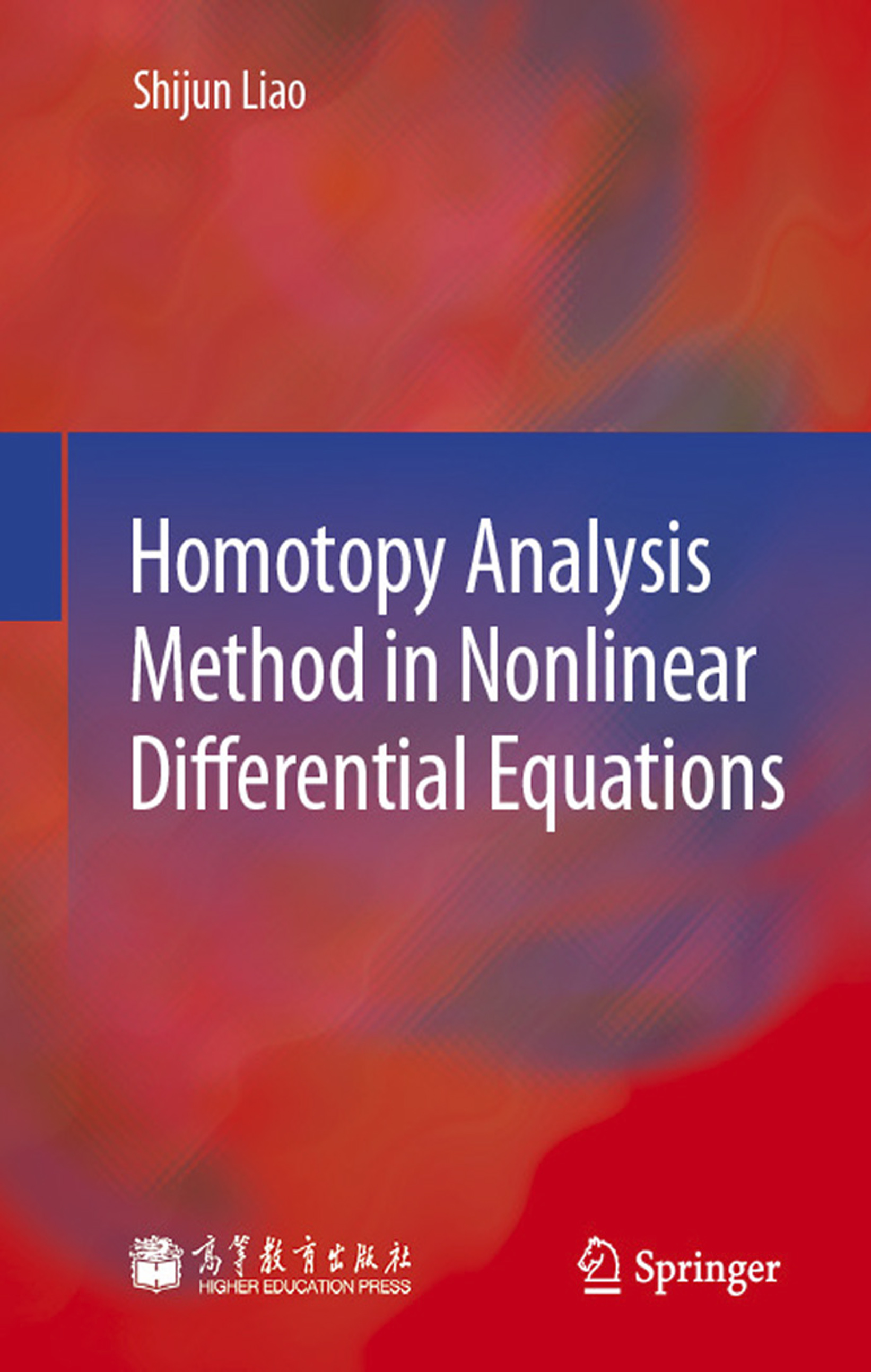




同伦分析方法与非线性微分方程(英文版)
作者: 廖世俊
出版社:高等教育出版社
- 高等教育出版社
- 9787040322989
- 1版
- 47266028-1
- 16开
- 700
- 理学
- 数学类
- 数学
- 研究生及以上
本书与Springer合作出版。
本书介绍同伦分析方法的基本思想、理论上的发展与完善以及新的应用。全书分三个部分。第一部分描述同伦分析方法的基本思想和相关理论。第二部分给出基于同伦分析方法和计算机代数软件 Mathematica 开发的软件包 BVPh 1.0 及其应用举例。该软件包可以求解具有多解、奇性、多点边界条件的多种类型的非线性边值问题。第三部分给出同伦分析方法求解非线性偏微分方程的一些典型例子,如美式期权问题、任意多个波浪的共振条件等。本书提供可免费下载的 Mathematica 程序,以方便读者更好地理解和应用该方法。
本书适合于应用数学、物理、非线性力学、金融和工程等领域对强非线性问题解析近似解感兴趣的科研人员和研究生。
This work is subject to copyright. All rights are reserved, whether the whole or part of the material is concerned, specifically the rights of translation, reprinting, reuse of illustrations, recitation, broadcasting, reproduction on microfilm or in any other way, and storage in data banks. Duplication of this publication or parts thereof is permitted only under the provisions of the German Copyright Law of September 9, 1965, in its current version, and permission for use must always be obtained from Springer. Violations are liable to prosecution under the German Copyright Law.
The use of general descriptive names, registered names, trademarks, etc. in this publication does not imply, even in the absence of a specific statement, that such names are exempt from the relevant protective laws and regulations and therefore free for general use.
FrontMatter
PartIBasicIdeasandTheorems
1Introduction
1.1Motivationandpurpose
1.2Characteristicofhomotopyanalysismethod
1.3Outline
References
2BasicIdeasoftheHomotopyAnalysisMethod
2.1Conceptofhomotopy
2.2Example2.1:generalizedNewtonianiterationformula
2.3Example2.2:nonlinearoscillation
2.3.1Analysisofthesolutioncharacteristic
2.3.2Mathematicalformulations
2.3.3Convergenceofhomotopy-seriessolution
2.3.4Essenceoftheconvergence-controlparameterc0
2.3.5Convergenceaccelerationbyhomotopy-Pad′etechnique
2.3.6Convergenceaccelerationbyoptimalinitialapproximation
2.3.7Convergenceaccelerationbyiteration
2.3.8Flexibilityonthechoiceofauxiliarylinearoperator
2.4Concludingremarksanddiscussions
Appendix2.1Derivationofdnin(2.57)
Appendix2.2Derivationof(2.55)bythe2ndapproach
Appendix2.3ProofofTheorem2.3
Appendix2.4Mathematicacode(withoutiteration)forExample2.2
Appendix2.5Mathematicacode(withiteration)forExample2.2Problems
References
3OptimalHomotopyAnalysisMethod
3.1Introduction
3.2Anillustrativedescription
3.2.1Basicideas
3.2.2Differenttypesofoptimalmethods
3.3Systematicdescription
3.4Concludingremarksanddiscussions
Appendix3.1MathematicacodeforBlasiusflow
Problems
References
4SystematicDescriptionsandRelatedTheorems
4.1Briefframeofthehomotopyanalysismethod
4.2Propertiesofhomotopy-derivative
4.3Deformationequations
4.3.1Abriefhistory
4.3.2High-orderdeformationequations
4.3.3Examples
4.4Convergencetheorems
4.5Solutionexpression
4.5.1Choiceofinitialapproximation
4.5.2Choiceofauxiliarylinearoperator
4.6Convergencecontrolandacceleration
4.6.1Optimalconvergence-controlparameter
4.6.2Optimalinitialapproximation
4.6.3Homotopy-iterationtechnique
4.6.4Homotopy-Pad′etechnique
4.7Discussionsandopenquestions
References
5RelationshiptoEulerTransform
5.1Introduction
5.2GeneralizedTaylorseries
5.3Homotopytransform
5.4RelationbetweenhomotopyanalysismethodandEulertransform
5.5Concludingremarks
References
6SomeMethodsBasedontheHAM
6.1Abriefhistoryofthehomotopyanalysismethod
6.2Homotopyperturbationmethod
6.3Optimalhomotopyasymptoticmethod
6.4Spectralhomotopyanalysismethod
6.5Generalizedboundaryelementmethod
6.6Generalizedscaledboundaryfiniteelementmethod
6.7Predictorhomotopyanalysismethod
References
PartIIMathematicaPackageBVPhandItsApplications
7MathematicaPackageBVPh
7.1Introduction
7.1.1Scope
7.1.2Briefmathematicalformulas
7.1.3Choiceofbasefunctionandinitialguess
7.1.4Choiceoftheauxiliarylinearoperator
7.1.5Choiceoftheauxiliaryfunction
7.1.6Choiceoftheconvergence-controlparameterc0
7.2Approximationanditerationofsolutions
7.2.1Polynomials
7.2.2Trigonometricfunctions
7.2.3Hybrid-basefunctions
7.3AsimpleusersguideoftheBVPh1.0
7.3.1Keymodules
7.3.2Controlparameters
7.3.3Input
7.3.4Output
7.3.5Globalvariables
Appendix7.1MathematicapackageBVPh(version1.0)
References
8NonlinearBoundary-valueProblemswithMultipleSolutions
8.1Introduction
8.2Briefmathematicalformulas
8.3Examples
8.3.1Nonlineardiffusion-reactionmodel
8.3.2Athree-pointnonlinearboundary-valueproblem
8.3.3Channelflowswithmultiplesolutions
8.4Concludingremarks
Appendix8.1InputdataofBVPhforExample8.3.1
Appendix8.2InputdataofBVPhforExample8.3.2
Appendix8.3InputdataofBVPhforExample8.3.3
Problems
References
9NonlinearEigenvalueEquationswithVaryingCoefficients
9.1Introduction
9.2Briefmathematicalformulas
9.3Examples
9.3.1Non-uniformbeamactedbyaxialload
9.3.2Gelfandequation
9.3.3Equationwithsingularityandvaryingcoefficient
9.3.4Multipointboundary-valueproblemwithmultiplesolutions
9.3.5Orr-Sommerfeldstabilityequationwithcomplexcoefficient
9.4Concludingremarks
Appendix9.1InputdataofBVPhforExample9.3.1
Appendix9.2InputdataofBVPhforExample9.3.2
Appendix9.3InputdataofBVPhforExample9.3.3
Appendix9.4InputdataofBVPhforExample9.3.4
Appendix9.5InputdataofBVPhforExample9.3.5
Problems
References
10ABoundary-layerFlowwithanInfiniteNumberofSolutions
10.1Introduction
10.2Exponentiallydecayingsolutions
10.3Algebraicallydecayingsolutions
10.4Concludingremarks
Appendix10.1InputdataofBVPhforexponentiallydecayingsolution
Appendix10.2InputdataofBVPhforalgebraicallydecayingsolution
References
11Non-similarityBoundary-layerFlows
11.1Introduction
11.2Briefmathematicalformulas
11.3Homotopy-seriessolution
11.4Concludingremarks
Appendix11.1InputdataofBVPh
References
12UnsteadyBoundary-layerFlows
12.1Introduction
12.2Perturbationapproximation
12.3Homotopy-seriessolution
12.3.1Briefmathematicalformulas
12.3.2Homotopy-approximation
12.4Concludingremarks
Appendix12.1InputdataofBVPh
References
PartIIIApplicationsinNonlinearPartialDifferentialEquations
13ApplicationsinFinance:AmericanPutOptions
13.1Mathematicalmodeling
13.2Briefmathematicalformulas
13.3Validityoftheexplicithomotopy-approximations
13.4Apracticalcodeforbusinessmen
13.5Concludingremarks
Appendix13.1Detailedderivationoffn()andgn()
Appendix13.2MathematicacodeforAmericanputoption
Appendix13.3MathematicacodeAPOhforbusinessmen
References
14TwoandThreeDimensionalGelfandEquation
14.1Introduction
14.2Homotopy-approximationsof2DGelfandequation
14.2.1Briefmathematicalformulas
14.2.2Homotopy-approximations
14.3Homotopy-approximationsof3DGelfandequation
14.4Concludingremarks
Appendix14.1Mathematicacodeof2DGelfandequation
Appendix14.2Mathematicacodeof3DGelfandequation
References
15InteractionofNonlinearWaterWaveandNonuniformCurrents
15.1Introduction
15.2Mathematicalmodeling
15.2.1Originalboundary-valueequation
15.2.2Dubreil-Jacotintransformation
15.3Briefmathematicalformulas
15.3.1Solutionexpression
15.3.2Zeroth-orderdeformationequation.
15.3.3High-orderdeformationequation
15.3.4Successivesolutionprocedure
15.4Homotopyapproximations
15.5Concludingremarks
Appendix15.1Mathematicacodeofwave-currentinteraction
References
16ResonanceofArbitraryNumberofPeriodicTravelingWaterWaves
16.1Introduction
16.2Resonancecriterionoftwosmall-amplitudeprimarywaves
16.2.1BriefMathematicalformulas
16.2.2Non-resonantwaves
16.2.3Resonantwaves
16.3Resonancecriterionofarbitrarynumberofprimarywaves
16.3.1Resonancecriterionofsmall-amplitudewaves
16.3.2Resonancecriterionoflarge-amplitudewaves
16.4Concludingremarkanddiscussions
Appendix16.1Detailedderivationofhigh-orderequation
References
Index
FrontMatter
PartIBasicIdeasandTheorems
1Introduction
1.1Motivationandpurpose
1.2Characteristicofhomotopyanalysismethod
1.3Outline
References
2BasicIdeasoftheHomotopyAnalysisMethod
2.1Conceptofhomotopy
2.2Example2.1:generalizedNewtonianiterationformula
2.3Example2.2:nonlinearoscillation
2.3.1Analysisofthesolutioncharacteristic
2.3.2Mathematicalformulations
2.3.3Convergenceofhomotopy-seriessolution
2.3.4Essenceoftheconvergence-controlparameterc0
2.3.5Convergenceaccelerationbyhomotopy-Pad′etechnique
2.3.6Convergenceaccelerationbyoptimalinitialapproximation
2.3.7Convergenceaccelerationbyiteration
2.3.8Flexibilityonthechoiceofauxiliarylinearoperator
2.4Concludingremarksanddiscussions
Appendix2.1Derivationofdnin(2.57)
Appendix2.2Derivationof(2.55)bythe2ndapproach
Appendix2.3ProofofTheorem2.3
Appendix2.4Mathematicacode(withoutiteration)forExample2.2
Appendix2.5Mathematicacode(withiteration)forExample2.2Problems
References
3OptimalHomotopyAnalysisMethod
3.1Introduction
3.2Anillustrativedescription
3.2.1Basicideas
3.2.2Differenttypesofoptimalmethods
3.3Systematicdescription
3.4Concludingremarksanddiscussions
Appendix3.1MathematicacodeforBlasiusflow
Problems
References
4SystematicDescriptionsandRelatedTheorems
4.1Briefframeofthehomotopyanalysismethod
4.2Propertiesofhomotopy-derivative
4.3Deformationequations
4.3.1Abriefhistory
4.3.2High-orderdeformationequations
4.3.3Examples
4.4Convergencetheorems
4.5Solutionexpression
4.5.1Choiceofinitialapproximation
4.5.2Choiceofauxiliarylinearoperator
4.6Convergencecontrolandacceleration
4.6.1Optimalconvergence-controlparameter
4.6.2Optimalinitialapproximation
4.6.3Homotopy-iterationtechnique
4.6.4Homotopy-Pad′etechnique
4.7Discussionsandopenquestions
References
5RelationshiptoEulerTransform
5.1Introduction
5.2GeneralizedTaylorseries
5.3Homotopytransform
5.4RelationbetweenhomotopyanalysismethodandEulertransform
5.5Concludingremarks
References
6SomeMethodsBasedontheHAM
6.1Abriefhistoryofthehomotopyanalysismethod
6.2Homotopyperturbationmethod
6.3Optimalhomotopyasymptoticmethod
6.4Spectralhomotopyanalysismethod
6.5Generalizedboundaryelementmethod
6.6Generalizedscaledboundaryfiniteelementmethod
6.7Predictorhomotopyanalysismethod
References
PartIIMathematicaPackageBVPhandItsApplications
7MathematicaPackageBVPh
7.1Introduction
7.1.1Scope
7.1.2Briefmathematicalformulas
7.1.3Choiceofbasefunctionandinitialguess
7.1.4Choiceoftheauxiliarylinearoperator
7.1.5Choiceoftheauxiliaryfunction
7.1.6Choiceoftheconvergence-controlparameterc0
7.2Approximationanditerationofsolutions
7.2.1Polynomials
7.2.2Trigonometricfunctions
7.2.3Hybrid-basefunctions
7.3AsimpleusersguideoftheBVPh1.0
7.3.1Keymodules
7.3.2Controlparameters
7.3.3Input
7.3.4Output
7.3.5Globalvariables
Appendix7.1MathematicapackageBVPh(version1.0)
References
8NonlinearBoundary-valueProblemswithMultipleSolutions
8.1Introduction
8.2Briefmathematicalformulas
8.3Examples
8.3.1Nonlineardiffusion-reactionmodel
8.3.2Athree-pointnonlinearboundary-valueproblem
8.3.3Channelflowswithmultiplesolutions
8.4Concludingremarks
Appendix8.1InputdataofBVPhforExample8.3.1
Appendix8.2InputdataofBVPhforExample8.3.2
Appendix8.3InputdataofBVPhforExample8.3.3
Problems
References
9NonlinearEigenvalueEquationswithVaryingCoefficients
9.1Introduction
9.2Briefmathematicalformulas
9.3Examples
9.3.1Non-uniformbeamactedbyaxialload
9.3.2Gelfandequation
9.3.3Equationwithsingularityandvaryingcoefficient
9.3.4Multipointboundary-valueproblemwithmultiplesolutions
9.3.5Orr-Sommerfeldstabilityequationwithcomplexcoefficient
9.4Concludingremarks
Appendix9.1InputdataofBVPhforExample9.3.1
Appendix9.2InputdataofBVPhforExample9.3.2
Appendix9.3InputdataofBVPhforExample9.3.3
Appendix9.4InputdataofBVPhforExample9.3.4
Appendix9.5InputdataofBVPhforExample9.3.5
Problems
References
10ABoundary-layerFlowwithanInfiniteNumberofSolutions
10.1Introduction
10.2Exponentiallydecayingsolutions
10.3Algebraicallydecayingsolutions
10.4Concludingremarks
Appendix10.1InputdataofBVPhforexponentiallydecayingsolution
Appendix10.2InputdataofBVPhforalgebraicallydecayingsolution
References
11Non-similarityBoundary-layerFlows
11.1Introduction
11.2Briefmathematicalformulas
11.3Homotopy-seriessolution
11.4Concludingremarks
Appendix11.1InputdataofBVPh
References
12UnsteadyBoundary-layerFlows
12.1Introduction
12.2Perturbationapproximation
12.3Homotopy-seriessolution
12.3.1Briefmathematicalformulas
12.3.2Homotopy-approximation
12.4Concludingremarks
Appendix12.1InputdataofBVPh
References
PartIIIApplicationsinNonlinearPartialDifferentialEquations
13ApplicationsinFinance:AmericanPutOptions
13.1Mathematicalmodeling
13.2Briefmathematicalformulas
13.3Validityoftheexplicithomotopy-approximations
13.4Apracticalcodeforbusinessmen
13.5Concludingremarks
Appendix13.1Detailedderivationoffn()andgn()
Appendix13.2MathematicacodeforAmericanputoption
Appendix13.3MathematicacodeAPOhforbusinessmen
References
14TwoandThreeDimensionalGelfandEquation
14.1Introduction
14.2Homotopy-approximationsof2DGelfandequation
14.2.1Briefmathematicalformulas
14.2.2Homotopy-approximations
14.3Homotopy-approximationsof3DGelfandequation
14.4Concludingremarks
Appendix14.1Mathematicacodeof2DGelfandequation
Appendix14.2Mathematicacodeof3DGelfandequation
References
15InteractionofNonlinearWaterWaveandNonuniformCurrents
15.1Introduction
15.2Mathematicalmodeling
15.2.1Originalboundary-valueequation
15.2.2Dubreil-Jacotintransformation
15.3Briefmathematicalformulas
15.3.1Solutionexpression
15.3.2Zeroth-orderdeformationequation.
15.3.3High-orderdeformationequation
15.3.4Successivesolutionprocedure
15.4Homotopyapproximations
15.5Concludingremarks
Appendix15.1Mathematicacodeofwave-currentinteraction
References
16ResonanceofArbitraryNumberofPeriodicTravelingWaterWaves
16.1Introduction
16.2Resonancecriterionoftwosmall-amplitudeprimarywaves
16.2.1BriefMathematicalformulas
16.2.2Non-resonantwaves
16.2.3Resonantwaves
16.3Resonancecriterionofarbitrarynumberofprimarywaves
16.3.1Resonancecriterionofsmall-amplitudewaves
16.3.2Resonancecriterionoflarge-amplitudewaves
16.4Concludingremarkanddiscussions
Appendix16.1Detailedderivationofhigh-orderequation
References
Index
