

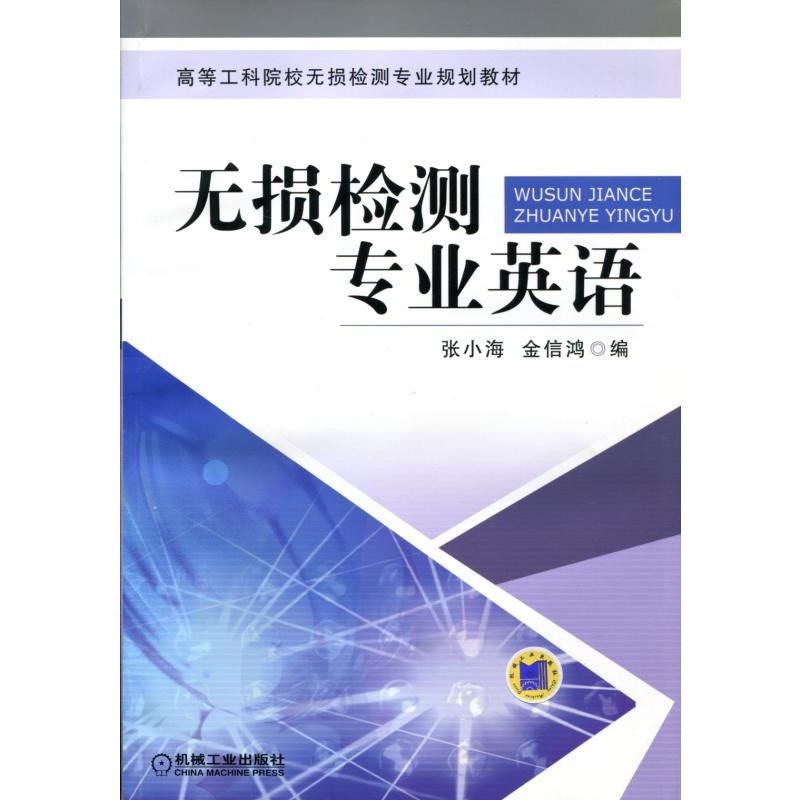



- 机械工业出版社
- 9787111347965
- 1-8
- 47268566-8
- 16开
- 2019-05-30
- 420
- 工学
- 材料类
- 无损检测
- 本科
内容简介
本书是针对高等院校无损检测专业英语课程的需要而编写的。共由八个章节构成,其中包括无损检测与质量控制、材料缺陷的形成、射线检测技术、超声检测技术、磁粉检测技术、涡流检测技术、渗透检测技术、其他非常规无损检测技术。课文选材涵盖了无损检测的主要技术、新发展及相关知识,具有专业知识及专业英语紧密结合的特点。每一章节内容按照每种技术的发展历史、、优越性及局限性、检测原理、检测方法、检测设备及器材,以及应用的逻辑关系编排,并在每章后附有无损检测相关知识、术语双解,以及常用科技英语语法介绍等。因此,本书不仅可以作为无损检测专业及相关专业(机械、材料工程、质量检验等)本科生的专业英语教材,无损检测专业专科学生也可选择性使用,同样适用于无损检测及相关专业的工程技术、管理人员使用
目录
序
丛书序言
前言
Chapter 1Quality Control and NDT
1.1NDT in Industry
1.2NDT in Everyday Life
1.3History of NDT
1.4Understand the NDT Choices
1.5Reliability of NDT
1.6International Organizations of Quality Control and NDT
Words and Phrases
Notes
Exercises
Appendix Ⅰ质量控制常用术语的中英双解
Appendix Ⅱ国外主要无损检测学术机构、组织介绍
Chapter 2Discontinuities—Origins and Classification
2.1Primary Production of Metals
2.2Casting
2.3Cracks
2.4Welding Discontinuities
2.5Discontinuities Resulting from Plastic Deformation
2.6Corrosion-Induced Discontinuities
2.7Operationally Induced Discontinuities—Fatigue Cracking
2.8Operationally Induced Discontinuities—Creep
2.9Operationally Induced Discontinuities—Brittle Fracture
2.10Geometric Discontinuities
2.11Summary
2.12Indications: False, Nonrelevant, Relevant
Words and Phrases
Notes
Exercises
Appendix Ⅰ缺陷有关术语的中英双解
Appendix Ⅱ科技英语语法特点
Chapter 3Radiographic Testing
3.1Introduction
3.1.1Historical Background
3.1.2Advantages and Disadvantages
3.2Theory and Principles
3.2.1Basic Principles
3.2.2X-Rays, Grenz-Rays, and γ-Rays
3.2.3Absorption and Scattering of X-Rays in Matter
3.2.4Recording the X-Ray Image
3.2.5X-Ray Image Quality
3.3Radiographic Technique
3.4Equipment and Accessories
3.4.1X-Ray Generators
3.4.2Image Quality Indicators, Penetrameters
3.5Applications
Words and Phrases
Notes
Exercises
Appendix Ⅰ射线检测常用术语的中英双解
Appendix Ⅱ科技英语常用词缀
Chapter 4Ultrasonic Testing
4.1Introduction
4.1.1Historical Background
4.1.2Advantages and Disadvantages
4.2Theory and Principles
4.2.1Wave Propagation
4.2.2Ultrasonic Waves
4.2.3Specific Acoustic Impedance
4.2.4Reflection and Transmission at Boundaries
4.2.5Wave Mode Conversion at Boundaries
4.2.6Beam Attenuation
4.2.7Pulse Shape and Beam Shape
4.3Ultrasonic Techniques
4.4Equipment and Accessories
4.4.1Ultrasonic Transducers
4.4.2Pulse Echo Display System
4.4.3Automated Systems
4.4.4Calibration and Reference Standards
4.5Applications
Words and Phrases
Notes
Exercises
Appendix Ⅰ超声检测常用术语的中英双解
Appendix Ⅱ无损检测常用的缩略语
Chapter 5Magnetic Particle Inspection
5.1Introduction
5.1.1Historical Background
5.1.2Advantages and Disadvantages
5.2Theory and Principles
5.2.1Basic Principles
5.2.2The Hysteresis Loop and Magnetic Properties
5.2.3Electrical Current and Electrical Powder
5.2.4Demagnetisation
5.3MPI Techniques
5.3.1Magnetization Techniques
5.3.2Magnetic Flow Techniques (Indirect)
5.3.3Current Flow Techniques (Direct)
5.3.4Coil Technique
5.3.5Central Conductor Technique
5.3.6Continuous and Residual Techniques
5.3.7Color and Fluorescence
5.3.8Summary of Technique Choices
5.4Equipment and Accessories
5.4.1Stationary Units
5.4.2Mobile and Portable Units
5.4.3Electromagnetic Yoke
5.4.4Permanent Magnets
5.4.5Black Lights
5.4.6Flux Direction Indicators
5.4.7AC Demagnetizing Coils
5.4.8Magnetic Ink
5.5Applications
Words and Phrases
Notes
Exercises
Appendix Ⅰ磁粉检测常用术语的中英双解
Appendix Ⅱ无损检测技术常用的物理量纲及英语表达
Chapter 6Eddy Current Testing
6.1Introduction
6.1.1Historical Background
6.1.2Advantages and Disadvantages
6.2Theory and Principles
6.2.1Basic Principles
6.2.2Magnetic Induction (Self and Mutual)
6.2.3Coil Impedance
6.2.4Eddy Current Density and Skin Depth
6.3Eddy Current Testing Techniques
6.3.1Impedance Analysis Method
6.3.2Other EC Methods
6.4Equipment and Accessories
6.4.1EC Transducers (Probes)
6.4.2Eddy Current Instruments
6.5Applications
Words and Phrases
Notes
Exercises
Appendix Ⅰ涡流检测常用术语的中英双解
Appendix Ⅱ常用数学符号及表达式
Chapter 7Penetrant Testing
7.1Introduction
7.1.1Historical Background
7.1.2Advantages and Disadvantages
7.2Theory and Principles
7.2.1Fluid Flow
7.2.2Surface Tension
7.2.3Contact Angle and Surface Wetting
7.2.4Capillarity
7.3Penetrant Techniques
7.3.1Basic Method
7.3.2Cleaning
7.3.3Applying Penetrant to Specimen Surface
7.3.4Temperature
7.3.5Dwell Time
7.3.6Removing Excess Penetrant
7.3.7Applying Developers
7.3.8Examination and Interpretation
7.3.9Illumination
7.3.10Final Cleaning
7.4Penetrant Materials and Equipment
7.4.1Penetrant Materials
7.4.2Penetrant Equipment
7.5Applications of Penetrant Testing
7.5.1Fabrication Industries
7.5.2Aerospace Industries
7.5.3Automotive and Marine Manufacture and Maintenance
7.5.4Electrical Power Industry
Words and Phrases
Notes
Exercises
Appendix Ⅰ渗透检测常用术语的中英双解
Appendix Ⅱ英语论文摘要写作
Chapter 8Introduction to Other NDT Methods
8.1Acoustic Emission
8.1.1Theory and Principles
8.1.2Applications
8.2Time-of-Flight Diffraction (TOFD)
8.2.1Theory and Principles
8.2.2Applications
8.2.3Advantages and Disadvantages
8.3Thermal Nondestructive Testing
8.3.1Theory and Principles
8.3.2Applications
8.3.3Advantages and Disadvantages
8.4Laser Testing Method
8.4.1Holographic Interferometry
8.4.2Advantages and Disadvantages
8.5Microwave NDT
8.5.1Theory and Principles
8.5.2Applications
8.6Leak Testing
8.6.1Theory and Principles
8.6.2Applications
8.7Neutron Radiographic Testing
8.7.1Theory and Principles
8.7.2Applications
8.8Industrial Computed Tomography
8.8.1Industrial CT History
8.8.2Theory and Principles
8.8.3Applications
8.8.4Advantages and Disadvantages
8.9Vibration Analysis Method
8.10Visual and Optical Inspection
8.10.1Theory and Principles
8.10.2Applications
8.10.3Advantages and Disadvantages
Words and Phrases
Notes
Exercises
Appendix Ⅰ国外有关无损检测技术主要学术期刊
Appendix Ⅱ国外无损检测技术主要标准中英对照
Appendix Ⅲ国外开展无损检测技术研究的部分高等院校
Appendix Ⅳ无损检测英文检测报告示例
References
丛书序言
前言
Chapter 1Quality Control and NDT
1.1NDT in Industry
1.2NDT in Everyday Life
1.3History of NDT
1.4Understand the NDT Choices
1.5Reliability of NDT
1.6International Organizations of Quality Control and NDT
Words and Phrases
Notes
Exercises
Appendix Ⅰ质量控制常用术语的中英双解
Appendix Ⅱ国外主要无损检测学术机构、组织介绍
Chapter 2Discontinuities—Origins and Classification
2.1Primary Production of Metals
2.2Casting
2.3Cracks
2.4Welding Discontinuities
2.5Discontinuities Resulting from Plastic Deformation
2.6Corrosion-Induced Discontinuities
2.7Operationally Induced Discontinuities—Fatigue Cracking
2.8Operationally Induced Discontinuities—Creep
2.9Operationally Induced Discontinuities—Brittle Fracture
2.10Geometric Discontinuities
2.11Summary
2.12Indications: False, Nonrelevant, Relevant
Words and Phrases
Notes
Exercises
Appendix Ⅰ缺陷有关术语的中英双解
Appendix Ⅱ科技英语语法特点
Chapter 3Radiographic Testing
3.1Introduction
3.1.1Historical Background
3.1.2Advantages and Disadvantages
3.2Theory and Principles
3.2.1Basic Principles
3.2.2X-Rays, Grenz-Rays, and γ-Rays
3.2.3Absorption and Scattering of X-Rays in Matter
3.2.4Recording the X-Ray Image
3.2.5X-Ray Image Quality
3.3Radiographic Technique
3.4Equipment and Accessories
3.4.1X-Ray Generators
3.4.2Image Quality Indicators, Penetrameters
3.5Applications
Words and Phrases
Notes
Exercises
Appendix Ⅰ射线检测常用术语的中英双解
Appendix Ⅱ科技英语常用词缀
Chapter 4Ultrasonic Testing
4.1Introduction
4.1.1Historical Background
4.1.2Advantages and Disadvantages
4.2Theory and Principles
4.2.1Wave Propagation
4.2.2Ultrasonic Waves
4.2.3Specific Acoustic Impedance
4.2.4Reflection and Transmission at Boundaries
4.2.5Wave Mode Conversion at Boundaries
4.2.6Beam Attenuation
4.2.7Pulse Shape and Beam Shape
4.3Ultrasonic Techniques
4.4Equipment and Accessories
4.4.1Ultrasonic Transducers
4.4.2Pulse Echo Display System
4.4.3Automated Systems
4.4.4Calibration and Reference Standards
4.5Applications
Words and Phrases
Notes
Exercises
Appendix Ⅰ超声检测常用术语的中英双解
Appendix Ⅱ无损检测常用的缩略语
Chapter 5Magnetic Particle Inspection
5.1Introduction
5.1.1Historical Background
5.1.2Advantages and Disadvantages
5.2Theory and Principles
5.2.1Basic Principles
5.2.2The Hysteresis Loop and Magnetic Properties
5.2.3Electrical Current and Electrical Powder
5.2.4Demagnetisation
5.3MPI Techniques
5.3.1Magnetization Techniques
5.3.2Magnetic Flow Techniques (Indirect)
5.3.3Current Flow Techniques (Direct)
5.3.4Coil Technique
5.3.5Central Conductor Technique
5.3.6Continuous and Residual Techniques
5.3.7Color and Fluorescence
5.3.8Summary of Technique Choices
5.4Equipment and Accessories
5.4.1Stationary Units
5.4.2Mobile and Portable Units
5.4.3Electromagnetic Yoke
5.4.4Permanent Magnets
5.4.5Black Lights
5.4.6Flux Direction Indicators
5.4.7AC Demagnetizing Coils
5.4.8Magnetic Ink
5.5Applications
Words and Phrases
Notes
Exercises
Appendix Ⅰ磁粉检测常用术语的中英双解
Appendix Ⅱ无损检测技术常用的物理量纲及英语表达
Chapter 6Eddy Current Testing
6.1Introduction
6.1.1Historical Background
6.1.2Advantages and Disadvantages
6.2Theory and Principles
6.2.1Basic Principles
6.2.2Magnetic Induction (Self and Mutual)
6.2.3Coil Impedance
6.2.4Eddy Current Density and Skin Depth
6.3Eddy Current Testing Techniques
6.3.1Impedance Analysis Method
6.3.2Other EC Methods
6.4Equipment and Accessories
6.4.1EC Transducers (Probes)
6.4.2Eddy Current Instruments
6.5Applications
Words and Phrases
Notes
Exercises
Appendix Ⅰ涡流检测常用术语的中英双解
Appendix Ⅱ常用数学符号及表达式
Chapter 7Penetrant Testing
7.1Introduction
7.1.1Historical Background
7.1.2Advantages and Disadvantages
7.2Theory and Principles
7.2.1Fluid Flow
7.2.2Surface Tension
7.2.3Contact Angle and Surface Wetting
7.2.4Capillarity
7.3Penetrant Techniques
7.3.1Basic Method
7.3.2Cleaning
7.3.3Applying Penetrant to Specimen Surface
7.3.4Temperature
7.3.5Dwell Time
7.3.6Removing Excess Penetrant
7.3.7Applying Developers
7.3.8Examination and Interpretation
7.3.9Illumination
7.3.10Final Cleaning
7.4Penetrant Materials and Equipment
7.4.1Penetrant Materials
7.4.2Penetrant Equipment
7.5Applications of Penetrant Testing
7.5.1Fabrication Industries
7.5.2Aerospace Industries
7.5.3Automotive and Marine Manufacture and Maintenance
7.5.4Electrical Power Industry
Words and Phrases
Notes
Exercises
Appendix Ⅰ渗透检测常用术语的中英双解
Appendix Ⅱ英语论文摘要写作
Chapter 8Introduction to Other NDT Methods
8.1Acoustic Emission
8.1.1Theory and Principles
8.1.2Applications
8.2Time-of-Flight Diffraction (TOFD)
8.2.1Theory and Principles
8.2.2Applications
8.2.3Advantages and Disadvantages
8.3Thermal Nondestructive Testing
8.3.1Theory and Principles
8.3.2Applications
8.3.3Advantages and Disadvantages
8.4Laser Testing Method
8.4.1Holographic Interferometry
8.4.2Advantages and Disadvantages
8.5Microwave NDT
8.5.1Theory and Principles
8.5.2Applications
8.6Leak Testing
8.6.1Theory and Principles
8.6.2Applications
8.7Neutron Radiographic Testing
8.7.1Theory and Principles
8.7.2Applications
8.8Industrial Computed Tomography
8.8.1Industrial CT History
8.8.2Theory and Principles
8.8.3Applications
8.8.4Advantages and Disadvantages
8.9Vibration Analysis Method
8.10Visual and Optical Inspection
8.10.1Theory and Principles
8.10.2Applications
8.10.3Advantages and Disadvantages
Words and Phrases
Notes
Exercises
Appendix Ⅰ国外有关无损检测技术主要学术期刊
Appendix Ⅱ国外无损检测技术主要标准中英对照
Appendix Ⅲ国外开展无损检测技术研究的部分高等院校
Appendix Ⅳ无损检测英文检测报告示例
References
