

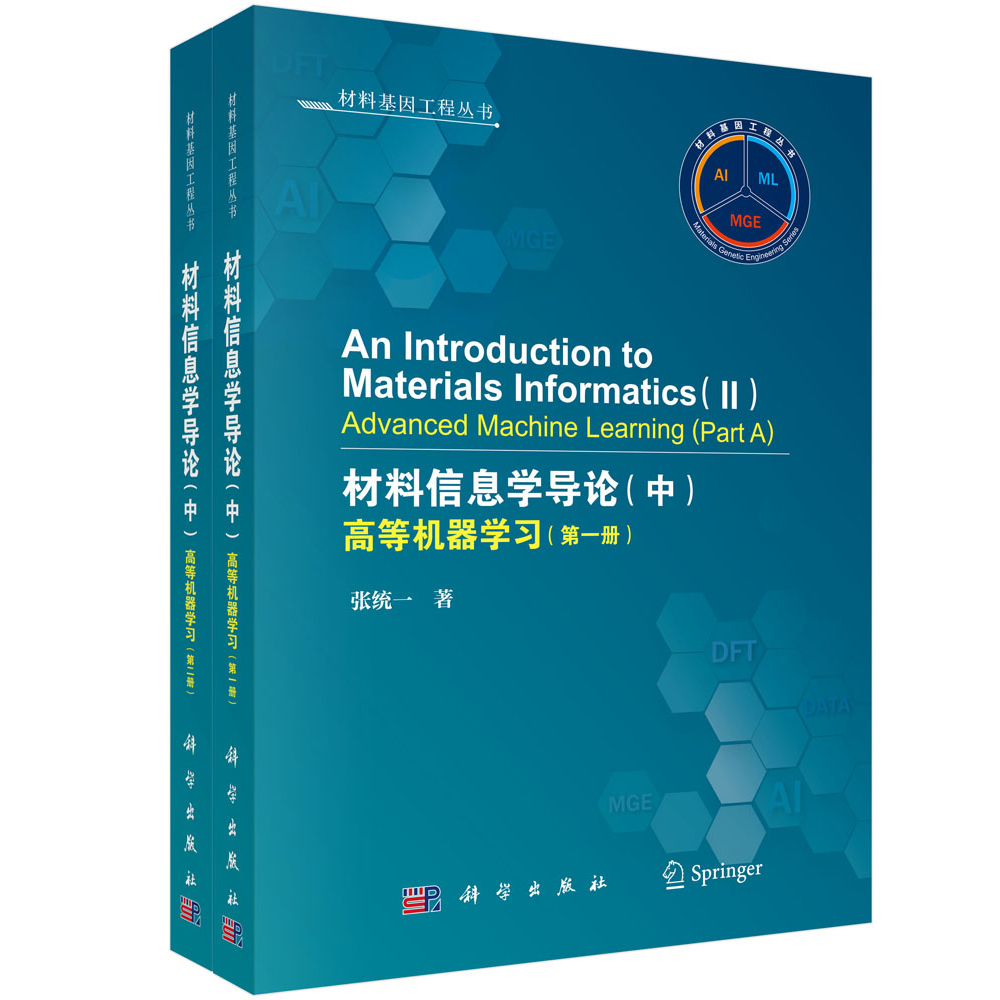






An Introduction to Materials Informatics(II) - Advanced Machine Learning(材料信息学导论 中:高等机器学习) / 材料基因工程丛书
定价:¥358.00
作者: 张统一
出版时间:2026-06
出版社:科学出版社
以下为《An Introduction to Materials Informatics(II) - Advanced Machine Learning(材料信息学导论 中:高等机器学习)》的配套数字资源,这些资源在您购买图书后将免费附送给您:
- 科学出版社
- 9787030863430
- 1版
- B5
- 2026-06
作者简介
内容简介
本书稿是材料信息学系列简介的第二本书。系列第一本书名为《材料信息学导论(I):机器学习基础》,专讲经典机器学习或者统计学习。如在第一本书第1章中所述,自适应和迭代式的主动学习是数据驱动材料逆向设计的好方法。当考虑实验不确定性和AI模型不确定性时,全局贝叶斯优化和基于群体的优化在材料信息学和主动学习中被广泛地用于平衡探索和利用。本书第1章和第2章分别描述了经典的全局贝叶斯优化和群体优化算法,并讲解了帕累托前沿。第3章迁移学习和多任务学习通过整合多个源域的数据能够提高AI模型的鲁棒性。迁移学习和多任务学习中即使用了许多经典机器学习算法,也使用了大量深度学习算法。本书的第4-9章都是关于深度学习的,包括第4章的卷积神经网络(CNNs)、第5章的递归神经网络(RNNs)和长短期记忆网络(LSTMs)、第6章的图神经网络(GNN)、第7章的生成对抗网络(GANs)、第8章的扩散模型、第9章的Transformers以及第10章的物理信息神经网络(PINN)。除了监督学习和无监督学习,强化学习(RL)被视为第三种机器学习范式,因此第11章介绍了强化学习和深度强化学习。
目录
Contents
Part A Optimization and Learning Strategies
1 Bayesian Global Optimization 3
1.1 Gaussian Process Regression (GPR), Ordinary Kriging (OK), and Jones Approach 6
1.2 Acquisition Functions 31
1.2.1 Expected Improvement (EI) 31
1.2.2 Expected Improvement with Plugin (EI Plugin) 44
1.2.3 The Reinterpolation Procedure 47
1.2.4 Augmented Expected Improvement (AEI) 51
1.2.5 Upper Confidence Bound (UCB) and Minimum Quantile (MQ) 59
1.2.6 Probability of Improvement (PI or PoI) 66
1.2.7 Expected Quantile Improvement (EQI) 73
1.2.8 Knowledge Gradient (KG) 83
1.2.9 Entropy Search (ES) 94
1.2.10 Utility Functions and Acquisition Functions for Classification 99
1.3 Multiobjective Optimization 108
1.3.1 Classical Methods for Multiobjective Optimization 110
1.3.2 Nondominated Feature Points (Solutions) and Pareto Front (Srinivas and Deb 1791–1994) 114
1.3.3 Hypervolume Improvement 128
References 150
2 Swarm-Based Optimization Algorithms 155
2.1 Particle Swarm Optimization (PSO) 155
2.2 Whale Optimization Algorithm (WOA) 165
2.2.1 Shrinking Encircling Method 167
2.2.2 Bubble-Net Method 168
2.2.3 Exploration in WOA: Search for the Prey 169
2.3 Ant Colony Optimization (ACO) 177
References 184
3 Transfer Learning 187
3.1 Basic Concepts 188
3.1.1 Definitions 188
3.1.2 Categorization of Transfer Learning 189
3.2 AdaBoost Transfer Learning 190
3.2.1 AdaBoost Transfer Classification 190
3.2.2 AdaBoost Transfer Regression 208
3.3 Instance-Transfer Learning 235
3.3.1 Kernel Mean Matching (KMM) Method in Linear Regression 238
3.3.2 KMM in Support Vector Machine 239
3.4 Mapping Transfer Learning and Neural Network-Based Transfer Learning 245
3.4.1 Deep Adaptation Network (DAN) 252
3.4.2 Domain-Adversarial Neural Network (DANN) 271
3.4.3 Wasserstein Distance-Based Deep Transfer Learning (WD-DTL) 278
3.5 Feature Augmentation 289
References 296
4 Reinforcement Learning 299
4.1 The K-armed Bandit Algorithm 300
4.1.1 The Softmax Method 302
4.1.2 The Normal Distribution Awards 310
4.1.3 The Upper Bound Method 311
4.1.4 The Incremental Method with a Constant Step-Size 315
4.2 The Gradient Bandit Algorithm 317
4.3 Markov Decision Process (MDP) 320
4.4 Dynamic Programming 348
4.4.1 Policy Iteration—Policy Evaluation 349
4.4.2 Policy Iteration—Policy Improvement 351
4.4.3 Value Iteration 354
4.4.4 Variants of Dynamic Programming 358
4.5 Monte Carlo Methods 365
4.5.1 Monte Carlo Policy Evaluation 365
4.5.2 Monte Carlo Policy Estimation 370
4.5.3 Monte Carlo Policy Improvement 373
4.5.4 On-Policy Monte Carlo Control 376
4.5.5 Off-Policy Monte Carlo Estimation 379
4.5.6 Off-Policy Monte Carlo Control 388
4.6 Temporal-Difference (TD) Learning 393
4.6.1 TD Prediction 393
4.6.2 Q-Learning and Expected Sarsa 397
4.6.3 Double Q-Learning 401
4.6.4 Neural Fitted Q Iteration (NFQ) 403
4.7 Deep Reinforcement Learning 410
4.7.1 Deep Q-Networks (DQNs) 410
4.7.2 Policy Gradient Algorithms 424
4.7.3 Deep Deterministic Policy Gradient (DDPG) Algorithm 432
References 440
Part B Advanced Neural Networks
5 Convolutional Neural Networks 445
5.1 Convolution and Cross-Correlation of Two Functions 445
5.2 The Architecture of CNNs 447
5.3 How CNN Works 451
5.4 Finite Element Analysis Network (FEA-Net) 473
References 486
6 Recurrent, Long Short-Term Memory, and Gated Recurrent Unit Neural Networks 489
6.1 Recurrent Neural Network (RNN) 489
6.1.1 Backpropagation Through Time (BPTT) 494
6.1.2 Gradient Vanishing and Exploding in RNNs 505
6.2 Long Short-Term Memory (LSTM) 507
6.2.1 BPTT in LSTM 513
6.3 Gated Recurrent Unit (GRU) 518
6.4 Applications of LSTMs in Materials Informatics 524
References 534
7 Graph Neural Networks (GNNs) 535
7.1 Graph Representation 536
7.1.1 Definitions of Graph 538
7.2 Recurrent GNNs (RecGNNs) 542
7.2.1 Convergence-Based Recurrent GNNs 542
7.2.2 Gate-Based Recurrent GNNs 550
7.3 Convolutional Graph Neural Networks 594
7.3.1 Spectral-Based ConvGNNs 594
7.3.2 ChebNet 611
7.3.3 Graph Convolutional Network (GCN) 615
7.3.4 Spatial-Based ConvGNNs 618
7.3.5 Diffusion Convolutional Neural Networks (DCNN) 621
7.3.6 Deep Graph Convolutional Neural Network (DGCNN) 627
7.3.7 Parametric Graph Convolution (PGC)-DGCNN 631
7.3.8 Message Passing Neural Networks (MPNNs) 636
7.3.9 Graph Isomorphism Network (GIN) 640
7.3.10 GraphSAGE (Sample and Aggregation) 642
7.3.11 Crystal Graph Convolutional Neural Networks (CGCNN) 647
7.4 Variational Graph Auto-Encoders (VGAE) 654
7.5 Attention-Based GNNs 658
7.5.1 Graph Attention Networks (GATs) 658
7.5.2 Crystal Edge Graph Attention Neural Network (CEGANN) 662
7.5.3 Matformer 671
7.6 Temporal Graph Convolutional Network (T-GCN) 683
7.7 Fingerprints of Molecules in CEGANN 686
References 691
8 Generative Adversarial Networks (GANs) 695
8.1 Vanilla GAN 696
8.1.1 Working Flow 702
8.1.2 Training Process 704
8.2 Conditional GAN (CGAN) 707
8.2.1 Working Flow 715
8.2.2 Training Process 719
8.3 Classified Conditional GAN (CCGAN) 725
8.4 Wasserstein GAN (WGAN) 727
8.4.1 Working Flow 733
8.4.2 Training Process 734
8.5 Deep Convolutional GAN (DCGAN) 736
8.6 Cycle GAN (CycleGAN) 740
8.7 Conditional Tabular GAN (CTGAN) 746
8.8 MatGAN 762
8.9 Physics Guided Crystal Generative Model (PGCGM) 766
8.9.1 Crystal Representation 767
8.9.2 Architecture of PGCGM 771
8.9.3 Physical Constraint Loss Function 771
References 773
9 Diffusion Networks 775
9.1 Denoising Diffusion Probabilistic Models (DDPM) 776
9.1.1 Training Process 786
9.2 The Inverse Process of DDPM 787
9.3 Noise Conditional Score-Based Model (NCSN) 789
9.3.1 Working Flow 791
9.3.2 Training Process 792
9.4 Crystal Diffusion Variational Autoencoder (CDVAE) 793
9.4.1 Crystal Representation 794
9.4.2 Periodic Graph Neural Networks (PGNNs) 797
9.4.3 Forward Process in Training Networks 799
9.4.4 Material Generation with Langevin Dynamics 801
References 808
10 Attention Mechanism and Transformers 811
10.1 Attention 812
10.1.1 Attention Pooling 812
10.1.2 Scaled Dot-Product Attention 814
10.1.3 Multi-head Attention 814
10.1.4 Self-attention 816
10.2 Transformer 816
10.2.1 Positional Encoding 817
10.2.2 Encoder 818
10.2.3 Decoder 819
10.3 MolGPT 830
10.4 Vision Transformer (ViT) 836
10.5 Informer 842
10.6 Patch Time-Series Transformer (PatchTST) 855
10.7 Long-Term Time-Series Forecasting-Linear (LTSF-Linear) 861
10.7.1 NLinear 862
10.7.2 DLinear 864
References 867
11 Physics-Informed Neural Networks 869
11.1 Physics-Informed Neural Networks (PINNs) 869
11.2 The Methods to Calculate Derivatives of a Function 873
11.2.1 Finite Difference Method 873
11.2.2 Dual Numbers 874
11.2.3 Hyper-Dual Numbers 876
11.2.4 The Dual Number Finite Difference Method 877
11.2.5 The AutoGrad Method 878
References 887
Appendix A: Atomic Covalent Bonds 889
Appendix B: Simplified Molecular Input Line Entry System (SMILES) 895
Appendix C: Extended Connectivity FingerPrints (ECFP) 897
Index 903
Part A Optimization and Learning Strategies
1 Bayesian Global Optimization 3
1.1 Gaussian Process Regression (GPR), Ordinary Kriging (OK), and Jones Approach 6
1.2 Acquisition Functions 31
1.2.1 Expected Improvement (EI) 31
1.2.2 Expected Improvement with Plugin (EI Plugin) 44
1.2.3 The Reinterpolation Procedure 47
1.2.4 Augmented Expected Improvement (AEI) 51
1.2.5 Upper Confidence Bound (UCB) and Minimum Quantile (MQ) 59
1.2.6 Probability of Improvement (PI or PoI) 66
1.2.7 Expected Quantile Improvement (EQI) 73
1.2.8 Knowledge Gradient (KG) 83
1.2.9 Entropy Search (ES) 94
1.2.10 Utility Functions and Acquisition Functions for Classification 99
1.3 Multiobjective Optimization 108
1.3.1 Classical Methods for Multiobjective Optimization 110
1.3.2 Nondominated Feature Points (Solutions) and Pareto Front (Srinivas and Deb 1791–1994) 114
1.3.3 Hypervolume Improvement 128
References 150
2 Swarm-Based Optimization Algorithms 155
2.1 Particle Swarm Optimization (PSO) 155
2.2 Whale Optimization Algorithm (WOA) 165
2.2.1 Shrinking Encircling Method 167
2.2.2 Bubble-Net Method 168
2.2.3 Exploration in WOA: Search for the Prey 169
2.3 Ant Colony Optimization (ACO) 177
References 184
3 Transfer Learning 187
3.1 Basic Concepts 188
3.1.1 Definitions 188
3.1.2 Categorization of Transfer Learning 189
3.2 AdaBoost Transfer Learning 190
3.2.1 AdaBoost Transfer Classification 190
3.2.2 AdaBoost Transfer Regression 208
3.3 Instance-Transfer Learning 235
3.3.1 Kernel Mean Matching (KMM) Method in Linear Regression 238
3.3.2 KMM in Support Vector Machine 239
3.4 Mapping Transfer Learning and Neural Network-Based Transfer Learning 245
3.4.1 Deep Adaptation Network (DAN) 252
3.4.2 Domain-Adversarial Neural Network (DANN) 271
3.4.3 Wasserstein Distance-Based Deep Transfer Learning (WD-DTL) 278
3.5 Feature Augmentation 289
References 296
4 Reinforcement Learning 299
4.1 The K-armed Bandit Algorithm 300
4.1.1 The Softmax Method 302
4.1.2 The Normal Distribution Awards 310
4.1.3 The Upper Bound Method 311
4.1.4 The Incremental Method with a Constant Step-Size 315
4.2 The Gradient Bandit Algorithm 317
4.3 Markov Decision Process (MDP) 320
4.4 Dynamic Programming 348
4.4.1 Policy Iteration—Policy Evaluation 349
4.4.2 Policy Iteration—Policy Improvement 351
4.4.3 Value Iteration 354
4.4.4 Variants of Dynamic Programming 358
4.5 Monte Carlo Methods 365
4.5.1 Monte Carlo Policy Evaluation 365
4.5.2 Monte Carlo Policy Estimation 370
4.5.3 Monte Carlo Policy Improvement 373
4.5.4 On-Policy Monte Carlo Control 376
4.5.5 Off-Policy Monte Carlo Estimation 379
4.5.6 Off-Policy Monte Carlo Control 388
4.6 Temporal-Difference (TD) Learning 393
4.6.1 TD Prediction 393
4.6.2 Q-Learning and Expected Sarsa 397
4.6.3 Double Q-Learning 401
4.6.4 Neural Fitted Q Iteration (NFQ) 403
4.7 Deep Reinforcement Learning 410
4.7.1 Deep Q-Networks (DQNs) 410
4.7.2 Policy Gradient Algorithms 424
4.7.3 Deep Deterministic Policy Gradient (DDPG) Algorithm 432
References 440
Part B Advanced Neural Networks
5 Convolutional Neural Networks 445
5.1 Convolution and Cross-Correlation of Two Functions 445
5.2 The Architecture of CNNs 447
5.3 How CNN Works 451
5.4 Finite Element Analysis Network (FEA-Net) 473
References 486
6 Recurrent, Long Short-Term Memory, and Gated Recurrent Unit Neural Networks 489
6.1 Recurrent Neural Network (RNN) 489
6.1.1 Backpropagation Through Time (BPTT) 494
6.1.2 Gradient Vanishing and Exploding in RNNs 505
6.2 Long Short-Term Memory (LSTM) 507
6.2.1 BPTT in LSTM 513
6.3 Gated Recurrent Unit (GRU) 518
6.4 Applications of LSTMs in Materials Informatics 524
References 534
7 Graph Neural Networks (GNNs) 535
7.1 Graph Representation 536
7.1.1 Definitions of Graph 538
7.2 Recurrent GNNs (RecGNNs) 542
7.2.1 Convergence-Based Recurrent GNNs 542
7.2.2 Gate-Based Recurrent GNNs 550
7.3 Convolutional Graph Neural Networks 594
7.3.1 Spectral-Based ConvGNNs 594
7.3.2 ChebNet 611
7.3.3 Graph Convolutional Network (GCN) 615
7.3.4 Spatial-Based ConvGNNs 618
7.3.5 Diffusion Convolutional Neural Networks (DCNN) 621
7.3.6 Deep Graph Convolutional Neural Network (DGCNN) 627
7.3.7 Parametric Graph Convolution (PGC)-DGCNN 631
7.3.8 Message Passing Neural Networks (MPNNs) 636
7.3.9 Graph Isomorphism Network (GIN) 640
7.3.10 GraphSAGE (Sample and Aggregation) 642
7.3.11 Crystal Graph Convolutional Neural Networks (CGCNN) 647
7.4 Variational Graph Auto-Encoders (VGAE) 654
7.5 Attention-Based GNNs 658
7.5.1 Graph Attention Networks (GATs) 658
7.5.2 Crystal Edge Graph Attention Neural Network (CEGANN) 662
7.5.3 Matformer 671
7.6 Temporal Graph Convolutional Network (T-GCN) 683
7.7 Fingerprints of Molecules in CEGANN 686
References 691
8 Generative Adversarial Networks (GANs) 695
8.1 Vanilla GAN 696
8.1.1 Working Flow 702
8.1.2 Training Process 704
8.2 Conditional GAN (CGAN) 707
8.2.1 Working Flow 715
8.2.2 Training Process 719
8.3 Classified Conditional GAN (CCGAN) 725
8.4 Wasserstein GAN (WGAN) 727
8.4.1 Working Flow 733
8.4.2 Training Process 734
8.5 Deep Convolutional GAN (DCGAN) 736
8.6 Cycle GAN (CycleGAN) 740
8.7 Conditional Tabular GAN (CTGAN) 746
8.8 MatGAN 762
8.9 Physics Guided Crystal Generative Model (PGCGM) 766
8.9.1 Crystal Representation 767
8.9.2 Architecture of PGCGM 771
8.9.3 Physical Constraint Loss Function 771
References 773
9 Diffusion Networks 775
9.1 Denoising Diffusion Probabilistic Models (DDPM) 776
9.1.1 Training Process 786
9.2 The Inverse Process of DDPM 787
9.3 Noise Conditional Score-Based Model (NCSN) 789
9.3.1 Working Flow 791
9.3.2 Training Process 792
9.4 Crystal Diffusion Variational Autoencoder (CDVAE) 793
9.4.1 Crystal Representation 794
9.4.2 Periodic Graph Neural Networks (PGNNs) 797
9.4.3 Forward Process in Training Networks 799
9.4.4 Material Generation with Langevin Dynamics 801
References 808
10 Attention Mechanism and Transformers 811
10.1 Attention 812
10.1.1 Attention Pooling 812
10.1.2 Scaled Dot-Product Attention 814
10.1.3 Multi-head Attention 814
10.1.4 Self-attention 816
10.2 Transformer 816
10.2.1 Positional Encoding 817
10.2.2 Encoder 818
10.2.3 Decoder 819
10.3 MolGPT 830
10.4 Vision Transformer (ViT) 836
10.5 Informer 842
10.6 Patch Time-Series Transformer (PatchTST) 855
10.7 Long-Term Time-Series Forecasting-Linear (LTSF-Linear) 861
10.7.1 NLinear 862
10.7.2 DLinear 864
References 867
11 Physics-Informed Neural Networks 869
11.1 Physics-Informed Neural Networks (PINNs) 869
11.2 The Methods to Calculate Derivatives of a Function 873
11.2.1 Finite Difference Method 873
11.2.2 Dual Numbers 874
11.2.3 Hyper-Dual Numbers 876
11.2.4 The Dual Number Finite Difference Method 877
11.2.5 The AutoGrad Method 878
References 887
Appendix A: Atomic Covalent Bonds 889
Appendix B: Simplified Molecular Input Line Entry System (SMILES) 895
Appendix C: Extended Connectivity FingerPrints (ECFP) 897
Index 903
