

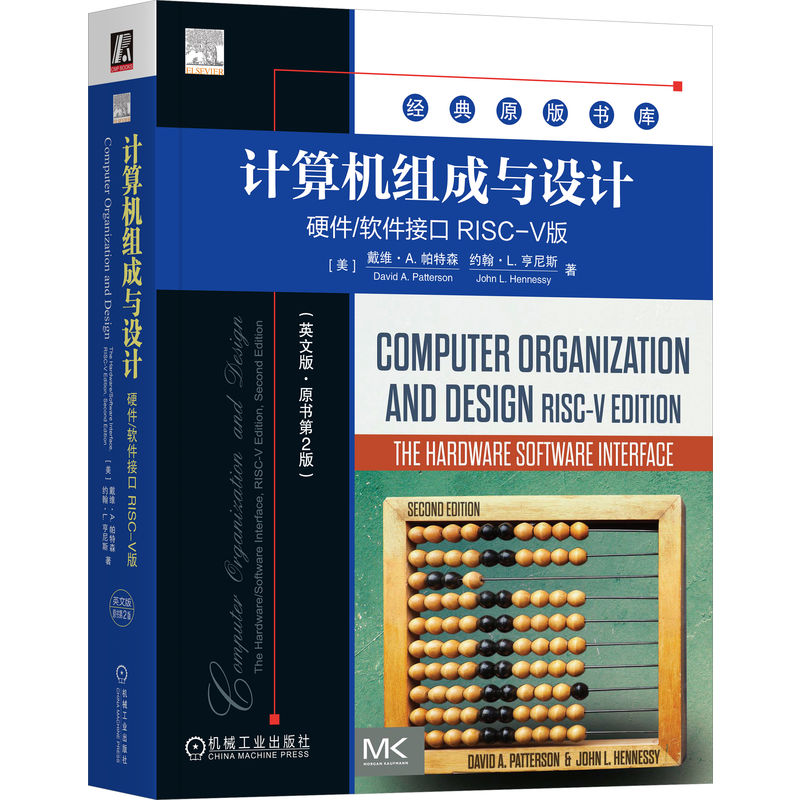





计算机组成与设计:硬件/软件接口 RISC-V版(英文版·原书第2版) / 经典原版书库
定价:¥199.00
作者: [美]戴维·A.帕特森,约翰·L.亨尼斯
出版时间:2024-02-02
出版社:机械工业出版社
- 机械工业出版社
- 9787111742661
- 1-1
- 2024-02-02
- 1473
内容简介
本书由2017年图灵奖得主Patterson和Hennessy共同撰写,是计算机体系结构领域的经典书籍,强调软硬件协同设计及其对性能的影响。本书采用开源的RISC-V指令系统体系结构,讲解硬件技术、指令、算术运算、流水线、存储层次、I/O以及并行处理器等。第2版将RV64切换为RV32以降低学习难度,新增关于领域定制体系结构(DSA)的讨论以反映新的技术趋势。此外,每一章都增加了“性能提升”和“自学”章节,并更新了大量练习题。本书适合计算机体系结构领域的专业技术人员参考,也适合高等院校计算机相关专业的学生阅读。
目录
Contents
CHAPTERS
Computer Abstractions and Technology 2
1.1 Introduction 3
1.2 Seven Great Ideas in Computer Architecture 10
1.3 Below Your Program 13
1.4 Under the Covers 16
1.5 Technologies for Building Processors and Memory 25
1.6 Performance 29
1.7 The Power Wall 40
1.8 The Sea Change: The Switch from Uniprocessors to Multiprocessors 43
1.9 Real Stuff: Benchmarking the Intel Core i7 46
1.10 Going Faster: Matrix Multiply in Python 49
1.11 Fallacies and Pitfalls 50
1.12 Concluding Remarks 53
1.13 Historical Perspective and Further Reading 55
1.14 Self-Study 55
1.15 Exercises 59
Instructions: Language of the Computer 66
2.1 Introduction 68
2.2 Operations of the Computer Hardware 69
2.3 Operands of the Computer Hardware 73
2.4 Signed and Unsigned Numbers 80
2.5 Representing Instructions in the Computer 87
2.6 Logical Operations 95
2.7 Instructions for Making Decisions 98
2.8 Supporting Procedures in Computer Hardware 104
2.9 Communicating with People 114
2.10 RISC-V Addressing for Wide Immediates and Addresses 120
2.11 Parallelism and Instructions: Synchronization 128
2.12 Translating and Starting a Program 131
2.13 A C Sort Example to Put it All Together 140
2.14 Arrays versus Pointers 148
2.15 Advanced Material: Compiling C and Interpreting Java 151
2.16 Real Stuff: MIPS Instructions 152
2.17 Real Stuff: ARMv7 (32-bit) Instructions 153
2.18 Real Stuff: ARMv8 (64-bit) Instructions 157
2.19 Real Stuff: x86 Instructions 158
2.20 Real Stuff: The Rest of the RISC-V Instruction Set 167
2.21 Going Faster: Matrix Multiply in C 168
2.22 Fallacies and Pitfalls 170
2.23 Concluding Remarks 172
2.24 Historical Perspective and Further Reading 174
2.25 Self-Study 175
2.26 Exercises 178
Arithmetic for Computers 188
3.1 Introduction 190
3.2 Addition and Subtraction 190
3.3 Multiplication 193
3.4 Division 199
3.5 Floating Point 208
3.6 Parallelism and Computer Arithmetic: Subword Parallelism 233
3.7 Real Stuff: Streaming SIMD Extensions and Advanced Vector Extensions
in x86 234
3.8 Going Faster: Subword Parallelism and Matrix Multiply 236
3.9 Fallacies and Pitfalls 238
3.10 Concluding Remarks 241
3.11 Historical Perspective and Further Reading 242
3.12 Self-Study 242
3.13 Exercises 246
The Processor 252
4.1 Introduction 254
4.2 Logic Design Conventions 258
4.3 Building a Datapath 261
4.4 A Simple Implementation Scheme 269
4.5 Multicycle Implementation 282
4.6 An Overview of Pipelining 283
4.7 Pipelined Datapath and Control 296
4.8 Data Hazards: Forwarding versus Stalling 313
4.9 Control Hazards 325
4.10 Exceptions 333
4.11 Parallelism via Instructions 340
4.12 Putting It All Together: The Intel Core i7 6700 and ARM
Cortex-A53 354
4.13 Going Faster: Instruction-Level Parallelism and Matrix Multiply 363
4.14 Advanced Topic: An Introduction to Digital Design Using a Hardware Design Language to Describe and Model a Pipeline and More Pipelining Illustrations 365
4.15 Fallacies and Pitfalls 365
4.16 Concluding Remarks 367
4.17 Historical Perspective and Further Reading 368
4.18 Self-Study 368
4.19 Exercises 369
Large and Fast: Exploiting Memory Hierarchy 386
5.1 Introduction 388
5.2 Memory Technologies 392
5.3 The Basics of Caches 398
5.4 Measuring and Improving Cache Performance 412
5.5 Dependable Memory Hierarchy 431
5.6 Virtual Machines 436
5.7 Virtual Memory 440
5.8 A Common Framework for Memory Hierarchy 464
5.9 Using a Finite-State Machine to Control a Simple Cache 470
5.10 Parallelism and Memory Hierarchy: Cache Coherence 475
5.11 Parallelism and Memory Hierarchy: Redundant Arrays of Inexpensive
Disks 479
5.12 Advanced Material: Implementing Cache Controllers 480
5.13 Real Stuff: The ARM Cortex-A53 and Intel Core i7 Memory
Hierarchies 480
5.14 Real Stuff: The Rest of the RISC-V System and Special Instructions 486
5.15 Going Faster: Cache Blocking and Matrix Multiply 488
5.16 Fallacies and Pitfalls 489
5.17 Concluding Remarks 494
5.18 Historical Perspective and Further Reading 495
5.19 Self-Study 495
5.20 Exercises 499
Parallel Processors from Client to Cloud 518
6.1 Introduction 520
6.2 The Difficulty of Creating Parallel Processing Programs 522
6.3 SISD, MIMD, SIMD, SPMD, and Vector 527
6.4 Hardware Multithreading 534
6.5 Multicore and Other Shared Memory Multiprocessors 537
6.6 Introduction to Graphics Processing Units 542
6.7 Domain-Specific Architectures 549
6.8 Clusters, Warehouse Scale Computers, and Other Message-Passing Multiprocessors 552
6.9 Introduction to Multiprocessor Network Topologies 557
6.10 Communicating to the Outside World: Cluster Networking 561
6.11 Multiprocessor Benchmarks and Performance Models 561
6.12 Real Stuff: Benchmarking the Google TPUv3 Supercomputer and an NVIDIA Volta GPU Cluster 572
6.13 Going Faster: Multiple Processors and Matrix Multiply 580
6.14 Fallacies and Pitfalls 583
6.15 Concluding Remarks 585
6.16 Historical Perspective and Further Reading 587
6.17 Self-Study 588
6.18 Exercises 590
APPENDIX
The Basics of Logic Design A-2
A.1 Introduction A-3
A.2 Gates, Truth Tables, and Logic Equations A-4
A.3 Combinational Logic A-9
A.4 Using a Hardware Description Language A-20
A.5 Constructing a Basic Arithmetic Logic Unit A-26
A.6 Faster Addition: Carry Lookahead A-37
A.7 Clocks A-47
A.8 Memory Elements: Flip-Flops, Latches, and Registers A-49
A.9 Memory Elements: SRAMs and DRAMs A-57
A.10 Finite-State Machines A-66
A.11 Timing Methodologies A-71
A.12 Field Programmable Devices A-77
A.13 Concluding Remarks A-78
A.14 Exercises A-79 Index I-1
ONLINE CONTENT
Graphics and Computing GPUs B-2
B.1 Introduction B-3
B.2 GPU System Architectures B-7
B.3 Programming GPUs B-12
B.4 Multithreaded Multiprocessor Architecture B-25
B.5 Parallel Memory System B-36
B.6 Floating-point Arithmetic B-41
B.7 Real Stuff: The NVIDIA GeForce 8800 B-46
B.8 Real Stuff: Mapping Applications to GPUs B-55
B.9 Fallacies and Pitfalls B-72
B.10 Concluding Remarks B-76
B.11 Historical Perspective and Further Reading B-77
Mapping Control to Hardware C-2
C.1 Introduction C-3
C.2 Implementing Combinational Control Units C-4
C.3 Implementing Finite-State Machine Control C-8
C.4 Implementing the Next-State Function with a Sequencer C-22
C.5 Translating a Microprogram to Hardware C-28
C.6 Concluding Remarks C-32
C.7 Exercises C-33
Survey of Instruction Set Architectures D-2
D.1 Introduction D-3
D.2 A Survey of RISC Architectures for Desktop, Server, and Embedded Computers D-4
D.3 The Intel 80×86 D-30
D.4 The VAX Architecture D-50
D.5 The IBM 360/370 Architecture for Mainframe Computers D-68
D.6 Historical Perspective and References D-74 Glossary G-1 Further Reading FR-1
CHAPTERS
Computer Abstractions and Technology 2
1.1 Introduction 3
1.2 Seven Great Ideas in Computer Architecture 10
1.3 Below Your Program 13
1.4 Under the Covers 16
1.5 Technologies for Building Processors and Memory 25
1.6 Performance 29
1.7 The Power Wall 40
1.8 The Sea Change: The Switch from Uniprocessors to Multiprocessors 43
1.9 Real Stuff: Benchmarking the Intel Core i7 46
1.10 Going Faster: Matrix Multiply in Python 49
1.11 Fallacies and Pitfalls 50
1.12 Concluding Remarks 53
1.13 Historical Perspective and Further Reading 55
1.14 Self-Study 55
1.15 Exercises 59
Instructions: Language of the Computer 66
2.1 Introduction 68
2.2 Operations of the Computer Hardware 69
2.3 Operands of the Computer Hardware 73
2.4 Signed and Unsigned Numbers 80
2.5 Representing Instructions in the Computer 87
2.6 Logical Operations 95
2.7 Instructions for Making Decisions 98
2.8 Supporting Procedures in Computer Hardware 104
2.9 Communicating with People 114
2.10 RISC-V Addressing for Wide Immediates and Addresses 120
2.11 Parallelism and Instructions: Synchronization 128
2.12 Translating and Starting a Program 131
2.13 A C Sort Example to Put it All Together 140
2.14 Arrays versus Pointers 148
2.15 Advanced Material: Compiling C and Interpreting Java 151
2.16 Real Stuff: MIPS Instructions 152
2.17 Real Stuff: ARMv7 (32-bit) Instructions 153
2.18 Real Stuff: ARMv8 (64-bit) Instructions 157
2.19 Real Stuff: x86 Instructions 158
2.20 Real Stuff: The Rest of the RISC-V Instruction Set 167
2.21 Going Faster: Matrix Multiply in C 168
2.22 Fallacies and Pitfalls 170
2.23 Concluding Remarks 172
2.24 Historical Perspective and Further Reading 174
2.25 Self-Study 175
2.26 Exercises 178
Arithmetic for Computers 188
3.1 Introduction 190
3.2 Addition and Subtraction 190
3.3 Multiplication 193
3.4 Division 199
3.5 Floating Point 208
3.6 Parallelism and Computer Arithmetic: Subword Parallelism 233
3.7 Real Stuff: Streaming SIMD Extensions and Advanced Vector Extensions
in x86 234
3.8 Going Faster: Subword Parallelism and Matrix Multiply 236
3.9 Fallacies and Pitfalls 238
3.10 Concluding Remarks 241
3.11 Historical Perspective and Further Reading 242
3.12 Self-Study 242
3.13 Exercises 246
The Processor 252
4.1 Introduction 254
4.2 Logic Design Conventions 258
4.3 Building a Datapath 261
4.4 A Simple Implementation Scheme 269
4.5 Multicycle Implementation 282
4.6 An Overview of Pipelining 283
4.7 Pipelined Datapath and Control 296
4.8 Data Hazards: Forwarding versus Stalling 313
4.9 Control Hazards 325
4.10 Exceptions 333
4.11 Parallelism via Instructions 340
4.12 Putting It All Together: The Intel Core i7 6700 and ARM
Cortex-A53 354
4.13 Going Faster: Instruction-Level Parallelism and Matrix Multiply 363
4.14 Advanced Topic: An Introduction to Digital Design Using a Hardware Design Language to Describe and Model a Pipeline and More Pipelining Illustrations 365
4.15 Fallacies and Pitfalls 365
4.16 Concluding Remarks 367
4.17 Historical Perspective and Further Reading 368
4.18 Self-Study 368
4.19 Exercises 369
Large and Fast: Exploiting Memory Hierarchy 386
5.1 Introduction 388
5.2 Memory Technologies 392
5.3 The Basics of Caches 398
5.4 Measuring and Improving Cache Performance 412
5.5 Dependable Memory Hierarchy 431
5.6 Virtual Machines 436
5.7 Virtual Memory 440
5.8 A Common Framework for Memory Hierarchy 464
5.9 Using a Finite-State Machine to Control a Simple Cache 470
5.10 Parallelism and Memory Hierarchy: Cache Coherence 475
5.11 Parallelism and Memory Hierarchy: Redundant Arrays of Inexpensive
Disks 479
5.12 Advanced Material: Implementing Cache Controllers 480
5.13 Real Stuff: The ARM Cortex-A53 and Intel Core i7 Memory
Hierarchies 480
5.14 Real Stuff: The Rest of the RISC-V System and Special Instructions 486
5.15 Going Faster: Cache Blocking and Matrix Multiply 488
5.16 Fallacies and Pitfalls 489
5.17 Concluding Remarks 494
5.18 Historical Perspective and Further Reading 495
5.19 Self-Study 495
5.20 Exercises 499
Parallel Processors from Client to Cloud 518
6.1 Introduction 520
6.2 The Difficulty of Creating Parallel Processing Programs 522
6.3 SISD, MIMD, SIMD, SPMD, and Vector 527
6.4 Hardware Multithreading 534
6.5 Multicore and Other Shared Memory Multiprocessors 537
6.6 Introduction to Graphics Processing Units 542
6.7 Domain-Specific Architectures 549
6.8 Clusters, Warehouse Scale Computers, and Other Message-Passing Multiprocessors 552
6.9 Introduction to Multiprocessor Network Topologies 557
6.10 Communicating to the Outside World: Cluster Networking 561
6.11 Multiprocessor Benchmarks and Performance Models 561
6.12 Real Stuff: Benchmarking the Google TPUv3 Supercomputer and an NVIDIA Volta GPU Cluster 572
6.13 Going Faster: Multiple Processors and Matrix Multiply 580
6.14 Fallacies and Pitfalls 583
6.15 Concluding Remarks 585
6.16 Historical Perspective and Further Reading 587
6.17 Self-Study 588
6.18 Exercises 590
APPENDIX
The Basics of Logic Design A-2
A.1 Introduction A-3
A.2 Gates, Truth Tables, and Logic Equations A-4
A.3 Combinational Logic A-9
A.4 Using a Hardware Description Language A-20
A.5 Constructing a Basic Arithmetic Logic Unit A-26
A.6 Faster Addition: Carry Lookahead A-37
A.7 Clocks A-47
A.8 Memory Elements: Flip-Flops, Latches, and Registers A-49
A.9 Memory Elements: SRAMs and DRAMs A-57
A.10 Finite-State Machines A-66
A.11 Timing Methodologies A-71
A.12 Field Programmable Devices A-77
A.13 Concluding Remarks A-78
A.14 Exercises A-79 Index I-1
ONLINE CONTENT
Graphics and Computing GPUs B-2
B.1 Introduction B-3
B.2 GPU System Architectures B-7
B.3 Programming GPUs B-12
B.4 Multithreaded Multiprocessor Architecture B-25
B.5 Parallel Memory System B-36
B.6 Floating-point Arithmetic B-41
B.7 Real Stuff: The NVIDIA GeForce 8800 B-46
B.8 Real Stuff: Mapping Applications to GPUs B-55
B.9 Fallacies and Pitfalls B-72
B.10 Concluding Remarks B-76
B.11 Historical Perspective and Further Reading B-77
Mapping Control to Hardware C-2
C.1 Introduction C-3
C.2 Implementing Combinational Control Units C-4
C.3 Implementing Finite-State Machine Control C-8
C.4 Implementing the Next-State Function with a Sequencer C-22
C.5 Translating a Microprogram to Hardware C-28
C.6 Concluding Remarks C-32
C.7 Exercises C-33
Survey of Instruction Set Architectures D-2
D.1 Introduction D-3
D.2 A Survey of RISC Architectures for Desktop, Server, and Embedded Computers D-4
D.3 The Intel 80×86 D-30
D.4 The VAX Architecture D-50
D.5 The IBM 360/370 Architecture for Mainframe Computers D-68
D.6 Historical Perspective and References D-74 Glossary G-1 Further Reading FR-1
