

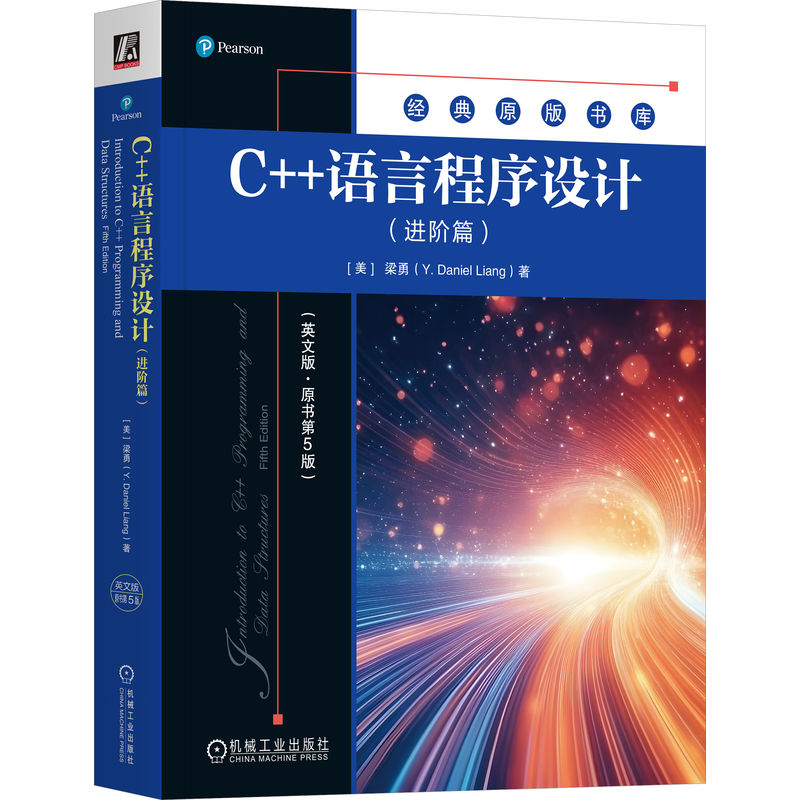


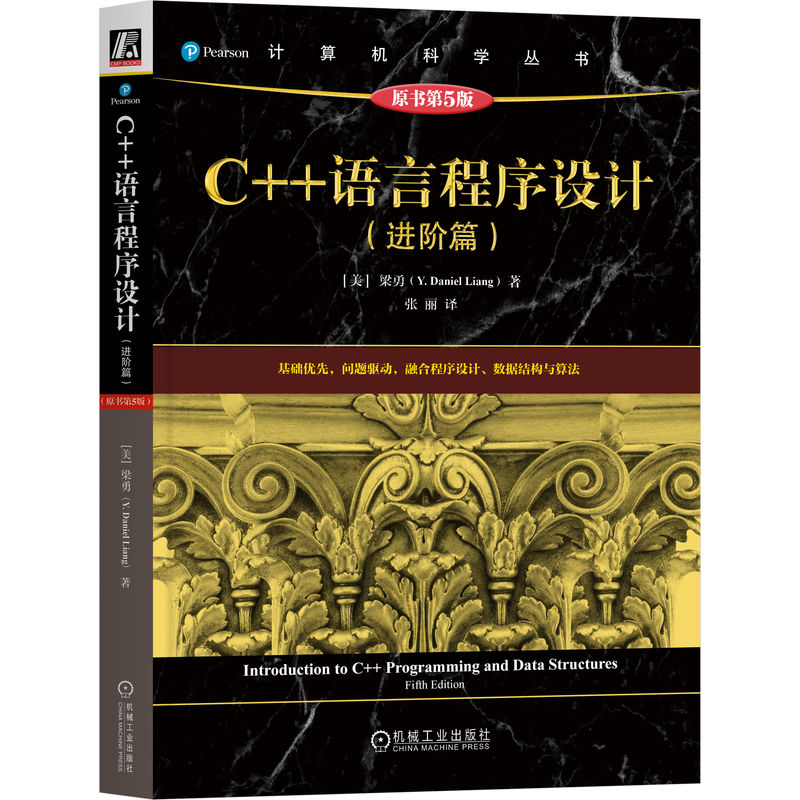
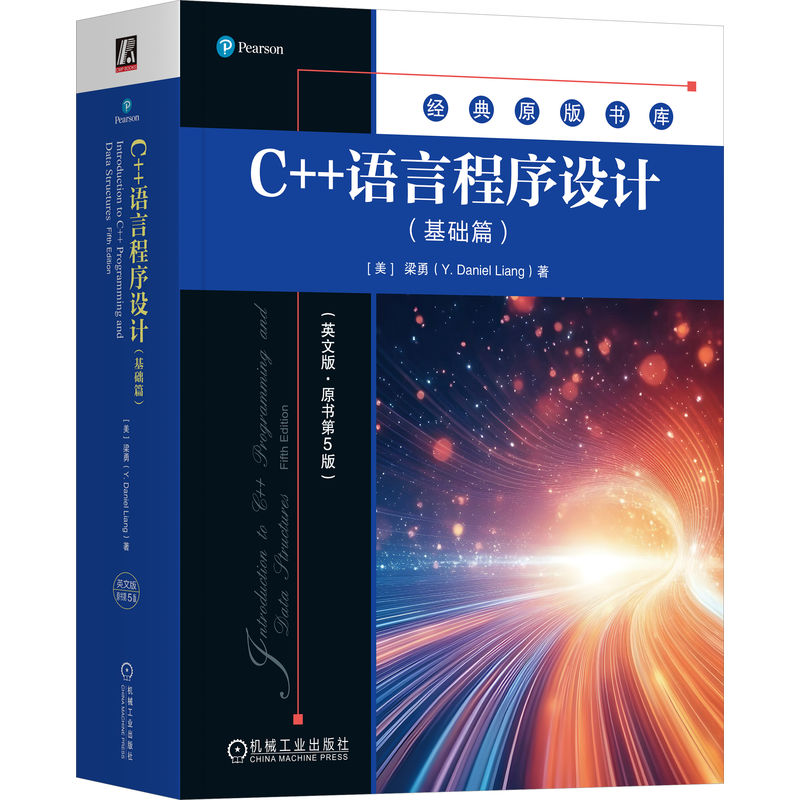
C++语言程序设计(进阶篇)(英文版·原书第5版) / 经典原版书库
定价:¥99.00
作者: [美]梁勇(Y.Daniel Liang)
出版时间:2025-03-14
出版社:机械工业出版社
- 机械工业出版社
- 9787111774822
- 1-1
- 2025-03-14
- 802
内容简介
本书是关于C++程序设计的经典教材,分为基础篇和进阶篇,主要介绍程序设计基础、面向对象程序设计和数据结构。本书采用“基础优先,问题驱动”的教学方式,在设计自定义类之前介绍基本的编程概念和技术,同时侧重于解决问题而非语法,通过不同领域的示例说明相关概念。本书引导读者循序渐进地学习,从基本的编程技术到面向对象编程,从简单的数据类型到经典的结构,为读者构建了友好的学习曲线。本书可作为高等院校计算机相关专业程序设计课程的教材,也可作为C++语言及编程爱好者的参考书。
目录
目 录
Introduction to C++ Programming and Data Structures, Fifth Edition
第17章 递归 1
17.1 简介 1
17.2 案例研究:计算阶乘 2
17.3 案例研究:斐波那契数 8
17.4 使用递归解决问题 12
17.5 递归辅助函数 16
17.5.1 选择排序 18
17.5.2 二分查找 20
17.6 汉诺塔 22
17.7 八皇后问题 26
17.8 递归与迭代 30
17.9 尾递归 31
关键术语 34
章节总结 35
编程练习 35
第18章 开发高效算法 46
18.1 简介 47
18.2 使用大O表示法衡量算法效率 47
18.3 示例:确定大O 50
18.4 分析算法时间复杂度 56
18.4.1 分析二分查找 56
18.4.2 分析选择排序 57
18.4.3 分析汉诺塔问题 58
18.4.4 常见的递归关系 59
18.4.5 比较常见的增长函数 59
18.5 使用动态规划求斐波那契数 63
18.6 使用欧几里得算法求最大
公约数 66
18.7 寻找质数的高效算法 72
18.8 使用分治法寻找最近点对 81
18.9 使用回溯法解决八皇后问题 84
18.10 案例研究:寻找凸包 88
18.10.1 礼品包装算法 89
18.10.2 Graham算法 90
18.11 字符串匹配 92
18.11.1 Boyer-Moore算法 95
18.11.2 Knuth-Morris-Pratt算法 98
关键术语 102
章节总结 103
编程练习 104
第19章 排序 111
19.1 简介 111
19.2 插入排序 112
19.3 冒泡排序 115
19.4 归并排序 117
19.5 快速排序 123
19.6 堆排序 127
19.6.1 存储堆 129
19.6.2 添加新节点 130
19.6.3 删除根 131
19.6.4 Heap类 134
19.6.5 使用Heap类进行排序 137
19.6.6 堆排序的时间复杂度 139
19.7 桶排序和基数排序 140
19.8 外部排序 143
19.8.1 实现第一阶段 145
19.8.2 实现第二阶段 146
19.8.3 合成两个阶段 149
19.8.4 外部排序复杂度 150
关键术语 151
章节总结 151
编程练习 151
第20章 链表、队列和优先级队列 154
20.1 简介 154
20.2 节点 155
20.3 LinkedList类 159
20.4 实现LinkedList 163
20.4.1 实现addFirst
(T element) 164
20.4.2 实现addLast
(T element) 165
20.4.3 实现add(int index,
T element) 166
20.4.4 实现removeFirst() 168
20.4.5 实现removeLast() 170
20.4.6 实现removeAt
(int index) 171
20.4.7 LinkedList的源代码 173
20.4.8 LinkedList的时间
复杂度 175
20.5 迭代器 179
20.6 C++11 foreach循环 184
20.7 链表的变体 186
20.8 队列 189
20.9 优先级队列 192
关键术语 196
章节总结 196
编程练习 197
第21章 二叉查找树 200
21.1 简介 200
21.2 二叉查找树基础知识 201
21.3 表示二叉查找树 202
21.4 访问二叉查找树中的节点 204
21.5 查找元素 204
21.6 将元素插入二叉查找树 206
21.7 树的遍历 208
21.8 BST类 210
21.9 删除二叉查找树中的元素 216
21.10 BST的迭代器 224
21.11 案例研究:数据压缩 227
关键术语 232
章节总结 233
编程练习 233
第22章 STL容器 236
22.1 简介 236
22.2 STL基础 237
22.3 STL迭代器 243
22.3.1 迭代器的类型 245
22.3.2 迭代器运算符 246
22.3.3 预定义迭代器 248
22.3.4 istream_iterator和ostream_iterator 250
22.4 C++11自动类型推断 252
22.5 序列容器 253
22.5.1 序列容器:vector 254
22.5.2 序列容器:deque 257
22.5.3 序列容器:list 259
22.6 关联容器 263
22.6.1 关联容器:set和
multiset 263
22.6.2 关联容器:map和
multimap 265
22.7 容器适配器 269
22.7.1 容器适配器:stack 269
22.7.2 容器适配器:queue 270
22.7.3 容器适配器:priority_
queue 272
关键术语 274
章节总结 275
编程练习 276
第23章 STL算法 280
23.1 简介 281
23.2 算法类型 282
23.3 copy函数 284
23.4 fill和fill_n 287
23.5 将函数作为参数传递 289
23.6 generate和generate_n 293
23.7 remove、remove_if、
remove_copy和
remove_copy_if 295
23.8 replace、replace_if、replace_copy和
replace_copy_if 299
23.9 find、find_if、find_end和
find_first_of 303
23.10 search和search_n 309
23.11 sort和binary_search 311
23.12 adjacent_find、merge和inplace_merge 315
23.13 reverse和reverse_copy 317
23.14 rotate和rotate_copy 319
23.15 swap、iter_swap和swap_ranges 321
23.16 count和count_if 323
23.17 max_element和
min_element 324
23.18 random_shuffle 325
23.19 for_each和transform 327
23.20 includes、set_union、set_difference、set_intersection和set_symmetric_difference 329
23.21 accumulate、adjacent_difference、inner_product和partial_sum
23.22 lambda表达式 334
23.23 新的C++11 STL算法 338
关键术语 341
章节总结 343
编程练习 345
第24章 散列 346
24.1 简介 348
24.2 散列是什么 348
24.3 散列函数和散列码 350
24.3.1 基元类型的散列码 350
24.3.2 字符串的散列码 351
24.3.3 压缩散列码 351
24.4 用开放寻址处理冲突 354
24.4.1 线性探测 354
24.4.2 平方探测 355
24.4.3 双重散列 357
24.5 用独立链处理冲突 360
24.6 负载因子和再散列 361
24.7 用散列实现映射 362
24.8 用散列实现集合 369
关键术语 374
章节总结 375
编程练习 375
第25章 AVL树 377
25.1 简介 377
25.2 再平衡树 379
25.3 设计AVL树类 382
25.4 重写insert函数 384
25.5 实现旋转 386
25.6 实现remove函数 387
25.7 AVLTree类 389
25.8 测试AVLTree类 392
25.9 AVL树的时间复杂度分析 397
关键术语 397
章节总结 398
编程练习 398
第26章 图及其应用 400
26.1 简介 400
26.2 基本图术语 402
26.3 图的表示 405
26.3.1 顶点的表示 406
26.3.2 边的表示(用于输入):
边数组 407
26.3.3 边的表示(用于输入):
Edge对象 408
26.3.4 边的表示:邻接矩阵 408
26.3.5 边的表示:邻接列表 409
26.4 Graph类 413
26.5 图遍历 420
26.6 深度优先搜索 422
26.6.1 深度优先搜索算法 422
26.6.2 深度优先搜索的实现 424
26.6.3 DFS的应用 426
26.7 广度优先搜索 428
26.7.1 广度优先搜索算法 428
26.7.2 广度优先搜索的实现 429
26.7.3 BFS的应用 431
26.8 案例研究:九枚硬币翻转问题 432
关键术语 440
章节总结 441
编程练习 441
第27章 加权图及其应用 445
27.1 简介 445
27.2 加权图的表示 447
27.2.1 加权边的表示:边数组 447
27.2.2 加权相邻列表 448
27.3 WeightedGraph类 450
27.4 最小生成树 457
27.4.1 最小生成树算法 457
27.5 寻找最短路径 465
27.6 案例研究:加权九枚硬币
翻转问题 472
关键术语 477
章节总结 477
编程练习 477
附录A C++关键字 482
附录B ASCII字符集 484
附录C 运算符优先级表 486
附录D 数字系统 487
附录E 按位运算 494
附录F 使用命令行参数 497
附录G 枚举类型 501
附录H 正则表达式 506
附录??I? 大O、大Omega和大Theta
表示法 515
Contents
17: Recursion 1
17.1: Introduction 1
17.2: Case Study: Computing Factorials 2
17.3: Case Study: Fibonacci Numbers 8
17.4: Problem Solving Using Recursion 12
17.5: Recursive Helper Functions 16
17.5.1: Selection Sort 18
17.5.2: Binary Search 20
17.6: Towers of Hanoi 22
17.7: Eight Queens 26
17.8: Recursion versus Iteration 30
17.9: Tail Recursion 31
Key Terms 34
Chapter Summary 35
Programming Exercises 35
18: Developing Efficient
Algorithms 46
18.1: Introduction 47
18.2: Measuring Algorithm Efficiency
Using Big O Notation 47
18.3: Examples: Determining Big O 50
18.4: Analyzing Algorithm Time
Complexity 56
18.4.1: Analyzing Binary Search 56
18.4.2: Analyzing Selection Sort 57
18.4.3: Analyzing the Towers of Hanoi
Problem 58
18.4.4: Common Recurrence
Relations 59
18.4.5: Comparing Common Growth
Functions 59
18.5: Finding Fibonacci Numbers Using
Dynamic Programming 63
18.6: Finding Greatest Common Divisors
Using Euclid’s Algorithm 66
18.7: Efficient Algorithms for Finding
Prime Numbers 72
18.8: Finding the Closest Pair of Points
Using Divide-and-Conquer 81
18.9: Solving the Eight Queens Problem
Using Backtracking 84
18.10: Case Studies: Finding a Convex
Hull 88
18.10.1: Gift-Wrapping Algorithm 89
18.10.2: Graham’s Algorithm 90
18.11: String Matching 92
18.11.1: The Boyer-Moore Algorithm 95
18.11.2: The Knuth-Morris-Pratt
Algorithm 98
Key Terms 102
Chapter Summary 103
Programming Exercises 104
19: Sorting 111
19.1: Introduction 111
19.2: Insertion Sort 112
19.3: Bubble Sort 115
19.4: Merge Sort 117
19.5: Quick Sort 123
19.6: Heap Sort 127
19.6.1: Storing a Heap 129
19.6.2: Adding a New Node 130
19.6.3: Removing the Root 131
19.6.4: The Heap Class 134
19.6.5: Sorting Using the Heap Class 137
19.6.6: Heap Sort Time Complexity 139
19.7: Bucket Sort and Radix Sort 140
19.8: External Sort 143
19.8.1: Implementing Phase I 145
19.8.2: Implementing Phase II 146
19.8.3: Combining Two Phases 149
19.8.4: External Sort Complexity 150
Key Terms 151
Chapter Summary 151
Programming Exercises 151
20: Linked Lists, Queues, and
Priority Queues 154
20.1: Introduction 154
20.2: Nodes 155
20.3: The LinkedList Class 159
20.4: Implementing LinkedList 163
20.4.1: Implementing addFirst
(T element) 164
20.4.2: Implementing addLast
(T element) 165
20.4.3: Implementing add(int
index, T element) 166
20.4.4: Implementing
removeFirst() 168
20.4.5: Implementing
removeLast() 170
20.4.6: Implementing removeAt
(int index) 171
20.4.7: The source code for
LinkedList 173
20.4.8: The time complexity of
LinkedList 175
20.5: Iterators 179
20.6: C++11 Foreach Loop 184
20.7: Variations of Linked Lists 186
20.8: Queues 189
20.9: Priority Queues 192
Key Terms 196
Chapter Summary 196
Programming Exercises 197
21: Binary Search Trees 200
21.1: Introduction 200
21.2: Binary Search Trees Basics 201
21.3: Representing Binary Search Trees 202
21.4: Accessing Nodes in Binary Trees 204
21.5: Searching for an Element 204
21.6: Inserting an Element into a BST 206
21.7: Tree Traversal 208
21.8: The BST Class 210
21.9: Deleting Elements in a BST 216
21.10: Iterators for BST 224
21.11: Case Study: Data Compression 227
Key Terms 232
Chapter Summary 233
Programming Exercises 233
22: STL Containers 236
22.1: Introduction 236
22.2: STL Basics 237
22.3: STL Iterators 243
22.3.1: Types of Iterators 245
22.3.2: Iterator Operators 246
22.3.3: Predefined Iterators 248
22.3.4: istream_iterator and
ostream_iterator 250
22.4: C++11 Auto-Type Inference 252
22.5: Sequence Containers 253
22.5.1: Sequence Container: vector 254
22.5.2: Sequence Container: deque 257
22.5.3: Sequence Container: list 259
22.6: Associative Containers 263
22.6.1: Associative Containers: set
and multiset 263
22.6.2: Associative Containers: map
and multimap 265
22.7: Container Adapters 269
22.7.1: Container Adapter: stack 269
22.7.2: Container Adapter: queue 270
22.7.3: Container Adapter:
priority_queue 272
Key Terms 274
Chapter Summary 275
Programming Exercises 276
23: STL Algorithms 280
23.1: Introduction 281
23.2: Types of Algorithms 282
23.3: copy 284
23.4: fill and fill_n 287
23.5: Passing Functions as Parameters 289
23.6: generate and generate_n 293
23.7: remove, remove_if, remove_copy,
and remove_copy_if 295
23.8: replace, replace_if, replace_
copy, and replace_copy_if 299
23.9: find, find_if, find_end, and
find_first_of 303
23.10: search and search_n 309
23.11: sort and binary_search 311
23.12: adjacent_find, merge, and
inplace_merge 315
23.13: reverse and reverse_copy 317
23.14: rotate and rotate_copy 319
23.15: swap, iter_swap, and swap_
ranges 321
23.16: count and count_if 323
23.17: max_element and
min_element 324
23.18: random_shuffle 325
23.19: for_each and transform 327
23.20: includes, set_union, set_
difference, set_intersection,
and set_symmetric_
difference 329
23.21: accumulate, adjacent_
difference, inner_product,
and partial_sum 334
23.22: Lambda Expressions 338
23.23: New C++11 STL Algorithms 341
Key Terms 343
Chapter Summary 345
Programming Exercises 346
24: Hashing 348
24.1: Introduction 348
24.2: What is Hashing? 348
24.3: Hash Functions and Hash Codes 350
24.3.1: Hash Codes for Primitive
Types 350
24.3.2: Hash Codes for Strings 351
24.3.3: Compressing Hash Codes 351
24.4: Handling Collisions Using Open
Addressing 354
24.4.1: Linear Probing 354
24.4.2: Quadratic Probing 355
24.4.3: Double Hashing 357
24.5: Handling Collisions Using Separate
Chaining 360
24.6: Load Factor and Rehashing 361
24.7: Implementing a Map Using
Hashing 362
24.8: Implementing Set Using Hashing 369
Key Terms 374
Chapter Summary 375
Programming Exercises 375
25: AVL Trees 377
25.1: Introduction 377
25.2: Rebalancing Trees 379
25.3: Designing Classes for AVL Trees 382
25.4: Overriding the insert Function 384
25.5: Implementing Rotations 386
25.6: Implementing the remove
Function 387
25.7: The AVLTree Class 389
25.8: Testing the AVLTree Class 392
25.9: AVL Tree Time Complexity
Analysis 397
Key Terms 397
Chapter Summary 398
Programming Exercises 398
26: Graphs and Applications 400
26.1: Introduction 400
26.2: Basic Graph Terminologies 402
26.3: Representing Graphs 405
26.3.1: Representing Vertices 406
26.3.2: Representing Edges (for input):
Edge Array 407
26.3.3: Representing Edges (for input):
Edge Objects 408
26.3.4: Representing Edges: Adjacency
Matrices 408
26.3.5: Representing Edges: Adjacency
Lists 409
26.4: The Graph Class 413
26.5: Graph Traversals 420
26.6: Depth-First Search 422
26.6.1: Depth-First Search Algorithm 422
26.6.2: Implementation of Depth-First
Search 424
26.6.3: Applications of the DFS 426
26.7: Breadth-First Search 428
26.7.1: Breadth-First Search
Algorithm 428
26.7.2: Implementation of Breadth-First
Search 429
26.7.3: Applications of the BFS 431
26.8: Case Study: The Nine Tail Problem 432
Key Terms 440
Chapter Summary 441
Programming Exercises 441
27: Weighted Graphs and
Applications 445
27.1: Introduction 445
27.2: Representing Weighted Graphs 447
27.2.1: Representing Weighted Edges:
Edge Array 447
27.2.2: Weighted Adjacency Lists 448
27.3: The WeightedGraph Class 450
27.4: Minimum Spanning Trees 457
27.4.1: Minimum Spanning Tree
Algorithms 457
27.5: Finding Shortest Paths 465
27.6: Case Study: The Weighted Nine Tail
Problem 472
Key Terms 477
Chapter Summary 477
Programming Exercises 477
Appendix A: C++ Keywords 482
Appendix B: The ASCII Character
Set 484
Appendix C: Operator Precedence
Chart 486
Appendix D: Number Systems 487
Appendix E: Bitwise
Operations 494
Appendix F: Using Command-
Line Arguments 497
Appendix G: Enumerated
Types 501
Appendix H: Regular
Expressions 506
Appendix I: The Big-O,
Big-Omega,
and Big-Theta
Notations 515
Introduction to C++ Programming and Data Structures, Fifth Edition
第17章 递归 1
17.1 简介 1
17.2 案例研究:计算阶乘 2
17.3 案例研究:斐波那契数 8
17.4 使用递归解决问题 12
17.5 递归辅助函数 16
17.5.1 选择排序 18
17.5.2 二分查找 20
17.6 汉诺塔 22
17.7 八皇后问题 26
17.8 递归与迭代 30
17.9 尾递归 31
关键术语 34
章节总结 35
编程练习 35
第18章 开发高效算法 46
18.1 简介 47
18.2 使用大O表示法衡量算法效率 47
18.3 示例:确定大O 50
18.4 分析算法时间复杂度 56
18.4.1 分析二分查找 56
18.4.2 分析选择排序 57
18.4.3 分析汉诺塔问题 58
18.4.4 常见的递归关系 59
18.4.5 比较常见的增长函数 59
18.5 使用动态规划求斐波那契数 63
18.6 使用欧几里得算法求最大
公约数 66
18.7 寻找质数的高效算法 72
18.8 使用分治法寻找最近点对 81
18.9 使用回溯法解决八皇后问题 84
18.10 案例研究:寻找凸包 88
18.10.1 礼品包装算法 89
18.10.2 Graham算法 90
18.11 字符串匹配 92
18.11.1 Boyer-Moore算法 95
18.11.2 Knuth-Morris-Pratt算法 98
关键术语 102
章节总结 103
编程练习 104
第19章 排序 111
19.1 简介 111
19.2 插入排序 112
19.3 冒泡排序 115
19.4 归并排序 117
19.5 快速排序 123
19.6 堆排序 127
19.6.1 存储堆 129
19.6.2 添加新节点 130
19.6.3 删除根 131
19.6.4 Heap类 134
19.6.5 使用Heap类进行排序 137
19.6.6 堆排序的时间复杂度 139
19.7 桶排序和基数排序 140
19.8 外部排序 143
19.8.1 实现第一阶段 145
19.8.2 实现第二阶段 146
19.8.3 合成两个阶段 149
19.8.4 外部排序复杂度 150
关键术语 151
章节总结 151
编程练习 151
第20章 链表、队列和优先级队列 154
20.1 简介 154
20.2 节点 155
20.3 LinkedList类 159
20.4 实现LinkedList 163
20.4.1 实现addFirst
(T element) 164
20.4.2 实现addLast
(T element) 165
20.4.3 实现add(int index,
T element) 166
20.4.4 实现removeFirst() 168
20.4.5 实现removeLast() 170
20.4.6 实现removeAt
(int index) 171
20.4.7 LinkedList的源代码 173
20.4.8 LinkedList的时间
复杂度 175
20.5 迭代器 179
20.6 C++11 foreach循环 184
20.7 链表的变体 186
20.8 队列 189
20.9 优先级队列 192
关键术语 196
章节总结 196
编程练习 197
第21章 二叉查找树 200
21.1 简介 200
21.2 二叉查找树基础知识 201
21.3 表示二叉查找树 202
21.4 访问二叉查找树中的节点 204
21.5 查找元素 204
21.6 将元素插入二叉查找树 206
21.7 树的遍历 208
21.8 BST类 210
21.9 删除二叉查找树中的元素 216
21.10 BST的迭代器 224
21.11 案例研究:数据压缩 227
关键术语 232
章节总结 233
编程练习 233
第22章 STL容器 236
22.1 简介 236
22.2 STL基础 237
22.3 STL迭代器 243
22.3.1 迭代器的类型 245
22.3.2 迭代器运算符 246
22.3.3 预定义迭代器 248
22.3.4 istream_iterator和ostream_iterator 250
22.4 C++11自动类型推断 252
22.5 序列容器 253
22.5.1 序列容器:vector 254
22.5.2 序列容器:deque 257
22.5.3 序列容器:list 259
22.6 关联容器 263
22.6.1 关联容器:set和
multiset 263
22.6.2 关联容器:map和
multimap 265
22.7 容器适配器 269
22.7.1 容器适配器:stack 269
22.7.2 容器适配器:queue 270
22.7.3 容器适配器:priority_
queue 272
关键术语 274
章节总结 275
编程练习 276
第23章 STL算法 280
23.1 简介 281
23.2 算法类型 282
23.3 copy函数 284
23.4 fill和fill_n 287
23.5 将函数作为参数传递 289
23.6 generate和generate_n 293
23.7 remove、remove_if、
remove_copy和
remove_copy_if 295
23.8 replace、replace_if、replace_copy和
replace_copy_if 299
23.9 find、find_if、find_end和
find_first_of 303
23.10 search和search_n 309
23.11 sort和binary_search 311
23.12 adjacent_find、merge和inplace_merge 315
23.13 reverse和reverse_copy 317
23.14 rotate和rotate_copy 319
23.15 swap、iter_swap和swap_ranges 321
23.16 count和count_if 323
23.17 max_element和
min_element 324
23.18 random_shuffle 325
23.19 for_each和transform 327
23.20 includes、set_union、set_difference、set_intersection和set_symmetric_difference 329
23.21 accumulate、adjacent_difference、inner_product和partial_sum
23.22 lambda表达式 334
23.23 新的C++11 STL算法 338
关键术语 341
章节总结 343
编程练习 345
第24章 散列 346
24.1 简介 348
24.2 散列是什么 348
24.3 散列函数和散列码 350
24.3.1 基元类型的散列码 350
24.3.2 字符串的散列码 351
24.3.3 压缩散列码 351
24.4 用开放寻址处理冲突 354
24.4.1 线性探测 354
24.4.2 平方探测 355
24.4.3 双重散列 357
24.5 用独立链处理冲突 360
24.6 负载因子和再散列 361
24.7 用散列实现映射 362
24.8 用散列实现集合 369
关键术语 374
章节总结 375
编程练习 375
第25章 AVL树 377
25.1 简介 377
25.2 再平衡树 379
25.3 设计AVL树类 382
25.4 重写insert函数 384
25.5 实现旋转 386
25.6 实现remove函数 387
25.7 AVLTree类 389
25.8 测试AVLTree类 392
25.9 AVL树的时间复杂度分析 397
关键术语 397
章节总结 398
编程练习 398
第26章 图及其应用 400
26.1 简介 400
26.2 基本图术语 402
26.3 图的表示 405
26.3.1 顶点的表示 406
26.3.2 边的表示(用于输入):
边数组 407
26.3.3 边的表示(用于输入):
Edge对象 408
26.3.4 边的表示:邻接矩阵 408
26.3.5 边的表示:邻接列表 409
26.4 Graph类 413
26.5 图遍历 420
26.6 深度优先搜索 422
26.6.1 深度优先搜索算法 422
26.6.2 深度优先搜索的实现 424
26.6.3 DFS的应用 426
26.7 广度优先搜索 428
26.7.1 广度优先搜索算法 428
26.7.2 广度优先搜索的实现 429
26.7.3 BFS的应用 431
26.8 案例研究:九枚硬币翻转问题 432
关键术语 440
章节总结 441
编程练习 441
第27章 加权图及其应用 445
27.1 简介 445
27.2 加权图的表示 447
27.2.1 加权边的表示:边数组 447
27.2.2 加权相邻列表 448
27.3 WeightedGraph类 450
27.4 最小生成树 457
27.4.1 最小生成树算法 457
27.5 寻找最短路径 465
27.6 案例研究:加权九枚硬币
翻转问题 472
关键术语 477
章节总结 477
编程练习 477
附录A C++关键字 482
附录B ASCII字符集 484
附录C 运算符优先级表 486
附录D 数字系统 487
附录E 按位运算 494
附录F 使用命令行参数 497
附录G 枚举类型 501
附录H 正则表达式 506
附录??I? 大O、大Omega和大Theta
表示法 515
Contents
17: Recursion 1
17.1: Introduction 1
17.2: Case Study: Computing Factorials 2
17.3: Case Study: Fibonacci Numbers 8
17.4: Problem Solving Using Recursion 12
17.5: Recursive Helper Functions 16
17.5.1: Selection Sort 18
17.5.2: Binary Search 20
17.6: Towers of Hanoi 22
17.7: Eight Queens 26
17.8: Recursion versus Iteration 30
17.9: Tail Recursion 31
Key Terms 34
Chapter Summary 35
Programming Exercises 35
18: Developing Efficient
Algorithms 46
18.1: Introduction 47
18.2: Measuring Algorithm Efficiency
Using Big O Notation 47
18.3: Examples: Determining Big O 50
18.4: Analyzing Algorithm Time
Complexity 56
18.4.1: Analyzing Binary Search 56
18.4.2: Analyzing Selection Sort 57
18.4.3: Analyzing the Towers of Hanoi
Problem 58
18.4.4: Common Recurrence
Relations 59
18.4.5: Comparing Common Growth
Functions 59
18.5: Finding Fibonacci Numbers Using
Dynamic Programming 63
18.6: Finding Greatest Common Divisors
Using Euclid’s Algorithm 66
18.7: Efficient Algorithms for Finding
Prime Numbers 72
18.8: Finding the Closest Pair of Points
Using Divide-and-Conquer 81
18.9: Solving the Eight Queens Problem
Using Backtracking 84
18.10: Case Studies: Finding a Convex
Hull 88
18.10.1: Gift-Wrapping Algorithm 89
18.10.2: Graham’s Algorithm 90
18.11: String Matching 92
18.11.1: The Boyer-Moore Algorithm 95
18.11.2: The Knuth-Morris-Pratt
Algorithm 98
Key Terms 102
Chapter Summary 103
Programming Exercises 104
19: Sorting 111
19.1: Introduction 111
19.2: Insertion Sort 112
19.3: Bubble Sort 115
19.4: Merge Sort 117
19.5: Quick Sort 123
19.6: Heap Sort 127
19.6.1: Storing a Heap 129
19.6.2: Adding a New Node 130
19.6.3: Removing the Root 131
19.6.4: The Heap Class 134
19.6.5: Sorting Using the Heap Class 137
19.6.6: Heap Sort Time Complexity 139
19.7: Bucket Sort and Radix Sort 140
19.8: External Sort 143
19.8.1: Implementing Phase I 145
19.8.2: Implementing Phase II 146
19.8.3: Combining Two Phases 149
19.8.4: External Sort Complexity 150
Key Terms 151
Chapter Summary 151
Programming Exercises 151
20: Linked Lists, Queues, and
Priority Queues 154
20.1: Introduction 154
20.2: Nodes 155
20.3: The LinkedList Class 159
20.4: Implementing LinkedList 163
20.4.1: Implementing addFirst
(T element) 164
20.4.2: Implementing addLast
(T element) 165
20.4.3: Implementing add(int
index, T element) 166
20.4.4: Implementing
removeFirst() 168
20.4.5: Implementing
removeLast() 170
20.4.6: Implementing removeAt
(int index) 171
20.4.7: The source code for
LinkedList 173
20.4.8: The time complexity of
LinkedList 175
20.5: Iterators 179
20.6: C++11 Foreach Loop 184
20.7: Variations of Linked Lists 186
20.8: Queues 189
20.9: Priority Queues 192
Key Terms 196
Chapter Summary 196
Programming Exercises 197
21: Binary Search Trees 200
21.1: Introduction 200
21.2: Binary Search Trees Basics 201
21.3: Representing Binary Search Trees 202
21.4: Accessing Nodes in Binary Trees 204
21.5: Searching for an Element 204
21.6: Inserting an Element into a BST 206
21.7: Tree Traversal 208
21.8: The BST Class 210
21.9: Deleting Elements in a BST 216
21.10: Iterators for BST 224
21.11: Case Study: Data Compression 227
Key Terms 232
Chapter Summary 233
Programming Exercises 233
22: STL Containers 236
22.1: Introduction 236
22.2: STL Basics 237
22.3: STL Iterators 243
22.3.1: Types of Iterators 245
22.3.2: Iterator Operators 246
22.3.3: Predefined Iterators 248
22.3.4: istream_iterator and
ostream_iterator 250
22.4: C++11 Auto-Type Inference 252
22.5: Sequence Containers 253
22.5.1: Sequence Container: vector 254
22.5.2: Sequence Container: deque 257
22.5.3: Sequence Container: list 259
22.6: Associative Containers 263
22.6.1: Associative Containers: set
and multiset 263
22.6.2: Associative Containers: map
and multimap 265
22.7: Container Adapters 269
22.7.1: Container Adapter: stack 269
22.7.2: Container Adapter: queue 270
22.7.3: Container Adapter:
priority_queue 272
Key Terms 274
Chapter Summary 275
Programming Exercises 276
23: STL Algorithms 280
23.1: Introduction 281
23.2: Types of Algorithms 282
23.3: copy 284
23.4: fill and fill_n 287
23.5: Passing Functions as Parameters 289
23.6: generate and generate_n 293
23.7: remove, remove_if, remove_copy,
and remove_copy_if 295
23.8: replace, replace_if, replace_
copy, and replace_copy_if 299
23.9: find, find_if, find_end, and
find_first_of 303
23.10: search and search_n 309
23.11: sort and binary_search 311
23.12: adjacent_find, merge, and
inplace_merge 315
23.13: reverse and reverse_copy 317
23.14: rotate and rotate_copy 319
23.15: swap, iter_swap, and swap_
ranges 321
23.16: count and count_if 323
23.17: max_element and
min_element 324
23.18: random_shuffle 325
23.19: for_each and transform 327
23.20: includes, set_union, set_
difference, set_intersection,
and set_symmetric_
difference 329
23.21: accumulate, adjacent_
difference, inner_product,
and partial_sum 334
23.22: Lambda Expressions 338
23.23: New C++11 STL Algorithms 341
Key Terms 343
Chapter Summary 345
Programming Exercises 346
24: Hashing 348
24.1: Introduction 348
24.2: What is Hashing? 348
24.3: Hash Functions and Hash Codes 350
24.3.1: Hash Codes for Primitive
Types 350
24.3.2: Hash Codes for Strings 351
24.3.3: Compressing Hash Codes 351
24.4: Handling Collisions Using Open
Addressing 354
24.4.1: Linear Probing 354
24.4.2: Quadratic Probing 355
24.4.3: Double Hashing 357
24.5: Handling Collisions Using Separate
Chaining 360
24.6: Load Factor and Rehashing 361
24.7: Implementing a Map Using
Hashing 362
24.8: Implementing Set Using Hashing 369
Key Terms 374
Chapter Summary 375
Programming Exercises 375
25: AVL Trees 377
25.1: Introduction 377
25.2: Rebalancing Trees 379
25.3: Designing Classes for AVL Trees 382
25.4: Overriding the insert Function 384
25.5: Implementing Rotations 386
25.6: Implementing the remove
Function 387
25.7: The AVLTree Class 389
25.8: Testing the AVLTree Class 392
25.9: AVL Tree Time Complexity
Analysis 397
Key Terms 397
Chapter Summary 398
Programming Exercises 398
26: Graphs and Applications 400
26.1: Introduction 400
26.2: Basic Graph Terminologies 402
26.3: Representing Graphs 405
26.3.1: Representing Vertices 406
26.3.2: Representing Edges (for input):
Edge Array 407
26.3.3: Representing Edges (for input):
Edge Objects 408
26.3.4: Representing Edges: Adjacency
Matrices 408
26.3.5: Representing Edges: Adjacency
Lists 409
26.4: The Graph Class 413
26.5: Graph Traversals 420
26.6: Depth-First Search 422
26.6.1: Depth-First Search Algorithm 422
26.6.2: Implementation of Depth-First
Search 424
26.6.3: Applications of the DFS 426
26.7: Breadth-First Search 428
26.7.1: Breadth-First Search
Algorithm 428
26.7.2: Implementation of Breadth-First
Search 429
26.7.3: Applications of the BFS 431
26.8: Case Study: The Nine Tail Problem 432
Key Terms 440
Chapter Summary 441
Programming Exercises 441
27: Weighted Graphs and
Applications 445
27.1: Introduction 445
27.2: Representing Weighted Graphs 447
27.2.1: Representing Weighted Edges:
Edge Array 447
27.2.2: Weighted Adjacency Lists 448
27.3: The WeightedGraph Class 450
27.4: Minimum Spanning Trees 457
27.4.1: Minimum Spanning Tree
Algorithms 457
27.5: Finding Shortest Paths 465
27.6: Case Study: The Weighted Nine Tail
Problem 472
Key Terms 477
Chapter Summary 477
Programming Exercises 477
Appendix A: C++ Keywords 482
Appendix B: The ASCII Character
Set 484
Appendix C: Operator Precedence
Chart 486
Appendix D: Number Systems 487
Appendix E: Bitwise
Operations 494
Appendix F: Using Command-
Line Arguments 497
Appendix G: Enumerated
Types 501
Appendix H: Regular
Expressions 506
Appendix I: The Big-O,
Big-Omega,
and Big-Theta
Notations 515
