

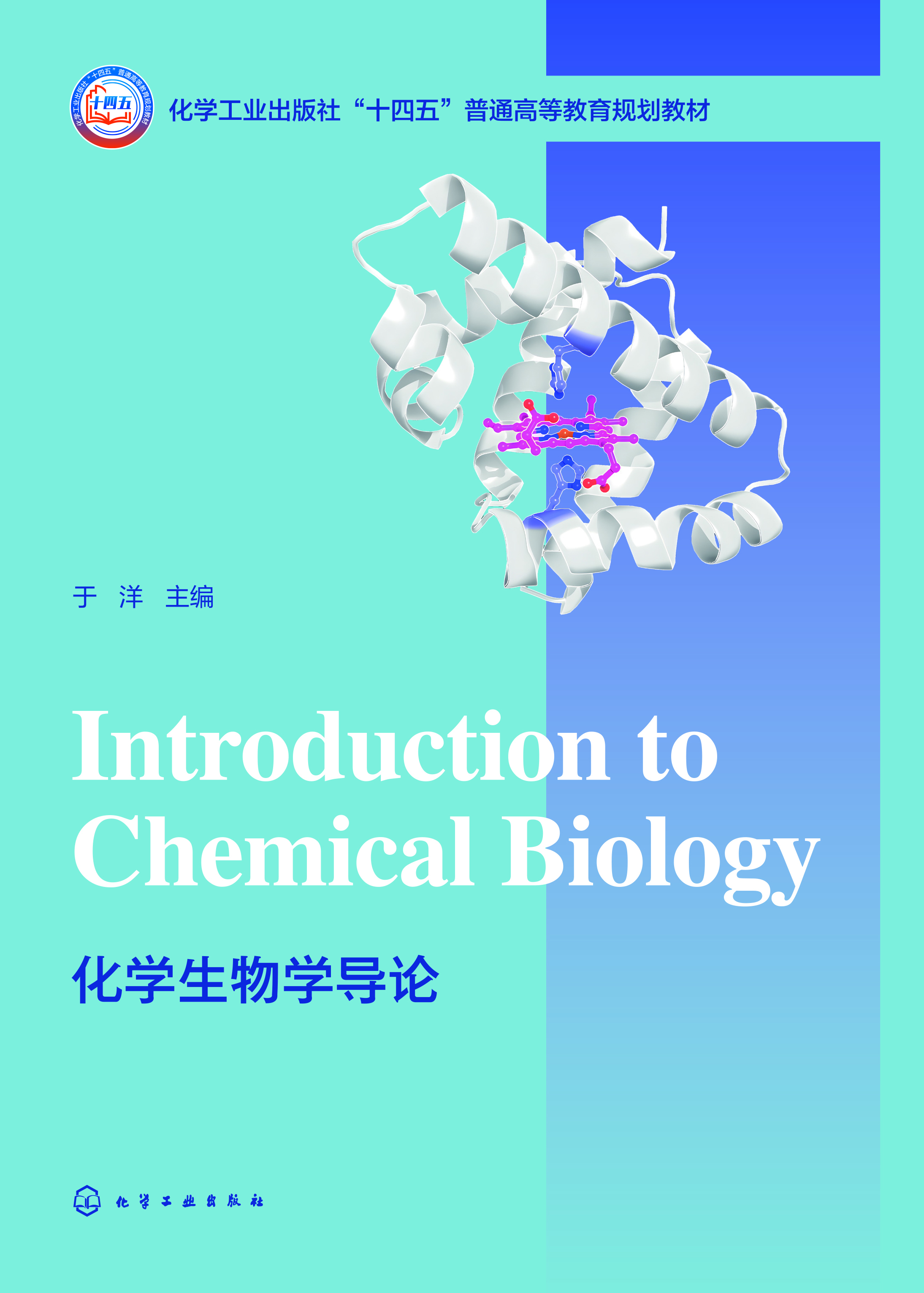


化学生物学导论(Introduction to Chemical Biology)
定价:¥75.00
作者: 于洋主编
出版时间:2026-02
出版社:化学工业出版社
- 化学工业出版社
- 9787122497260
- 1版
- 16开
- 2026-02
- 462
- 本科
目录
1 Introduction 001
1.1 Overview of Chemical Biology 002
1.2 Historical Context and Evolution of Chemical Biology 002
1.2.1 Biological Effects of Chemicals 003
1.2.2 Experiment against Vitalism 004
1.2.3 Manipulating Biomacromolecules 004
1.2.4 The Development of Synthetic Dyes and Chemotherapy 005
1.2.5 20th Century and On 006
1.3 Highlights of Contemporary Work 006
1.3.1 Bio-orthogonal Chemistry 007
1.3.2 Directed Evolution 007
1.3.3 Display Technologies 007
1.3.4 Deep Learning for Protein Structure Prediction 007
1.3.5 Chemical Genetics 008
1.3.6 Unnatural Amino Acids and Bases 008
1.3.7 Synthetic Genomes 008
Questions 009
References 009
2 Chemical Principles in Biology 010
2.1 Basic Chemistry of Biomolecules 011
2.1.1 The Chemical Composition of Biomolecules 011
2.1.2 Types of Biomolecules 011
2.2 Chemical Bonds and Interactions in Biological Systems 013
2.2.1 Covalent Bonds:The Backbone of Biomolecular Structure 013
2.2.2 Non-Covalent Interactions and Biomolecular Structure 014
2.3 Thermodynamics and Kinetics in Biochemical Reactions 017
2.3.1 Thermodynamics:The Energetics of Biochemical Reactions 017
2.3.2 Kinetics:The Rate of Biochemical Reactions 018
2.3.3 The Interplay of Thermodynamics and Kinetics 019
2.4 Conclusion 019
Questions 020
References 020
3 The Central Dogma of Molecular Biology 021
3.1 Discovery 022
3.2 Genetic Information Flow:Replication,Transcription,Translation 024
3.2.1 Replication:Preserving Genetic Continuity 024
3.2.2 Transcription:From DNA to RNA 025
3.2.3 Translation:Synthesizing Proteins 025
3.2.4 Integration of Genetic Information Flow 026
3.3 Exceptions to the Central Dogma of Molecular Biology 027
3.3.1 Reverse Transcription:RNA to DNA 027
3.3.2 RNA Replication:RNA to RNA 028
3.3.3 Perspective on Alternative Information Flow Pathways 028
Questions 029
References 030
4 Peptide and Protein 031
4.1 Amino Acid 032
4.1.1 Chemical Structure and Stereochemistry 032
4.1.2 Side Chain Groups and Their Properties 033
4.1.3 Post-Translational Modifications 034
4.2 Hierarchical Structure of Proteins 035
4.2.1 Primary Structure and Peptide 035
4.2.2 Secondary Structure 038
4.2.3 Tertiary Structure 040
4.2.4 Quaternary Structure 042
4.2.5 Protein Structure Determination 044
4.3 Chemical Synthesis of Peptides 047
4.3.1 Overview of Solid Phase Peptide Synthesis 047
4.3.2 Key Steps in Solid Phase Peptide Synthesis 047
4.3.3 Limitations of Solid Phase Peptide Synthesis 049
4.4 Native Chemical Ligation 050
4.5 Expressed Protein Ligation 053
4.6 Comparison of Biosynthesis and Chemical Synthesis 056
4.7 Conclusion 057
Questions 058
References 059
5 Nucleic Acid 060
5.1 Introduction 061
5.2 Chemical Composition and Structure of Nucleic Acids 062
5.3 Biosynthesis of Nucleic Acids 065
5.3.1 DNA Replication:Mechanism and Enzymatic Machinery 065
5.3.2 RNA Transcription:Mechanism and Enzymatic Machinery 066
5.3.3 Coordination and Regulation of Nucleic Acid Biosynthesis 067
5.4 Polymerase Chain Reaction 067
5.5 Chemical Synthesis of Nucleic Acids 070
5.5.1 Principles of Chemical Nucleic Acid Synthesis 070
5.5.2 Challenges and Advancements in Nucleic Acid Synthesis 072
5.5.3 Enzymatic synthesis of Nucleic Acids 072
5.6 Modifications and Labeling of Nucleic Acids 075
5.6.1 Chemical Modifications of Nucleic Acids 075
5.6.2 Labeling of Nucleic Acids 075
5.6.3 Applications of Modified and Labeled Nucleic Acids 076
5.7 Functional Versatility of Nucleic Acids 077
5.7.1 Ribozymes:Catalytic RNA Molecules 077
5.7.2 Riboswitches 078
5.7.3 Aptamers and DNAzymes:Functional Nucleic Acid Developed in a Lab 078
5.7.4 DNA as a Material:Structural and Functional Nanotechnology 080
5.8 Applications of Nucleic Acids 080
5.8.1 Nucleic Acids as Biosensors 080
5.8.2 Nucleic Acids for Data Storage 081
5.8.3 Nucleic Acids in Nanotechnology 083
5.9 Conclusion 084
Questions 085
References 085
6 Carbohydrates 086
6.1 Introduction to Carbohydrates 087
6.2 Structure and Classification of Carbohydrates 088
6.2.1 Monosaccharides:Structure and Stereochemistry 088
6.2.2 Cyclic Structure of Monosaccharides 089
6.2.3 Monosaccharide Derivatives 091
6.2.4 Oligosaccharides and Polysaccharides 091
6.3 Biosynthesis of Carbohydrates 092
6.3.1 Glycogenesis:Synthesis of Glycogen 092
6.3.2 Biosynthesis of Complex Carbohydrates:Glycosylation 094
6.4 Chemical Synthesis of Carbohydrates 094
6.4.1 Formation of Glycosidic Bonds 094
6.4.2 Synthesis of Complex Polysaccharides 098
6.4.3 Automated Chemical Synthesis of Polysaccharides 098
6.5 Chemical Probes for Carbohydrate Metabolism 099
6.5.1 Fluorescent Probes for Monitoring Carbohydrate Metabolism 100
6.5.2 Activity-Based Probes for Profiling Glycosidase and Glycosyltransferase Activities 100
6.5.3 Inhibitor-Based Probes for Modulating Carbohydrate Metabolism 101
6.5.4 Probes for Imaging Carbohydrate Metabolism in Vivo 101
6.6 Conclusion 102
Questions 103
References 103
7 Metals and Metalloprotein 104
7.1 Introduction to Metal Ions and Their Biological Importance 105
7.2 Essential Elements and Trace Metals 106
7.2.1 Essential Elements 106
7.2.2 Trace Metals 107
7.3 Functional Role of Metals in Biology 108
7.3.1 Role of Metals in Hydrolytic Reactions 108
7.3.2 Metals in Electron Transfer 109
7.4 Metal Catalyzed Oxygen Activation 109
7.4.1 Oxygen Activation by Transition Metals 111
7.4.2 Biological Implications of Metal-Mediated Oxygen Activation 112
7.5 Iron and Heme Proteins 112
7.5.1 Structure and Function of Heme 113
7.5.2 Oxygen Transport:Hemoglobin and Myoglobin 113
7.5.3 Electron Transfer:Cytochromes 114
7.5.4 Catalysis:P450 Monooxygenases 114
7.6 Conclusion 115
Questions 117
References 117
8 Bio-orthogonal Reaction 119
8.1 Definition and Principles 121
8.2 Bio-orthogonal Reactions 123
8.2.1 The Staudinger Ligation 123
8.2.2 Copper-Catalyzed Azide-Alkyne Cycloaddition (CuAAC) 125
8.2.3 Strain-Promoted Azide-Alkyne Cycloaddition 125
8.2.4 Tetrazine Ligation 126
8.2.5 Oxime and Hydrazone Formation 127
8.2.6 Photoinduced Bio-orthogonal Reactions 128
8.2.7 Metal-Mediated Bio-orthogonal Reactions 130
8.3 Applications of Bio-orthogonal Chemistry 131
8.3.1 Molecular Imaging and Labeling 131
8.3.2 Drug Delivery and Therapeutics 131
8.3.3 In Vivo Chemical Biology 132
8.4 Conclusion 133
Questions 134
References 134
9 Orthogonality in Biological Systems 135
9.1 Semantic and Alphabetic Orthogonality 137
9.2 Orthogonality in Translation Systems 138
9.2.1 Orthogonal tRNA and Aminoacyl-tRNA Synthetase Pairs 139
9.2.2 Orthogonal Ribosomes 140
9.3 Orthogonal Replication and Transcription System 140
9.3.1 Orthogonal DNA Replication Systems 141
9.3.2 Design and Implementation of Orthogonal Transcription Systems 141
9.4 Genetic Code Expansion 143
9.4.1 Reassigning Stop Codons 143
9.4.2 Quadruplet Codon Systems 147
9.4.3 Genome Redesign 147
9.4.4 Applications of Unnatural Amino Acids 148
9.5 Mirror-Image System 150
9.6 Expansion of the Genetic Alphabet 152
9.7 Conclusion 153
Questions 154
References 155
10 Sequencing and Biological Databases 156
10.1 Nucleic Acid Sequencing and the Omics 158
10.1.1 Sanger Sequencing:The Foundation of Genomics 158
10.1.2 The Human Genome Project:A Milestone in Genomic Research 159
10.1.3 Next-Generation Sequencing:High-Throughput Genomics 160
10.1.4 The Third-Generation Sequencing:Long Reads for Genomics Study 160
10.1.5 Metagenomics:Exploring the Microbial World 161
10.2 Protein Sequencing 162
10.2.1 Historical Context and Edman Degradation 162
10.2.2 Mass Spectrometry-Based Protein Sequencing 163
10.2.3 Nanopore Sequencing of Proteins 164
10.3 Biological Databases 165
10.3.1 GenBank:A Comprehensive Nucleotide Sequence Database 169
10.3.2 UniProt:The Universal Protein Resource 169
10.3.3 PDB:The Protein Data Bank 170
10.3.4 KEGG:Kyoto Encyclopedia of Genes and Genomes 171
10.3.5 BRENDA:The Comprehensive Enzyme Information System 171
10.3.6 Databases in the AI era 172
Questions 172
References 173
11 Protein Structure Prediction 174
11.1 Protein Folding 176
11.2 Computational Methods for Protein Structure Prediction 179
11.2.1 Molecular Dynamics Simulations 180
11.2.2 Homology Modeling and Threading 181
11.2.3 Rosetta 182
11.2.4 Critical Assessment of Structure Prediction (CASP) 184
11.3 AI Methods in Protein Structure Prediction 185
11.3.1 AlphaFold2:A Landmark Achievement 186
11.3.2 Protein Language Models and Structure Prediction 187
11.3.3 Other Structure Prediction Methods and Recent Advances 189
11.4 Impact of AI-Based Protein Structure Prediction 190
11.4.1 Establishment of Structural Databases 190
11.4.2 Transformation from Sequence-Based to Structure-Based Methods 191
11.5 Conclusion 191
Questions 192
References 193
12 Molecular Evolution and Directed Evolution 194
12.1 Natural Evolution 195
12.1.1 The Principles of Natural Evolution 195
12.1.2 From Natural to Directed Evolution 196
12.2 Evolution of Biomacromolecules 197
12.2.1 Phylogenetic Tree:Tracing Evolutionary Relationships 197
12.2.2 Information from Molecular Evolution and Rich Sequence Data 197
12.2.3 Ancestral Sequence Reconstruction 198
12.2.4 Amino Acid Coevolution 198
12.2.5 Evolution as a Searching Algorithm 199
12.3 Directed Evolution:Accelerating Natural Processes 200
12.3.1 Methods for Introducing Variation 201
12.3.2 Amplification and Linking of Gene Libraries 202
12.3.3 Screening and Selection 205
12.4 AI-Assisted Directed Evolution 207
12.4.1 Machine Learning in Directed Evolution 208
12.4.2 Protein Language Models 208
12.5 In Vivo Directed Evolution 209
12.5.1 Principles of In Vivo Directed Evolution 210
12.5.2 Examples of In Vivo Directed Evolution Systems 210
12.6 Conclusion 211
Questions 212
References 212
13 Protein Computational Design 214
13.1 Protein Sequence Space and Fitness Landscape 215
13.1.1 Exploring the Fitness Landscape 215
13.1.2 Schemes of Computational Design 217
13.2 Design Strategies:De Novo vs. Redesign 220
13.2.1 De Novo Protein Design 220
13.2.2 Protein Redesign and Mutation 220
13.2.3 Biochemical and Structural Biology Knowledge in Protein Design 223
13.3 Protein Design:An Overview 223
13.3.1 Historical Context 223
13.3.2 Peptide Design 224
13.3.3 Rosetta in Protein Design 226
13.4 Deep Learning-Based Methods in Computational Protein Design 227
13.4.1 The Inverse Folding Problem and Sequence Design 227
13.4.2 Backbone Design 229
13.4.3 Sequence-Structure Co-Design 231
13.4.4 Strategies toward Designing Function 232
13.5 Conclusion 237
13.5.1 Interplay of Experiment and Computation 238
13.5.2 Database for Training 238
13.5.3 Integration with Directed Evolution 239
13.5.4 Multimodal Design 239
Questions 240
References 241
14 Chemical Genetics 243
14.1 Classical Genetics 244
14.1.1 Forward Genetics 245
14.1.2 Reverse Genetics 245
14.2 Protein-Small Molecule Interactions 246
14.3 Principles of Chemical Genetics 248
14.3.1 Forward Chemical Genetics 248
14.3.2 Reverse Chemical Genetics 250
14.3.3 Methodologies in Chemical Genetics 251
14.4 Chemical Genetics in Drug Discovery 254
Questions 256
References 256
15 Biocatalysis 258
15.1 Chemo-enzymatic Catalysis 260
15.2 Artificial Enzymes 263
15.3 Photocatalysis 266
15.3.1 Strategies for Combining Biocatalysis and Photocatalysis 266
15.3.2 Repurposing Natural Photoenzymes 268
15.3.3 Elucidating New Photoreactivity Within Cofactor-Dependent Enzymes 268
15.3.4 Synergistic Combination of External Photocatalysis and Enzymes 269
15.3.5 Construction of Artificial Photoenzymes 269
15.4 Biocatalysis with Functional Materials 270
15.5 Conclusion 271
Questions 272
References 273
16 Biopharmaceuticals 275
16.1 Introduction to Biopharmaceuticals 276
16.2 Categories of Biopharmaceuticals 277
16.2.1 Biocatalysis and Biotransformation Products 277
16.2.2 Biomacromolecules 278
16.2.3 Cells and Cell Components 278
16.3 Case Studies in Biopharmaceuticals 279
16.3.1 Insulin as a Pioneering Biopharmaceutical 279
16.3.2 Biocatalysis in the Synthesis of Sitagliptin 282
16.3.3 Monoclonal Antibodies Engineering 283
16.3.4 CAR-T Therapy:A New Frontier in Cancer Treatment 285
16.4 Conclusion 287
Questions 288
References 288
1.1 Overview of Chemical Biology 002
1.2 Historical Context and Evolution of Chemical Biology 002
1.2.1 Biological Effects of Chemicals 003
1.2.2 Experiment against Vitalism 004
1.2.3 Manipulating Biomacromolecules 004
1.2.4 The Development of Synthetic Dyes and Chemotherapy 005
1.2.5 20th Century and On 006
1.3 Highlights of Contemporary Work 006
1.3.1 Bio-orthogonal Chemistry 007
1.3.2 Directed Evolution 007
1.3.3 Display Technologies 007
1.3.4 Deep Learning for Protein Structure Prediction 007
1.3.5 Chemical Genetics 008
1.3.6 Unnatural Amino Acids and Bases 008
1.3.7 Synthetic Genomes 008
Questions 009
References 009
2 Chemical Principles in Biology 010
2.1 Basic Chemistry of Biomolecules 011
2.1.1 The Chemical Composition of Biomolecules 011
2.1.2 Types of Biomolecules 011
2.2 Chemical Bonds and Interactions in Biological Systems 013
2.2.1 Covalent Bonds:The Backbone of Biomolecular Structure 013
2.2.2 Non-Covalent Interactions and Biomolecular Structure 014
2.3 Thermodynamics and Kinetics in Biochemical Reactions 017
2.3.1 Thermodynamics:The Energetics of Biochemical Reactions 017
2.3.2 Kinetics:The Rate of Biochemical Reactions 018
2.3.3 The Interplay of Thermodynamics and Kinetics 019
2.4 Conclusion 019
Questions 020
References 020
3 The Central Dogma of Molecular Biology 021
3.1 Discovery 022
3.2 Genetic Information Flow:Replication,Transcription,Translation 024
3.2.1 Replication:Preserving Genetic Continuity 024
3.2.2 Transcription:From DNA to RNA 025
3.2.3 Translation:Synthesizing Proteins 025
3.2.4 Integration of Genetic Information Flow 026
3.3 Exceptions to the Central Dogma of Molecular Biology 027
3.3.1 Reverse Transcription:RNA to DNA 027
3.3.2 RNA Replication:RNA to RNA 028
3.3.3 Perspective on Alternative Information Flow Pathways 028
Questions 029
References 030
4 Peptide and Protein 031
4.1 Amino Acid 032
4.1.1 Chemical Structure and Stereochemistry 032
4.1.2 Side Chain Groups and Their Properties 033
4.1.3 Post-Translational Modifications 034
4.2 Hierarchical Structure of Proteins 035
4.2.1 Primary Structure and Peptide 035
4.2.2 Secondary Structure 038
4.2.3 Tertiary Structure 040
4.2.4 Quaternary Structure 042
4.2.5 Protein Structure Determination 044
4.3 Chemical Synthesis of Peptides 047
4.3.1 Overview of Solid Phase Peptide Synthesis 047
4.3.2 Key Steps in Solid Phase Peptide Synthesis 047
4.3.3 Limitations of Solid Phase Peptide Synthesis 049
4.4 Native Chemical Ligation 050
4.5 Expressed Protein Ligation 053
4.6 Comparison of Biosynthesis and Chemical Synthesis 056
4.7 Conclusion 057
Questions 058
References 059
5 Nucleic Acid 060
5.1 Introduction 061
5.2 Chemical Composition and Structure of Nucleic Acids 062
5.3 Biosynthesis of Nucleic Acids 065
5.3.1 DNA Replication:Mechanism and Enzymatic Machinery 065
5.3.2 RNA Transcription:Mechanism and Enzymatic Machinery 066
5.3.3 Coordination and Regulation of Nucleic Acid Biosynthesis 067
5.4 Polymerase Chain Reaction 067
5.5 Chemical Synthesis of Nucleic Acids 070
5.5.1 Principles of Chemical Nucleic Acid Synthesis 070
5.5.2 Challenges and Advancements in Nucleic Acid Synthesis 072
5.5.3 Enzymatic synthesis of Nucleic Acids 072
5.6 Modifications and Labeling of Nucleic Acids 075
5.6.1 Chemical Modifications of Nucleic Acids 075
5.6.2 Labeling of Nucleic Acids 075
5.6.3 Applications of Modified and Labeled Nucleic Acids 076
5.7 Functional Versatility of Nucleic Acids 077
5.7.1 Ribozymes:Catalytic RNA Molecules 077
5.7.2 Riboswitches 078
5.7.3 Aptamers and DNAzymes:Functional Nucleic Acid Developed in a Lab 078
5.7.4 DNA as a Material:Structural and Functional Nanotechnology 080
5.8 Applications of Nucleic Acids 080
5.8.1 Nucleic Acids as Biosensors 080
5.8.2 Nucleic Acids for Data Storage 081
5.8.3 Nucleic Acids in Nanotechnology 083
5.9 Conclusion 084
Questions 085
References 085
6 Carbohydrates 086
6.1 Introduction to Carbohydrates 087
6.2 Structure and Classification of Carbohydrates 088
6.2.1 Monosaccharides:Structure and Stereochemistry 088
6.2.2 Cyclic Structure of Monosaccharides 089
6.2.3 Monosaccharide Derivatives 091
6.2.4 Oligosaccharides and Polysaccharides 091
6.3 Biosynthesis of Carbohydrates 092
6.3.1 Glycogenesis:Synthesis of Glycogen 092
6.3.2 Biosynthesis of Complex Carbohydrates:Glycosylation 094
6.4 Chemical Synthesis of Carbohydrates 094
6.4.1 Formation of Glycosidic Bonds 094
6.4.2 Synthesis of Complex Polysaccharides 098
6.4.3 Automated Chemical Synthesis of Polysaccharides 098
6.5 Chemical Probes for Carbohydrate Metabolism 099
6.5.1 Fluorescent Probes for Monitoring Carbohydrate Metabolism 100
6.5.2 Activity-Based Probes for Profiling Glycosidase and Glycosyltransferase Activities 100
6.5.3 Inhibitor-Based Probes for Modulating Carbohydrate Metabolism 101
6.5.4 Probes for Imaging Carbohydrate Metabolism in Vivo 101
6.6 Conclusion 102
Questions 103
References 103
7 Metals and Metalloprotein 104
7.1 Introduction to Metal Ions and Their Biological Importance 105
7.2 Essential Elements and Trace Metals 106
7.2.1 Essential Elements 106
7.2.2 Trace Metals 107
7.3 Functional Role of Metals in Biology 108
7.3.1 Role of Metals in Hydrolytic Reactions 108
7.3.2 Metals in Electron Transfer 109
7.4 Metal Catalyzed Oxygen Activation 109
7.4.1 Oxygen Activation by Transition Metals 111
7.4.2 Biological Implications of Metal-Mediated Oxygen Activation 112
7.5 Iron and Heme Proteins 112
7.5.1 Structure and Function of Heme 113
7.5.2 Oxygen Transport:Hemoglobin and Myoglobin 113
7.5.3 Electron Transfer:Cytochromes 114
7.5.4 Catalysis:P450 Monooxygenases 114
7.6 Conclusion 115
Questions 117
References 117
8 Bio-orthogonal Reaction 119
8.1 Definition and Principles 121
8.2 Bio-orthogonal Reactions 123
8.2.1 The Staudinger Ligation 123
8.2.2 Copper-Catalyzed Azide-Alkyne Cycloaddition (CuAAC) 125
8.2.3 Strain-Promoted Azide-Alkyne Cycloaddition 125
8.2.4 Tetrazine Ligation 126
8.2.5 Oxime and Hydrazone Formation 127
8.2.6 Photoinduced Bio-orthogonal Reactions 128
8.2.7 Metal-Mediated Bio-orthogonal Reactions 130
8.3 Applications of Bio-orthogonal Chemistry 131
8.3.1 Molecular Imaging and Labeling 131
8.3.2 Drug Delivery and Therapeutics 131
8.3.3 In Vivo Chemical Biology 132
8.4 Conclusion 133
Questions 134
References 134
9 Orthogonality in Biological Systems 135
9.1 Semantic and Alphabetic Orthogonality 137
9.2 Orthogonality in Translation Systems 138
9.2.1 Orthogonal tRNA and Aminoacyl-tRNA Synthetase Pairs 139
9.2.2 Orthogonal Ribosomes 140
9.3 Orthogonal Replication and Transcription System 140
9.3.1 Orthogonal DNA Replication Systems 141
9.3.2 Design and Implementation of Orthogonal Transcription Systems 141
9.4 Genetic Code Expansion 143
9.4.1 Reassigning Stop Codons 143
9.4.2 Quadruplet Codon Systems 147
9.4.3 Genome Redesign 147
9.4.4 Applications of Unnatural Amino Acids 148
9.5 Mirror-Image System 150
9.6 Expansion of the Genetic Alphabet 152
9.7 Conclusion 153
Questions 154
References 155
10 Sequencing and Biological Databases 156
10.1 Nucleic Acid Sequencing and the Omics 158
10.1.1 Sanger Sequencing:The Foundation of Genomics 158
10.1.2 The Human Genome Project:A Milestone in Genomic Research 159
10.1.3 Next-Generation Sequencing:High-Throughput Genomics 160
10.1.4 The Third-Generation Sequencing:Long Reads for Genomics Study 160
10.1.5 Metagenomics:Exploring the Microbial World 161
10.2 Protein Sequencing 162
10.2.1 Historical Context and Edman Degradation 162
10.2.2 Mass Spectrometry-Based Protein Sequencing 163
10.2.3 Nanopore Sequencing of Proteins 164
10.3 Biological Databases 165
10.3.1 GenBank:A Comprehensive Nucleotide Sequence Database 169
10.3.2 UniProt:The Universal Protein Resource 169
10.3.3 PDB:The Protein Data Bank 170
10.3.4 KEGG:Kyoto Encyclopedia of Genes and Genomes 171
10.3.5 BRENDA:The Comprehensive Enzyme Information System 171
10.3.6 Databases in the AI era 172
Questions 172
References 173
11 Protein Structure Prediction 174
11.1 Protein Folding 176
11.2 Computational Methods for Protein Structure Prediction 179
11.2.1 Molecular Dynamics Simulations 180
11.2.2 Homology Modeling and Threading 181
11.2.3 Rosetta 182
11.2.4 Critical Assessment of Structure Prediction (CASP) 184
11.3 AI Methods in Protein Structure Prediction 185
11.3.1 AlphaFold2:A Landmark Achievement 186
11.3.2 Protein Language Models and Structure Prediction 187
11.3.3 Other Structure Prediction Methods and Recent Advances 189
11.4 Impact of AI-Based Protein Structure Prediction 190
11.4.1 Establishment of Structural Databases 190
11.4.2 Transformation from Sequence-Based to Structure-Based Methods 191
11.5 Conclusion 191
Questions 192
References 193
12 Molecular Evolution and Directed Evolution 194
12.1 Natural Evolution 195
12.1.1 The Principles of Natural Evolution 195
12.1.2 From Natural to Directed Evolution 196
12.2 Evolution of Biomacromolecules 197
12.2.1 Phylogenetic Tree:Tracing Evolutionary Relationships 197
12.2.2 Information from Molecular Evolution and Rich Sequence Data 197
12.2.3 Ancestral Sequence Reconstruction 198
12.2.4 Amino Acid Coevolution 198
12.2.5 Evolution as a Searching Algorithm 199
12.3 Directed Evolution:Accelerating Natural Processes 200
12.3.1 Methods for Introducing Variation 201
12.3.2 Amplification and Linking of Gene Libraries 202
12.3.3 Screening and Selection 205
12.4 AI-Assisted Directed Evolution 207
12.4.1 Machine Learning in Directed Evolution 208
12.4.2 Protein Language Models 208
12.5 In Vivo Directed Evolution 209
12.5.1 Principles of In Vivo Directed Evolution 210
12.5.2 Examples of In Vivo Directed Evolution Systems 210
12.6 Conclusion 211
Questions 212
References 212
13 Protein Computational Design 214
13.1 Protein Sequence Space and Fitness Landscape 215
13.1.1 Exploring the Fitness Landscape 215
13.1.2 Schemes of Computational Design 217
13.2 Design Strategies:De Novo vs. Redesign 220
13.2.1 De Novo Protein Design 220
13.2.2 Protein Redesign and Mutation 220
13.2.3 Biochemical and Structural Biology Knowledge in Protein Design 223
13.3 Protein Design:An Overview 223
13.3.1 Historical Context 223
13.3.2 Peptide Design 224
13.3.3 Rosetta in Protein Design 226
13.4 Deep Learning-Based Methods in Computational Protein Design 227
13.4.1 The Inverse Folding Problem and Sequence Design 227
13.4.2 Backbone Design 229
13.4.3 Sequence-Structure Co-Design 231
13.4.4 Strategies toward Designing Function 232
13.5 Conclusion 237
13.5.1 Interplay of Experiment and Computation 238
13.5.2 Database for Training 238
13.5.3 Integration with Directed Evolution 239
13.5.4 Multimodal Design 239
Questions 240
References 241
14 Chemical Genetics 243
14.1 Classical Genetics 244
14.1.1 Forward Genetics 245
14.1.2 Reverse Genetics 245
14.2 Protein-Small Molecule Interactions 246
14.3 Principles of Chemical Genetics 248
14.3.1 Forward Chemical Genetics 248
14.3.2 Reverse Chemical Genetics 250
14.3.3 Methodologies in Chemical Genetics 251
14.4 Chemical Genetics in Drug Discovery 254
Questions 256
References 256
15 Biocatalysis 258
15.1 Chemo-enzymatic Catalysis 260
15.2 Artificial Enzymes 263
15.3 Photocatalysis 266
15.3.1 Strategies for Combining Biocatalysis and Photocatalysis 266
15.3.2 Repurposing Natural Photoenzymes 268
15.3.3 Elucidating New Photoreactivity Within Cofactor-Dependent Enzymes 268
15.3.4 Synergistic Combination of External Photocatalysis and Enzymes 269
15.3.5 Construction of Artificial Photoenzymes 269
15.4 Biocatalysis with Functional Materials 270
15.5 Conclusion 271
Questions 272
References 273
16 Biopharmaceuticals 275
16.1 Introduction to Biopharmaceuticals 276
16.2 Categories of Biopharmaceuticals 277
16.2.1 Biocatalysis and Biotransformation Products 277
16.2.2 Biomacromolecules 278
16.2.3 Cells and Cell Components 278
16.3 Case Studies in Biopharmaceuticals 279
16.3.1 Insulin as a Pioneering Biopharmaceutical 279
16.3.2 Biocatalysis in the Synthesis of Sitagliptin 282
16.3.3 Monoclonal Antibodies Engineering 283
16.3.4 CAR-T Therapy:A New Frontier in Cancer Treatment 285
16.4 Conclusion 287
Questions 288
References 288
