

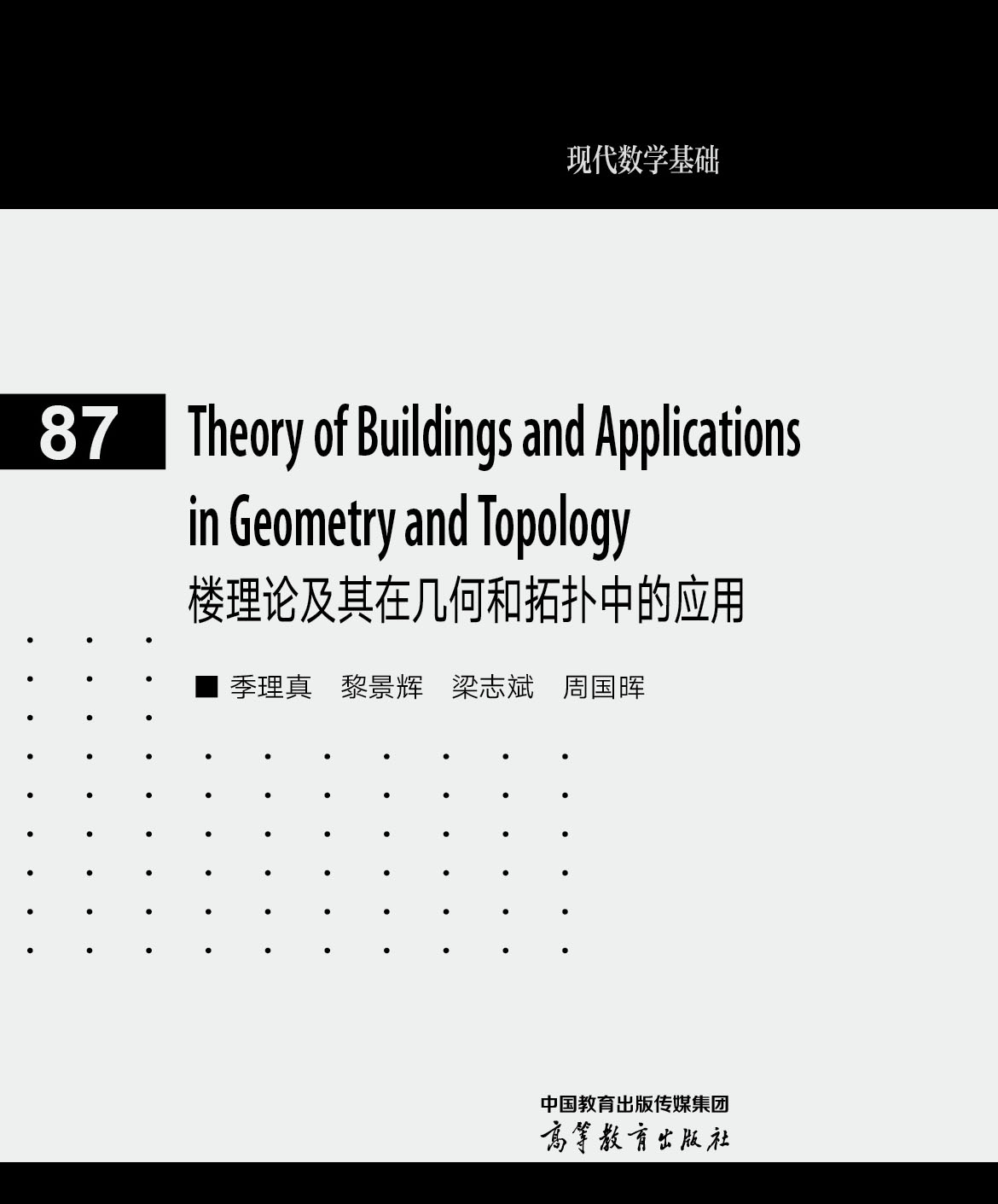







楼理论及其在几何和拓扑中的应用(英文版)
定价:¥99.00
作者: 季理真,黎景辉,梁志斌,周国晖
出版社:高等教育出版社
- 高等教育出版社
- 9787040628746
- 1版
- 47266206-3
- 16开
- 500
- 理学
- 数学类
- 数学类
- 本科 研究生及以上
目录
目录
前辅文
Part 1 Buildings and Groups
1. Combinatorics
1.1 Geometry
1.1.1 Graphs
1.1.2 Trees
1.1.3 Euclidean geometry
1.1.4 Incidence geometry
1.1.5 Projective space
1.2 Coxeter group
1.2.1 Coxeter system
1.2.2 Finite reflection group
1.2.3 Affine reflection group
1.3 Chamber systems
1.3.1 Edge-colored graphs
1.3.2 Buildings
1.4 Chamber complexes
1.4.1 Complexes
1.4.2 Chamber complex
1.4.3 Building
1.5 Conclusion
2. Chevalley Groups
2.1 (B;N) pairs
2.2 Simple Lie algebras
2.2.1 An
2.2.2 Bn
2.2.3 Cn
2.2.4 Dn
2.3 Classical groups
2.3.1 GLn
2.3.2 SLn
2.3.3 Sp2n
2.3.4 SO2n
2.3.5 SO2n+
2.4 Chevalley groups and (B;N) pairs
2.4.1 Chevalley basis
2.4.2 Lie algebra representations
2.4.3 Building of a Chevalley group
2.4.4 SLn
2.5 Chevalley groups over local fields
2.5.1 Affine roots
2.5.2 BN pair
2.6 Examples
2.6.1 Sp
2.6.2 SLn
2.6.3 SL3(Qp)
2.6.4 SL2(Qp)
2.7 Conclusion
3. Reductive Groups over Local Fields
3.1 Root data
3.2 Reductive group
3.2.1 Roots
3.2.2 Root data
3.2.3 Root group data
3.2.4 Pinning
3.3 Apartments
3.3.1 Affine space
3.3.2 Affine apartment
3.3.3 Affine extension
3.3.4 Affine roots
3.4 Building of a reductive group
3.4.1 Quasi-split groups
3.4.2 Filtration on root groups
3.4.3 Construction of the building
3.5 Compactification of buildings
3.5.1 Compactifying apartments
3.5.2 Metric
3.5.3 X
3.6 Congruence subgroup
3.6.1 Models
3.6.2 Smooth models of root subgroups
3.6.3 Filtrations on tori
3.6.4 Smooth models associated to concave functions
3.7 Bounded subgroups
3.7.1 Maximal bounded subgroups
3.7.2 Parabolics
3.7.3 Decompositions
3.8 Hecke algebra
3.8.1 Hecke algebra as a matrix algebra
3.8.2 Hecke algebra of p-adic groups
3.8.3 Iwahori subgroup and buildings
3.8.4 Iwahori-Hecke algebra
3.8.5 Hecke algebra and Coxeter group
3.9 Sheaves on buildings
3.9.1 Coefficient systems
3.9.2 Sheaves
4. Rigid Analytic Spaces
4.1 Rigid analytic space and formal schemes
4.2 Theorems of Mumford and Drinfeld
4.2.1 Uniformization
4.2.2 Moduli problem
4.3 Geometric invariant theory
4.3.1 Stable points
4.3.2 Toric action
4.4 Mumford prolongation
4.5 Formal schemes from flag varieties
4.6 Analytic generic fiber
Bibliography
Part 2 Buildings and Their Applications in Geometry and Topology
5. Introduction and History of Buildings
5.1 Summary
5.2 History of buildings and outline of this part
5.3 Acknowledgments and dedication
6. Spherical Tits Buildings
6.1 Definition of buildings as chamber complexes and Solomon-Tits theorem
6.2 Semisimple Lie groups and buildings
6.3 BN-pairs or Tits systems, and buildings
6.4 Other definitions of and approaches to buildings
6.5 Rigidity of Tits buildings
7. Geometric Realizations and Applications of Spherical Tits Buildings
7.1 Geodesic compactification of symmetric spaces
7.2 Buildings and compactifications of symmetric spaces
7.3 Topological spherical Tits buildings and Moufang buildings
7.4 Mostow strong rigidity
7.5 Rank rigidity of manifolds of nonpositive curvature
7.6 Rank rigidity for CAT(0)-spaces and CAT(0)-groups
7.7 Classification of isoparametric submanifolds
7.8 Spherical buildings and compactifications of locally symmetric spaces
7.9 Geodesic compactification, Gromov compactification and large scale geometry
7.10 Cohomology of arithmetic groups
7.11 Vanishing of simplicial volume of high rank locally symmetric spaces
7.12 Generalizations of buildings: curve complexes and applications
8. Euclidean Buildings
8.1 Definitions and basic properties
8.2 Semisimple p-adic groups and Euclidean buildings
8.3 Compactification of Euclidean buildings by spherical buildings
8.4 Satake compactifications of Bruhat-Tits buildings
9. Applications of Euclidean Buildings
9.1 p-adic curvature and vanishing of cohomology of lattices
9.2 Super-rigidity and harmonic maps into Euclidean buildings
9.3 Applications to S-arithmetic groups
9.4 Applications to harmonic analysis and representation theories
10. R-trees and R-buildings
10.1 Definition of R-trees and basic properties
10.2 Applications of R-trees in topology
10.3 R-Euclidean buildings
10.4 Quasi-isometry rigidity and tangent cones at infinity of symmetric spaces
11. Twin Buildings and Kac-Moody Groups
11.1 Twin buildings
11.2 Kac-Moody algebras and Kac-Moody groups
11.3 Kac-Moody groups as lattices and groups arising from buildings in geometric group theory
12. Other Applications of Buildings
12.1 Applications in algebraic geometry
12.2 Random walks and the Martin boundary
12.3 Finite groups
12.4 Finite geometry
12.5 Algebraic K-groups
12.6 Algebraic combinatorics
12.7 Expanders and Ramanujan graphs
Bibliography
Index
前辅文
Part 1 Buildings and Groups
1. Combinatorics
1.1 Geometry
1.1.1 Graphs
1.1.2 Trees
1.1.3 Euclidean geometry
1.1.4 Incidence geometry
1.1.5 Projective space
1.2 Coxeter group
1.2.1 Coxeter system
1.2.2 Finite reflection group
1.2.3 Affine reflection group
1.3 Chamber systems
1.3.1 Edge-colored graphs
1.3.2 Buildings
1.4 Chamber complexes
1.4.1 Complexes
1.4.2 Chamber complex
1.4.3 Building
1.5 Conclusion
2. Chevalley Groups
2.1 (B;N) pairs
2.2 Simple Lie algebras
2.2.1 An
2.2.2 Bn
2.2.3 Cn
2.2.4 Dn
2.3 Classical groups
2.3.1 GLn
2.3.2 SLn
2.3.3 Sp2n
2.3.4 SO2n
2.3.5 SO2n+
2.4 Chevalley groups and (B;N) pairs
2.4.1 Chevalley basis
2.4.2 Lie algebra representations
2.4.3 Building of a Chevalley group
2.4.4 SLn
2.5 Chevalley groups over local fields
2.5.1 Affine roots
2.5.2 BN pair
2.6 Examples
2.6.1 Sp
2.6.2 SLn
2.6.3 SL3(Qp)
2.6.4 SL2(Qp)
2.7 Conclusion
3. Reductive Groups over Local Fields
3.1 Root data
3.2 Reductive group
3.2.1 Roots
3.2.2 Root data
3.2.3 Root group data
3.2.4 Pinning
3.3 Apartments
3.3.1 Affine space
3.3.2 Affine apartment
3.3.3 Affine extension
3.3.4 Affine roots
3.4 Building of a reductive group
3.4.1 Quasi-split groups
3.4.2 Filtration on root groups
3.4.3 Construction of the building
3.5 Compactification of buildings
3.5.1 Compactifying apartments
3.5.2 Metric
3.5.3 X
3.6 Congruence subgroup
3.6.1 Models
3.6.2 Smooth models of root subgroups
3.6.3 Filtrations on tori
3.6.4 Smooth models associated to concave functions
3.7 Bounded subgroups
3.7.1 Maximal bounded subgroups
3.7.2 Parabolics
3.7.3 Decompositions
3.8 Hecke algebra
3.8.1 Hecke algebra as a matrix algebra
3.8.2 Hecke algebra of p-adic groups
3.8.3 Iwahori subgroup and buildings
3.8.4 Iwahori-Hecke algebra
3.8.5 Hecke algebra and Coxeter group
3.9 Sheaves on buildings
3.9.1 Coefficient systems
3.9.2 Sheaves
4. Rigid Analytic Spaces
4.1 Rigid analytic space and formal schemes
4.2 Theorems of Mumford and Drinfeld
4.2.1 Uniformization
4.2.2 Moduli problem
4.3 Geometric invariant theory
4.3.1 Stable points
4.3.2 Toric action
4.4 Mumford prolongation
4.5 Formal schemes from flag varieties
4.6 Analytic generic fiber
Bibliography
Part 2 Buildings and Their Applications in Geometry and Topology
5. Introduction and History of Buildings
5.1 Summary
5.2 History of buildings and outline of this part
5.3 Acknowledgments and dedication
6. Spherical Tits Buildings
6.1 Definition of buildings as chamber complexes and Solomon-Tits theorem
6.2 Semisimple Lie groups and buildings
6.3 BN-pairs or Tits systems, and buildings
6.4 Other definitions of and approaches to buildings
6.5 Rigidity of Tits buildings
7. Geometric Realizations and Applications of Spherical Tits Buildings
7.1 Geodesic compactification of symmetric spaces
7.2 Buildings and compactifications of symmetric spaces
7.3 Topological spherical Tits buildings and Moufang buildings
7.4 Mostow strong rigidity
7.5 Rank rigidity of manifolds of nonpositive curvature
7.6 Rank rigidity for CAT(0)-spaces and CAT(0)-groups
7.7 Classification of isoparametric submanifolds
7.8 Spherical buildings and compactifications of locally symmetric spaces
7.9 Geodesic compactification, Gromov compactification and large scale geometry
7.10 Cohomology of arithmetic groups
7.11 Vanishing of simplicial volume of high rank locally symmetric spaces
7.12 Generalizations of buildings: curve complexes and applications
8. Euclidean Buildings
8.1 Definitions and basic properties
8.2 Semisimple p-adic groups and Euclidean buildings
8.3 Compactification of Euclidean buildings by spherical buildings
8.4 Satake compactifications of Bruhat-Tits buildings
9. Applications of Euclidean Buildings
9.1 p-adic curvature and vanishing of cohomology of lattices
9.2 Super-rigidity and harmonic maps into Euclidean buildings
9.3 Applications to S-arithmetic groups
9.4 Applications to harmonic analysis and representation theories
10. R-trees and R-buildings
10.1 Definition of R-trees and basic properties
10.2 Applications of R-trees in topology
10.3 R-Euclidean buildings
10.4 Quasi-isometry rigidity and tangent cones at infinity of symmetric spaces
11. Twin Buildings and Kac-Moody Groups
11.1 Twin buildings
11.2 Kac-Moody algebras and Kac-Moody groups
11.3 Kac-Moody groups as lattices and groups arising from buildings in geometric group theory
12. Other Applications of Buildings
12.1 Applications in algebraic geometry
12.2 Random walks and the Martin boundary
12.3 Finite groups
12.4 Finite geometry
12.5 Algebraic K-groups
12.6 Algebraic combinatorics
12.7 Expanders and Ramanujan graphs
Bibliography
Index
前辅文
Part 1 Buildings and Groups
1. Combinatorics
1.1 Geometry
1.1.1 Graphs
1.1.2 Trees
1.1.3 Euclidean geometry
1.1.4 Incidence geometry
1.1.5 Projective space
1.2 Coxeter group
1.2.1 Coxeter system
1.2.2 Finite reflection group
1.2.3 Affine reflection group
1.3 Chamber systems
1.3.1 Edge-colored graphs
1.3.2 Buildings
1.4 Chamber complexes
1.4.1 Complexes
1.4.2 Chamber complex
1.4.3 Building
1.5 Conclusion
2. Chevalley Groups
2.1 (B;N) pairs
2.2 Simple Lie algebras
2.2.1 An
2.2.2 Bn
2.2.3 Cn
2.2.4 Dn
2.3 Classical groups
2.3.1 GLn
2.3.2 SLn
2.3.3 Sp2n
2.3.4 SO2n
2.3.5 SO2n+
2.4 Chevalley groups and (B;N) pairs
2.4.1 Chevalley basis
2.4.2 Lie algebra representations
2.4.3 Building of a Chevalley group
2.4.4 SLn
2.5 Chevalley groups over local fields
2.5.1 Affine roots
2.5.2 BN pair
2.6 Examples
2.6.1 Sp
2.6.2 SLn
2.6.3 SL3(Qp)
2.6.4 SL2(Qp)
2.7 Conclusion
3. Reductive Groups over Local Fields
3.1 Root data
3.2 Reductive group
3.2.1 Roots
3.2.2 Root data
3.2.3 Root group data
3.2.4 Pinning
3.3 Apartments
3.3.1 Affine space
3.3.2 Affine apartment
3.3.3 Affine extension
3.3.4 Affine roots
3.4 Building of a reductive group
3.4.1 Quasi-split groups
3.4.2 Filtration on root groups
3.4.3 Construction of the building
3.5 Compactification of buildings
3.5.1 Compactifying apartments
3.5.2 Metric
3.5.3 X
3.6 Congruence subgroup
3.6.1 Models
3.6.2 Smooth models of root subgroups
3.6.3 Filtrations on tori
3.6.4 Smooth models associated to concave functions
3.7 Bounded subgroups
3.7.1 Maximal bounded subgroups
3.7.2 Parabolics
3.7.3 Decompositions
3.8 Hecke algebra
3.8.1 Hecke algebra as a matrix algebra
3.8.2 Hecke algebra of p-adic groups
3.8.3 Iwahori subgroup and buildings
3.8.4 Iwahori-Hecke algebra
3.8.5 Hecke algebra and Coxeter group
3.9 Sheaves on buildings
3.9.1 Coefficient systems
3.9.2 Sheaves
4. Rigid Analytic Spaces
4.1 Rigid analytic space and formal schemes
4.2 Theorems of Mumford and Drinfeld
4.2.1 Uniformization
4.2.2 Moduli problem
4.3 Geometric invariant theory
4.3.1 Stable points
4.3.2 Toric action
4.4 Mumford prolongation
4.5 Formal schemes from flag varieties
4.6 Analytic generic fiber
Bibliography
Part 2 Buildings and Their Applications in Geometry and Topology
5. Introduction and History of Buildings
5.1 Summary
5.2 History of buildings and outline of this part
5.3 Acknowledgments and dedication
6. Spherical Tits Buildings
6.1 Definition of buildings as chamber complexes and Solomon-Tits theorem
6.2 Semisimple Lie groups and buildings
6.3 BN-pairs or Tits systems, and buildings
6.4 Other definitions of and approaches to buildings
6.5 Rigidity of Tits buildings
7. Geometric Realizations and Applications of Spherical Tits Buildings
7.1 Geodesic compactification of symmetric spaces
7.2 Buildings and compactifications of symmetric spaces
7.3 Topological spherical Tits buildings and Moufang buildings
7.4 Mostow strong rigidity
7.5 Rank rigidity of manifolds of nonpositive curvature
7.6 Rank rigidity for CAT(0)-spaces and CAT(0)-groups
7.7 Classification of isoparametric submanifolds
7.8 Spherical buildings and compactifications of locally symmetric spaces
7.9 Geodesic compactification, Gromov compactification and large scale geometry
7.10 Cohomology of arithmetic groups
7.11 Vanishing of simplicial volume of high rank locally symmetric spaces
7.12 Generalizations of buildings: curve complexes and applications
8. Euclidean Buildings
8.1 Definitions and basic properties
8.2 Semisimple p-adic groups and Euclidean buildings
8.3 Compactification of Euclidean buildings by spherical buildings
8.4 Satake compactifications of Bruhat-Tits buildings
9. Applications of Euclidean Buildings
9.1 p-adic curvature and vanishing of cohomology of lattices
9.2 Super-rigidity and harmonic maps into Euclidean buildings
9.3 Applications to S-arithmetic groups
9.4 Applications to harmonic analysis and representation theories
10. R-trees and R-buildings
10.1 Definition of R-trees and basic properties
10.2 Applications of R-trees in topology
10.3 R-Euclidean buildings
10.4 Quasi-isometry rigidity and tangent cones at infinity of symmetric spaces
11. Twin Buildings and Kac-Moody Groups
11.1 Twin buildings
11.2 Kac-Moody algebras and Kac-Moody groups
11.3 Kac-Moody groups as lattices and groups arising from buildings in geometric group theory
12. Other Applications of Buildings
12.1 Applications in algebraic geometry
12.2 Random walks and the Martin boundary
12.3 Finite groups
12.4 Finite geometry
12.5 Algebraic K-groups
12.6 Algebraic combinatorics
12.7 Expanders and Ramanujan graphs
Bibliography
Index
前辅文
Part 1 Buildings and Groups
1. Combinatorics
1.1 Geometry
1.1.1 Graphs
1.1.2 Trees
1.1.3 Euclidean geometry
1.1.4 Incidence geometry
1.1.5 Projective space
1.2 Coxeter group
1.2.1 Coxeter system
1.2.2 Finite reflection group
1.2.3 Affine reflection group
1.3 Chamber systems
1.3.1 Edge-colored graphs
1.3.2 Buildings
1.4 Chamber complexes
1.4.1 Complexes
1.4.2 Chamber complex
1.4.3 Building
1.5 Conclusion
2. Chevalley Groups
2.1 (B;N) pairs
2.2 Simple Lie algebras
2.2.1 An
2.2.2 Bn
2.2.3 Cn
2.2.4 Dn
2.3 Classical groups
2.3.1 GLn
2.3.2 SLn
2.3.3 Sp2n
2.3.4 SO2n
2.3.5 SO2n+
2.4 Chevalley groups and (B;N) pairs
2.4.1 Chevalley basis
2.4.2 Lie algebra representations
2.4.3 Building of a Chevalley group
2.4.4 SLn
2.5 Chevalley groups over local fields
2.5.1 Affine roots
2.5.2 BN pair
2.6 Examples
2.6.1 Sp
2.6.2 SLn
2.6.3 SL3(Qp)
2.6.4 SL2(Qp)
2.7 Conclusion
3. Reductive Groups over Local Fields
3.1 Root data
3.2 Reductive group
3.2.1 Roots
3.2.2 Root data
3.2.3 Root group data
3.2.4 Pinning
3.3 Apartments
3.3.1 Affine space
3.3.2 Affine apartment
3.3.3 Affine extension
3.3.4 Affine roots
3.4 Building of a reductive group
3.4.1 Quasi-split groups
3.4.2 Filtration on root groups
3.4.3 Construction of the building
3.5 Compactification of buildings
3.5.1 Compactifying apartments
3.5.2 Metric
3.5.3 X
3.6 Congruence subgroup
3.6.1 Models
3.6.2 Smooth models of root subgroups
3.6.3 Filtrations on tori
3.6.4 Smooth models associated to concave functions
3.7 Bounded subgroups
3.7.1 Maximal bounded subgroups
3.7.2 Parabolics
3.7.3 Decompositions
3.8 Hecke algebra
3.8.1 Hecke algebra as a matrix algebra
3.8.2 Hecke algebra of p-adic groups
3.8.3 Iwahori subgroup and buildings
3.8.4 Iwahori-Hecke algebra
3.8.5 Hecke algebra and Coxeter group
3.9 Sheaves on buildings
3.9.1 Coefficient systems
3.9.2 Sheaves
4. Rigid Analytic Spaces
4.1 Rigid analytic space and formal schemes
4.2 Theorems of Mumford and Drinfeld
4.2.1 Uniformization
4.2.2 Moduli problem
4.3 Geometric invariant theory
4.3.1 Stable points
4.3.2 Toric action
4.4 Mumford prolongation
4.5 Formal schemes from flag varieties
4.6 Analytic generic fiber
Bibliography
Part 2 Buildings and Their Applications in Geometry and Topology
5. Introduction and History of Buildings
5.1 Summary
5.2 History of buildings and outline of this part
5.3 Acknowledgments and dedication
6. Spherical Tits Buildings
6.1 Definition of buildings as chamber complexes and Solomon-Tits theorem
6.2 Semisimple Lie groups and buildings
6.3 BN-pairs or Tits systems, and buildings
6.4 Other definitions of and approaches to buildings
6.5 Rigidity of Tits buildings
7. Geometric Realizations and Applications of Spherical Tits Buildings
7.1 Geodesic compactification of symmetric spaces
7.2 Buildings and compactifications of symmetric spaces
7.3 Topological spherical Tits buildings and Moufang buildings
7.4 Mostow strong rigidity
7.5 Rank rigidity of manifolds of nonpositive curvature
7.6 Rank rigidity for CAT(0)-spaces and CAT(0)-groups
7.7 Classification of isoparametric submanifolds
7.8 Spherical buildings and compactifications of locally symmetric spaces
7.9 Geodesic compactification, Gromov compactification and large scale geometry
7.10 Cohomology of arithmetic groups
7.11 Vanishing of simplicial volume of high rank locally symmetric spaces
7.12 Generalizations of buildings: curve complexes and applications
8. Euclidean Buildings
8.1 Definitions and basic properties
8.2 Semisimple p-adic groups and Euclidean buildings
8.3 Compactification of Euclidean buildings by spherical buildings
8.4 Satake compactifications of Bruhat-Tits buildings
9. Applications of Euclidean Buildings
9.1 p-adic curvature and vanishing of cohomology of lattices
9.2 Super-rigidity and harmonic maps into Euclidean buildings
9.3 Applications to S-arithmetic groups
9.4 Applications to harmonic analysis and representation theories
10. R-trees and R-buildings
10.1 Definition of R-trees and basic properties
10.2 Applications of R-trees in topology
10.3 R-Euclidean buildings
10.4 Quasi-isometry rigidity and tangent cones at infinity of symmetric spaces
11. Twin Buildings and Kac-Moody Groups
11.1 Twin buildings
11.2 Kac-Moody algebras and Kac-Moody groups
11.3 Kac-Moody groups as lattices and groups arising from buildings in geometric group theory
12. Other Applications of Buildings
12.1 Applications in algebraic geometry
12.2 Random walks and the Martin boundary
12.3 Finite groups
12.4 Finite geometry
12.5 Algebraic K-groups
12.6 Algebraic combinatorics
12.7 Expanders and Ramanujan graphs
Bibliography
Index
